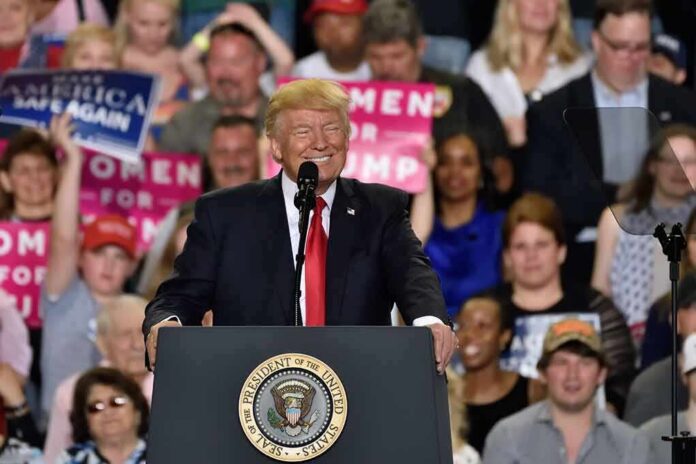
When a presidentially aligned super PAC drops eight figures into a single race, it is less a media buy than an organizing signal: a directive to donors, allied groups, and activists about where power intends to hold the line.
At a Glance
- MAGA Inc., the super PAC aligned with President Trump, disclosed $10 million to boost Ken Paxton in Texas’ Senate race, focused on TV and digital ads.
- The spending was reported via a formal FEC filing, not anonymous chatter, marking MAGA Inc.’s first major outlay inside 60 days of the midterms.
- Trump endorsed Paxton months earlier, and Paxton publicly embraced the backing, cementing the alliance before the cash arrived.
- The Texas contest, once reliably red, has tightened; both parties are treating it as a top-tier fight where outside money can shape the narrative.
What happened: a documented $10 million intervention
MAGA Inc. reported $10 million in independent expenditures to support Republican Ken Paxton in the Texas Senate race, with the filing specifying television and digital advertising. This is not rumor; news organizations reviewed the Saturday Federal Election Commission disclosure and reported the amount, the medium, and the timing as inside the final 60-day window before November. The scale matters: in modern Senate contests, eight-figure late-stage buys do more than fill airtime. They unlock coordination among like-minded committees, reassure nervous donors that a race remains a priority, and telegraph to campaigns down the ballot that turnout operations will be resourced.
The disclosure also resolves an earlier, salient question in Republican circles: whether and when Trump-aligned entities would put real money behind Paxton after the primary season. Prior reporting had framed Texas as simultaneously expensive and, unusually, competitive; party actors were watching to see if the national MAGA apparatus would enter decisively. The FEC filing answers that in the affirmative.
How we got here: endorsement first, then cash
Trump’s role in the race predates the checkbook. He endorsed Paxton on May 19, describing him as a “true MAGA Warrior” and urging Republicans to rally behind him in the Senate fight. Paxton reciprocated immediately and emphatically, trumpeting Trump’s “complete and total” support as a defining credential heading into the general election. The endorsement clarified factional lines within Texas Republican politics after a bruising primary season and set an expectation that national MAGA infrastructure would eventually provide muscle.
In the intervening months, the race itself hardened into the kind of contest that attracts super PAC dollars. Public analyses and coverage described Texas as far tighter than the recent past, with Democrats treating Paxton as beatable and Republicans publicly acknowledging a real fight against Democrat James Talarico. In that environment, outside money does two jobs at once: persuasion and posture. It buys reach, but it also signals to every allied spender that the “permission structure” to join the fray is in place.
Mechanics of an eight-figure super PAC buy
Independent expenditures are, by design, outside the candidate’s control: super PACs can spend unlimited sums advocating for or against candidates, so long as they do not coordinate strategy with campaigns. The FEC requires these groups to file itemized reports that include vendors, dates, and a purpose description—here, television and digital advertising. While journalists summarized the filing’s bottom line, the salient fact for practitioners is the time horizon and medium mix. Television saturates broad audiences statewide; digital can precision-target persuadables and mobilize base voters where turnout will decide close margins.
Scale changes sequencing. A $10 million burst places the buyer at or near the top of the state’s paid-media stack, forcing rivals to decide whether to match on air or pivot to ground and earned-media strategies. It also stabilizes price and inventory negotiations across Texas’ costly media markets; stations and platforms, once assured of large upfront commitments, lock in flight schedules and placement. That predictability benefits allied groups looking to layer messages without cannibalizing reach.
Why Texas, why now: the strategic logic
Texas is not the cheapest place to test messages, but it is among the most consequential if the map is wobbling. A visible MAGA Inc. intervention shores up a traditionally red pillar and deters a resource cascade from Democrats who need multiple pickups to flip the Senate. Politically, it also resolves donor anxiety after months of questions about when national money would arrive—and from whom. Earlier reporting chronicled pressure on Trump-world to fund Paxton meaningfully; this filing meets that expectation and sets a ceiling other Republican committees can cite to their contributors.
The sequence—endorsement, then a well-timed late-media push—is consistent with how modern campaigns translate presidential brand equity into tangible help. The endorsement anchored Paxton inside the Trump coalition; the super PAC spend operationalizes that bond in the only currency that matters in September and October: high-frequency communication and turnout insurance.
The competitive landscape and what money can and cannot do
Texas’ drift from “safe” to “contested” status is the essential backdrop. Public polling snapshots and nonpartisan ratings have moved the race into competitive territory, and both campaigns have behaved accordingly. Analysts and outlets described Paxton’s vulnerabilities and Talarico’s opportunity set, cues that outside groups on both sides read as an invitation to spend. In that environment, independent expenditures tend to bunch up—first movers buy reach at lower cost; late entries pay a premium or target niches that move narrower slices of voters.
There are limits. An ad blitz cannot rewire fundamentals like incumbency, macroeconomics, or candidate quality; it can, however, concentrate attention on contrasts that benefit your side and suppress drift among low-information partisans. In a high-salience race, the marginal effect of late television is often smaller than the same dollars spent earlier; digital and direct-contact overlays, when synchronized with absentee and early-vote windows, can still yield measurable lift. That is the bet MAGA Inc. appears to be placing.
🇺🇸 Trump’s MAGA Inc super PAC is putting $10 million into the Texas Senate race for Ken Paxton, according to a Saturday FEC filing.
Half will fund ads boosting the attorney general, the other half will hit Democrat James Talarico.
It is the group’s first major general election… pic.twitter.com/dm0CuxYgOB
— Mario Nawfal (@MarioNawfal) September 6, 2026
Implications beyond Election Day
Super PACs do not just win or lose races; they shape intra-party hierarchies. A $10 million show of force in Texas affiliates Paxton’s fortunes even more tightly with Trump’s coalition and resets the expectation that MAGA Inc. will function as the party’s kinetic arm in late-cycle fights. It also pressures other Republican-aligned spenders—issue groups, leadership PACs, and donor consortia—to decide whether to reinforce Texas or redeploy to cheaper states with similar margins.
How to read the next signals
Three tells will matter from here. First, copycat money: if other GOP outside groups scale up in Texas within days, the MAGA Inc. filing worked as a coordinating signal. Second, Democratic response: if allied Democratic PACs extend or front-load their Texas buys, they are calling the bluff and betting the market remains efficient for persuasion. Third, message mix: whether the MAGA Inc. creative focuses on Paxton’s positives, Talarico contrasts, or national themes tied to Trump’s record will signal whether this is primarily a mobilization play or a persuasion push. The filing confirms the magnitude; the ads themselves will tell us the aim.
Sources:
notus.org, nhregister.com, texasattorneygeneral.gov, texastribune.org, bbc.com
© featurednews.com 2026. All rights reserved.