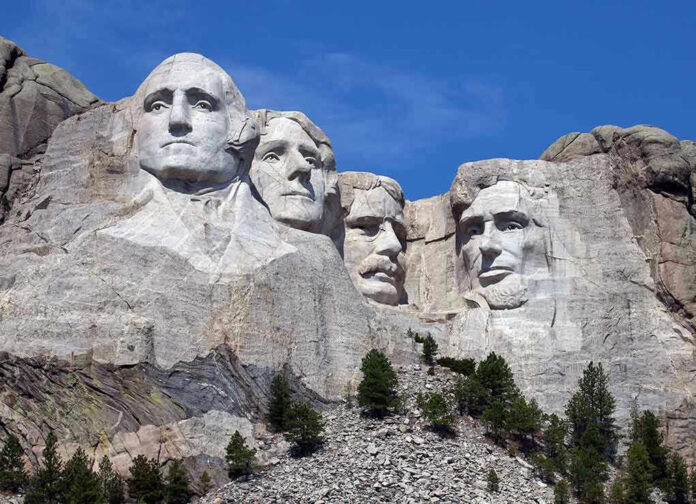
Only in America could Congress be debating whether to carve the face of Donald J. Trump into Mount Rushmore, giving the Founders a new neighbor and the left a fresh reason to lose their minds.
At a Glance
- House Republicans have introduced legislation to add Trump’s likeness to Mount Rushmore.
- The proposal has reignited national debate over who deserves commemoration on U.S. monuments.
- Historians and preservationists argue that Mount Rushmore should remain unchanged due to historical precedent.
- The bill has stalled in committee, with no signs of immediate action from federal agencies or the National Park Service.
Republican Lawmakers Push to Honor Trump on Mount Rushmore
In a move guaranteed to trigger every woke activist and armchair historian from coast to coast, House Republicans are officially pushing to add Donald Trump’s face to Mount Rushmore. Tennessee Rep. Andy Ogles and Florida Rep. Anna Paulina Luna are leading the charge, arguing that Trump’s policies and political legacy have earned him a spot among the giants of American history. Luna has introduced H.R. 792, which directs the Department of the Interior to carve Trump’s likeness alongside Washington, Jefferson, Roosevelt, and Lincoln. The bill’s supporters say it’s time to recognize a president who, in their view, “put America first” and reshaped the nation’s direction in the face of relentless opposition.
But let’s be honest: the odds are long and the resistance is fierce. The National Park Service oversees Mount Rushmore and, along with historians, preservationists, and the usual chorus of leftist critics, is not exactly rolling out the red carpet for a fifth face. The last time Congress seriously entertained the idea of adding someone—Susan B. Anthony, back in 1937—it passed a bill requiring only the completion of the existing monument. Still, Ogles and Luna are undeterred. Ogles has even sent a letter to Secretary of the Interior Doug Burgum, pressing the case and declaring Trump’s presidency a “transformative chapter” in American life. Whether you see this as overdue recognition or political theater, it’s a front-row seat to the culture war playing out in real time.
Historical Precedent and Fierce Debate
Mount Rushmore isn’t just a tourist trap; it’s a symbol of American leadership, chosen to represent the Founding (Washington), Expansion (Jefferson), Preservation (Lincoln), and Development (Roosevelt) of the nation. The monument’s creators, and generations of lawmakers since, have clung to this vision as a way to maintain the site’s historical integrity. Every few years, someone floats the idea of adding another face, and every time, the answer from Congress and preservationists is a resounding “no.” The rationale? Once you start chiseling modern politicians into the granite, where does it stop? The original four were selected for their unifying contributions and their place in the American psyche. Even proposals as significant as honoring Susan B. Anthony, a genuine trailblazer, were shot down to preserve the monument’s intent. Yet here we are, watching as the political pendulum swings and the debate fires up once again, this time with Trump at the center.
For the left, the idea is unthinkable—another assault on sacred norms, another reason to drop everything and protest. For Trump’s base, it’s about time a president who delivered on border security, economic growth, and a return to constitutional values got the recognition he deserves. At the end of the day, the monument’s legacy is itself becoming a battlefield in the broader war over America’s past, present, and future.
Symbolism and Stalling in Congress
The bill to add Trump to Mount Rushmore is, at present, little more than a symbolic gesture. H.R. 792 sits in committee, unlikely to move forward as long as Congress remains sharply divided and bureaucrats at the Department of the Interior remain allergic to controversy. No action has been taken by the National Park Service, and historians continue to warn that tampering with the monument could undermine its structural integrity, not to mention its intended message. Even if lawmakers could muster the votes, the logistics of actually carving Trump’s face into granite would be a nightmare—costly, controversial, and guaranteed to fuel further outrage from activist groups and those who claim the monument itself is illegitimate due to its location on land sacred to the Lakota Sioux.
Supporters argue that adding Trump would boost tourism and cement his legacy as a “transformative” leader. Opponents warn that opening the door to modern political figures risks turning Mount Rushmore into a never-ending parade of presidential vanity projects. The real story here isn’t whether Trump’s face will be carved into stone (don’t hold your breath)—it’s how even the idea exposes the deep divisions and ironies of American politics in 2025. When Congress spends time debating monuments while the border is in crisis and inflation eats away at family budgets, one can only marvel at the priorities of our ruling class.
Sources:
Trump’s 2025 Executive Orders: Reshaping Security on the Southern Border
CBP’s Primary Mission Areas in 2025
What’s in the 2025 Reconciliation Bill So Far?