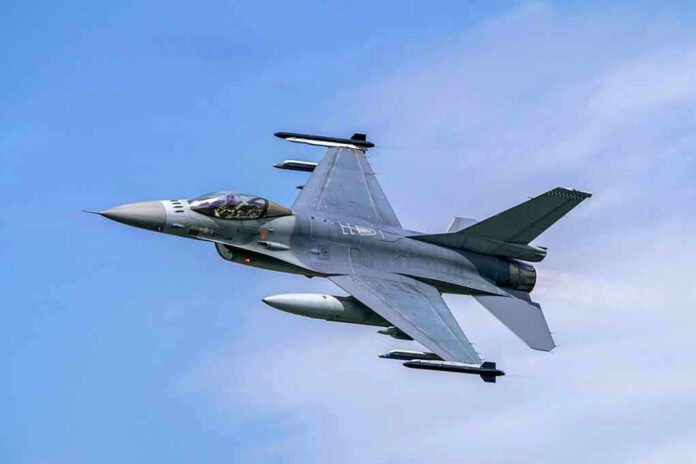
One European “no” forced American bombers to burn time, fuel, and goodwill—then France changed its mind.
Story Snapshot
- France initially restricted U.S. strategic bomber transit during Iran strike operations, complicating routes across Europe.
- Paris tried to split the difference: refueling support yes, combat-linked transit no—at least at first.
- Macron publicly criticized the U.S.-Israel campaign as outside international law, even as French bases and partners faced blowback.
- Flight-routing and NOTAM realities turned “neutral” talk into hard operational math for both militaries and airlines.
France’s Airspace “No” Was a Real Weapon, Not a Symbol
France’s initial refusal to let U.S. strategic bombers cross its airspace during strikes on Iran read like a diplomatic headline, but it functioned like a wrench thrown into a machine. When a B-1B can’t take the direct line home, the detour isn’t just inconvenience. It adds tanker demand, compresses maintenance windows, and tightens risk margins. Airspace permission becomes leverage, and allies learn fast who will help quietly and who will hesitate loudly.
That leverage matters because European geography still shapes Middle East operations. A bomber launching from or recovering toward the west needs predictable corridors, deconfliction, and refueling plans that assume cooperation. Remove one major transit country and planners must route around friendly territory, not enemy territory. That kind of reroute broadcasts friction inside NATO without a single press conference, and it tempts adversaries to test the seams with drones, missiles, and information warfare.
Macron’s Two-Track Message: “Outside International Law,” Yet Still NATO Routine
President Emmanuel Macron publicly described the U.S.-Israel operations in Iran as outside international law, signaling a posture that plays well with European instincts for diplomatic restraint. Days later, France still allowed U.S. support aircraft to use Istres for refueling, cast as routine procedure under NATO. Defense Minister Catherine Vautrin’s “service station” framing tried to draw a bright line: fuel and logistics are not combat. Voters hear restraint; planners hear permission.
That line works on paper, not in practice. Fueling enables combat the way ammunition enables marksmanship. American operational reality treats tankers, bases, and corridors as one integrated kill chain, even if some links never fire a weapon. France’s attempt to separate “defensive” support from offensive effect looked like legal hygiene. Common sense—especially to American readers who expect allies to act like allies—says enabling a mission while condemning it is a political compromise, not moral clarity.
Why Paris Shifted: French Bases Got Hit and Regional Commitments Got Real
France’s Middle East posture isn’t theoretical. It holds defense agreements with Gulf partners and maintains strong commitments with states such as Jordan and Iraq. When Iran retaliated across the region, French installations in the Emirates were reportedly attacked during the escalation. Paris also surged forces in a “strictly defensive” posture, including the Charles de Gaulle carrier to the Mediterranean and Rafale aircraft to the Emirates. That’s the moment diplomacy collides with responsibility: partners expect protection, not speeches.
Those commitments help explain the pivot. Once French forces, bases, and hosted citizens face consequences of a conflict, “neutrality” stops being a safe word and becomes a liability. From a conservative, practical perspective, France’s eventual permission for bomber transit looks less like ideological alignment and more like recognition that deterrence requires capability plus access. You can’t credibly defend regional partners while obstructing the allied logistics that shape the battlespace around them.
March 20: The Quiet Reversal That Said More Than a Summit Communiqué
France ultimately permitted U.S. strategic bombers to cross its airspace, a meaningful reversal from the earlier restrictive posture. Open-source flight tracking reports described bombers departing with visible cruise missiles and then taking routes that indicated new access. The exact internal moment of the policy shift between early March and March 20 remained hard to pin down in public reporting, but the operational outcome mattered more than the timeline. Airspace access shortened routes and reduced tanker strain immediately.
That reversal also exposed a broader European pattern: leaders talk like referees while realities force them to act like players. The United Kingdom took a more explicit supportive stance, including the use of British bases for what it framed as defensive operations. France, by contrast, tried to manage optics first and operations second—until the operational pressure rose. NATO cohesion doesn’t always break in dramatic votes; it frays in routing decisions, basing approvals, and refueling slots.
Commercial Aviation Learned the Same Lesson: NOTAMs Don’t Care About Narratives
The air war’s spillover didn’t stop at military jets. Aviation safety summaries and NOTAM guidance reflected a region where Iranian, Iraqi, and Lebanese airspace faced closures or restrictions, forcing airlines into longer routings with higher costs and more crew-time complexity. Every extra mile burns money; every new corridor concentrates traffic and raises risk. The public tends to treat NOTAMs as bureaucratic noise, but in crises they’re the skeleton key to understanding which conflicts threaten global commerce.
That’s also why Europe’s internal debate matters to Americans. If allies can’t align on basic transit permissions during a fast-moving conflict, the burden shifts to U.S. logistics, U.S. taxpayers, and U.S. readiness. A serious alliance treats access as a shared obligation, not a bargaining chip to be traded for domestic applause. France’s eventual permission was helpful, but the initial restriction offered adversaries a window into how quickly “unity” can wobble.
France Just Closed Its Airspace to U.S. Bombers Attacking Iran — A B-1B Had to Fly Around NATO Allies to Get Home From Its Missionhttps://t.co/wyCJJIBtC6
— 19FortyFive (@19_forty_five) March 23, 2026
The lingering question isn’t whether France can say yes; it’s how often allies will make America earn cooperation in the middle of danger. France tried to preserve independence, legality messaging, and defense commitments at the same time, and the strain showed. The conservative takeaway is straightforward: deterrence thrives on clarity. When allies hedge, enemies probe. When allies coordinate, conflicts end sooner and cost less—especially for the people paying the bills and filling the ranks.
Sources:
France allows US bombers through airspace for Iran strikes
France to let US planes not involved in Iran strikes use air base
NAMPA/AFP report (text/22872487)
US bombers avoid European airspace on Iran bombing runs
Europe defends military bases, struggles to evacuate citizens as it is drawn into Iran war