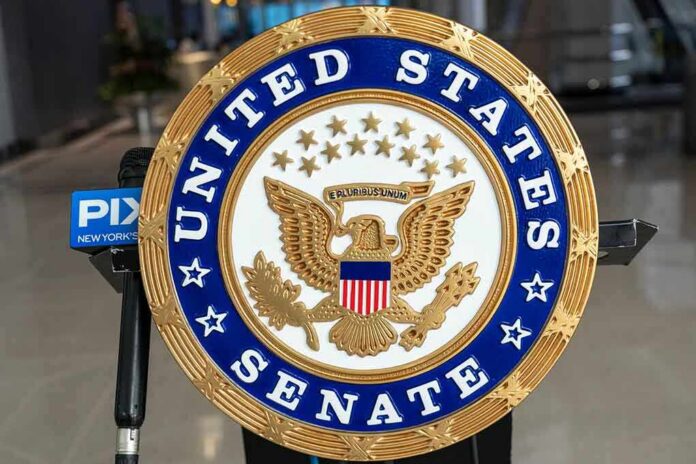
A 54-45 Senate vote just turned a 40-day Homeland Security mess into a high-stakes test of whether Washington can restore order without losing its mind.
Quick Take
- Sen. Markwayne Mullin (R-OK) won confirmation as DHS secretary on March 23, 2026, as the department staggered through a partial shutdown.
- The vote cracked the usual partisan pattern: two Democrats voted yes, while Sen. Rand Paul (R-KY) voted no.
- Mullin inherits operational strain at TSA and political fury over immigration enforcement after deadly Minneapolis shootings.
- His headline promise: more disciplined enforcement, including requiring judicial warrants for certain entries.
A confirmation vote shaped by shutdown pain and public anger
The Senate confirmed Markwayne Mullin as Secretary of the Department of Homeland Security on Monday evening, March 23, 2026, sending him into the job during a partial shutdown nearing 40 days. DHS is not a symbolic cabinet post; it runs airport screening through TSA, immigration enforcement through ICE, and disaster response through FEMA. When funding breaks down, travelers feel it first, and the political class feels it next.
Mullin replaces Kristi Noem after President Trump pushed her out earlier in March, following mounting criticism over DHS management and immigration crackdowns. The shutdown itself grew out of a funding standoff tied to demands for immigration enforcement reforms after deadly shootings by federal agents during operations in Minneapolis. That combination—operational chaos plus a legitimacy crisis—created the rare moment when senators started voting like frightened travelers instead of party mascots.
Why the tally mattered more than the win
The 54-45 result looked mostly party-line, but the exceptions told the real story. Democrats John Fetterman (Pennsylvania) and Martin Heinrich (New Mexico) voted to confirm Mullin, while Republican Rand Paul voted against him. Cross-aisle votes in a climate like this don’t happen by accident; they signal either personal trust, exhaustion, or a bet that the alternative is worse. All three motives probably played a role.
Heinrich and Fetterman framed Mullin as independent enough to manage DHS without acting as a remote-controlled lever for hardline White House figures. That claim will get stress-tested fast, because DHS sits at the intersection of constitutional rights and executive power. Conservatives should insist on both: aggressive, lawful enforcement and a chain of accountability that doesn’t depend on press conferences. When voters see chaos, they demand control; when they see abuse, they demand constraints.
Rand Paul’s “no” vote and what it signals inside the GOP
Paul’s opposition came after a sharp, personal confrontation in Mullin’s confirmation hearing, where Paul challenged Mullin over past comments touching on violence and impulse control. A lone “no” vote can be dismissed as a feud, but it also reflects a deeper Republican tension: the party’s populist appetite for forceful action versus its constitutional reflex to limit state power. DHS makes that tension impossible to hide because it carries badges, guns, and detention authority.
From a common-sense, conservative lens, Paul’s skepticism is not inherently anti-enforcement; it is pro-guardrail. The country needs border control and interior enforcement that works, yet any agency that can detain, deport, and search must operate under rules that stand up in court and under public scrutiny. Mullin’s challenge is to prove he can deliver results without feeding the kind of incidents that trigger backlash, lawsuits, and funding crises.
Mullin’s early message: warrants, discipline, and fewer headline fires
Mullin told senators he wanted to “empower people” inside DHS and emphasized requiring judicial warrants for entries—language aimed at curbing controversy around enforcement actions. He also telegraphed a pragmatic goal that sounds small until you’ve watched DHS over the years: stop being the lead story every day. That is not a vanity metric; it is an operational one. Agencies drowning in scandal spend more time on internal damage control than on mission execution.
Tom Homan, serving as the White House border czar, publicly backed Mullin and described him as the right fit for the moment. That matters because Homan’s enforcement-first posture will shape the field reality, while Mullin’s job is to keep the machinery legal, funded, and sustainable. Conservatives typically reward leaders who can impose order and produce measurable outcomes; the public typically punishes leaders when tactics look reckless or unaccountable.
The shutdown pressure cooker: TSA callouts, airport delays, and forced urgency
The shutdown’s most immediate political weapon was the airport. Reports of record TSA callouts—peaking at 11.76% on March 22—turned policy arguments into missed flights and visible disorder. The administration moved to deploy ICE personnel to assist at airports starting March 24, a short-term patch that also reveals a deeper problem: when you rob one mission to feed another, you admit the system has lost slack and resilience.
For readers who’ve lived through enough Washington standoffs to know the ending, this one still has a twist: the shutdown wasn’t just about spending levels; it was about rules of engagement for immigration enforcement after the Minneapolis shootings. Democrats pushed for restrictions; Republicans resisted constraints that could kneecap enforcement. Mullin walks into that argument with a timer running, because every extra day of dysfunction burns public patience and payroll morale.
The Minneapolis shootings and the legitimacy problem DHS must solve
The Minneapolis killings became the moral gravity well pulling everything else inward. Some reports differed on the victims’ names, but the larger fact stayed consistent: federal agents killed residents during immigration operations, sparking outrage that crossed party lines. Noem initially defended the actions and later faced additional scrutiny over spending decisions, including advertising. That mix—dead civilians plus perceived mismanagement—creates the exact environment where Congress reaches for control through funding.
Mullin’s warrant talk functions as a political pressure valve, but it also raises a serious operational question: will DHS implement clearer, more uniform standards that reduce mistakes, or will it layer new paperwork onto agents already working in a charged environment? The right answer is not “more force” or “more process.” The right answer is smarter enforcement: clear thresholds, auditable decisions, and consequences when people cut corners.
What happens next: a deal, a new tone, and an Oklahoma vacancy
Mullin’s confirmation removed leadership uncertainty, but it did not automatically reopen the government or repair public trust. Lawmakers signaled they were nearing a solution to the shutdown standoff, and the travel-season chaos strengthened the incentive to cut a deal. Meanwhile, Oklahoma now faces a Senate vacancy, with Gov. Kevin Stitt expected to appoint a replacement until a special election. That appointment will be its own small drama in a narrowly divided era.
Mullin confirmed as DHS chief as lawmakers near solution on shutdown standoff https://t.co/QSIjeJ5pcG #FoxNews
— Tom (@thmsm74) March 24, 2026
The real cliffhanger sits inside DHS: will Mullin’s tenure look like a recalibration—firm enforcement paired with tighter legal discipline—or will it become another chapter of churn, scandal, and shutdown brinkmanship? Americans over 40 have seen the pattern: when Washington loses competence, it compensates with theater. Mullin’s job is to bring competence back, because theater doesn’t screen airports, secure borders, or keep the country safe.
Sources:
Mullin confirmed as DHS chief as lawmakers near solution on shutdown standoff
Markwayne Mullin confirmed as DHS secretary by Senate
Senate set to vote on confirming Sen. Markwayne Mullin as DHS secretary
Senate advances Mullin’s DHS nomination
Markwayne Mullin confirmed as the next secretary of homeland security