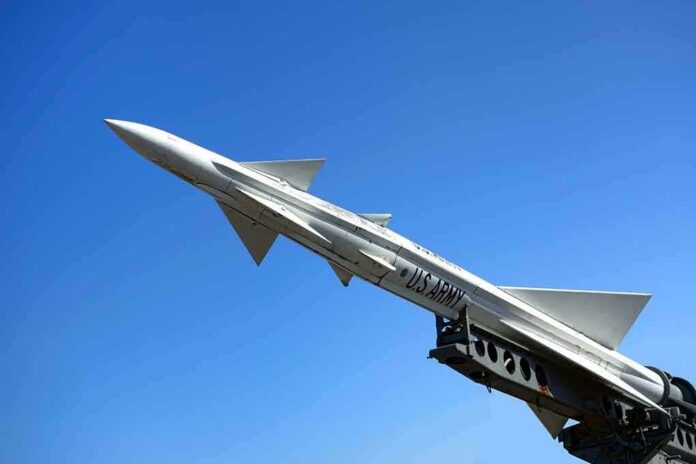
Air Force leaders are now asking for a missile that can reach targets 1,000 nautical miles away, and that kind of range changes the entire fight.
Quick Take
- The U.S. Air Force wants a new family of missiles with a minimum range of 1,000 nautical miles.[1]
- The planned weapons are meant to hit air, land, and sea targets in China-focused planning scenarios.[1][2]
- The notice does not say what aircraft will carry the missile or give full technical details.[1][2][3]
- The range goal is far beyond today’s air-to-air missiles and raises real questions about cost and feasibility.[2][3][4]
Air Force Pushes a Far Longer Reach
The Air Force Long Range Weapon program is the clearest sign yet that the service wants much more reach in future air combat. A recent industry notice says both the air-to-air and air-to-surface versions must reach at least 1,000 nautical miles and strike priority air, land, and sea targets “far and fast.” The notice also ties the effort to Pentagon planning scenarios focused on China.[1][2]
That matters because the Air Force is not talking about a small upgrade. The current AIM-120 Advanced Medium Range Air-to-Air Missile family is far shorter in reach, and the new goal would be roughly an order of magnitude beyond that. The notice describes the weapon as a responsive strike system, but it does not say which aircraft will launch it or how the missile will fit inside current fleets.[2][3]
Why the Range Goal Is Drawing Attention
The range figure is getting attention because it points to a new kind of standoff fight. The Air Force wants to be able to hit mobile enemy forces before they can close distance or disappear. That is a big shift from traditional air-to-air combat, where pilots and their weapons work much closer to the target. The service’s public rationale suggests it wants to defeat enemy aircraft, ships, and other high-value targets from deep outside threat range.[1][4]
At the same time, the public record is still thin on the hard engineering questions. The industry notice gives a range threshold, but it leaves out speed, payload, guidance, and launch-platform details. It also does not explain whether the missile is meant for fighters, bombers, or some other aircraft. That gap leaves open the practical questions every taxpayer should ask: what will this cost, what can carry it, and how fast can it really be fielded?[2][3]
The Strategic Case and the Skeptical Case
Supporters will argue the Air Force is preparing for the world it expects, not the world it wishes for. Its own 2024 report to Congress said future enemy anti-air missiles could reach out to 1,000 miles by 2050, which suggests the service sees a long-range threat on the horizon.[4] From that view, a 1,000-nautical-mile American missile is not excess. It is an answer to a future battlefield where distance no longer protects aircraft or tankers.
Skeptics, however, have a fair point on the current evidence. The notice does not prove the concept is practical, affordable, or ready for current fighters. It also does not show the full chain of reasoning behind the range target. Until the Air Force releases more detail, the public is left to judge a major weapons push on a short notice and a handful of reports. That is not enough for a clean debate.[1][2][3]
What to Watch Next
The next big test will be whether the Air Force shares a formal requirement, a budget line, or testimony that explains the missile in plain terms. If it does, readers will finally be able to compare the threat, the cost, and the platform limits in one place. If it does not, then the program will stay in the gray zone between smart deterrence and open-ended defense spending. For now, the only firm fact is that the Air Force wants far more reach than it has today.[1][2][4]
Sources:
[1] Web – Air Force Wants 1,000-Nautical Mile Missile for Air, Sea Targets
[2] Web – LGM-30G Minuteman III > Air Force > Fact Sheet Display
[3] Web – MMI ICBM – Association of Air Force Missileers
[4] Web – [PDF] USAF Ballistic Missile Programs (1964 -1966)
© featurednews.com 2026. All rights reserved.