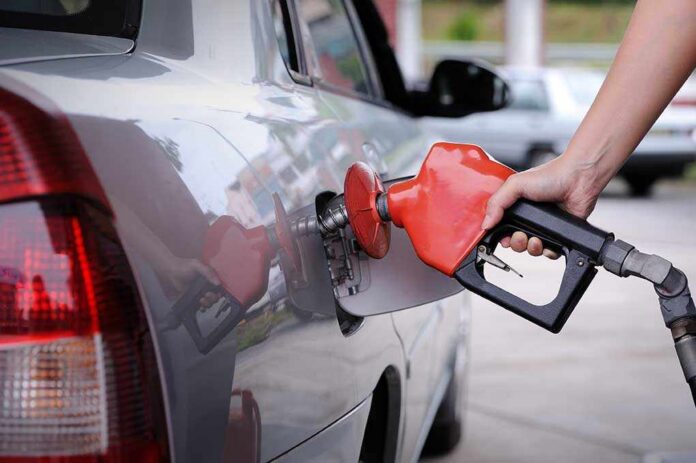
Gasoline prices seldom move in lockstep with crude oil—and decades of investigations suggest that what feels like “gouging” at the pump is more often the arithmetic of supply chains, refinery bottlenecks, and inventory timing than a prosecutable scheme.
The Short Version
- Past federal inquiries repeatedly found that retail gasoline prices largely reflect market forces, not coordinated manipulation or “illegal gouging.”[10][14]
- Crude oil is the biggest driver of pump prices, but pass-through is imperfect and delayed; stations sell through older, higher-cost inventory before prices fall.[10][11][14]
- Real-time data often show prices falling when politicians allege gouging, though declines can be uneven by region and slower than the crude drop.[12]
- Direct presidential pressure on the Justice Department may score political points; it rarely changes the economic mechanics of fuel pricing.[4]
What actually sets the price at the pump
Start with the structure: the retail gallon most of us buy incorporates crude costs, refining, distribution and marketing, and taxes. The Energy Information Administration estimates crude oil is the dominant component of the retail price over time, typically around half, but never the whole story. Refining margins expand and contract with outages and seasonal specification changes; wholesale and retail margins wax and wane with local competition, credit card fees, and the speed at which stations turn over inventory. No single company controls all those levers in every region, and retail stations are often franchisees or independents rather than vertically integrated arms of “Big Oil.” The American Petroleum Institute, summarizing EIA data and historical reviews, puts the point plainly: market conditions—global supply and demand—do most of the work.[10][14]
The mechanism that frustrates drivers is well-documented: asymmetric pass-through. Prices at the pump rise faster when crude jumps and fall more slowly when crude retreats. Economists have measured this lag for years; in short-run windows, adjustments to declines are sticky because retailers must sell higher-cost fuel in their tanks before they can pass through lower replacement costs. A peer-reviewed study of U.S. gasoline markets quantified these regional asymmetries, finding that pass-through dynamics vary across the country but share the basic pattern: the “rockets and feathers” phenomenon.[11]
The claim of “illegal gouging” versus the evidentiary bar
Allegations of gouging tend to spike when crude falls sharply yet local stations are slow to follow. Presidents of both parties have responded with rhetorical heat and investigative gestures; sometimes they ask the Federal Trade Commission to look for collusion, sometimes they urge the Justice Department to probe antitrust or consumer protection theories. Most of those probes, across decades, reached the same conclusion: price changes tracked market fundamentals, not conspiracies. That is not a philosophical defense of oil companies; it is a record of findings. When broader federal reviews have dug in—after hurricanes, wars, or global supply shocks—their bottom line has been consistent: no systemic, illegal manipulation explaining retail price levels nationwide.[10][14]
That history matters for a simple reason. “Gouging” has a precise legal meaning only in certain state statutes and disaster declarations; at the federal level, there isn’t a generalized price-gouging law for fuel. Enforcement typically proceeds under antitrust (collusion, price fixing) or unfair/deceptive practices authorities, each demanding evidence of agreement, deception, or market power abuse—emails, calls, algorithmic coordination, margin spikes disconnected from input costs. A presidential post asserting malfeasance is not evidence; it is a directive to look for it. Without internal communications or margin forensics showing profits abnormally inflated above input costs after controlling for seasonality and regional supply, the bar for “illegal” is not met. That is why prior FTC sweeps matter: they establish the base rate of confirmed misconduct as low.[10][14]
How prices can fall while frustration still feels justified
When analysts examine contemporaneous data, they often find prices declining even amid claims of gouging; the declines can be widespread yet not uniform. GasBuddy’s retail tracking frequently shows week-over-week reductions across most states, sometimes at a pace comparable to or faster than prior down-cycles after major peaks. In one such period, the national average fell roughly two-thirds of a dollar over about five weeks, a descent faster than the post-2022-peak glide. This does not make the corner station’s price feel fair if your town is lagging; it does indicate that, in aggregate, the market was moving down rather than being “stuck” by design.[12]
Lags stem from physical and financial plumbing. Wholesale racks reset daily; retailers buying from racks face spot variability but refill underground tanks episodically. Stations that bought dear must clear that inventory before repricing aggressively down or they lock in a loss; highly competitive intersections will move sooner, low-competition corridors later. Add regional refinery outages, seasonal gasoline blend switches, and localized tax differences, and the timing looks messy. None of this rules out misconduct in every circumstance, but it does explain why a simple chart of Brent or WTI next to last night’s marquee often misleads.
Refining, crude quality, and the bottlenecks that drive margins
Refining capacity is the fulcrum that turns crude into usable gasoline. The United States has not added a large greenfield refinery in decades; utilization swings and unplanned outages matter outsizedly. Seasonal maintenance, regulatory shifts in fuel specifications, and the mismatch between domestic crude quality and legacy refinery configurations further complicate pass-through. Several U.S. refineries were historically configured for heavier, sour crudes, while the shale boom produced copious light, sweet crude. When crude slates and refinery hardware are out of sync, refiners adjust with blending, exports, or differentials; short-term frictions can widen or compress gasoline crack spreads, temporarily overwhelming the direct signal from crude. The Dallas Fed has emphasized that refining bottlenecks and capacity constraints can keep retail prices elevated even when crude softens.[13]
Distribution and marketing add their own inertias. Pipeline tariffs, terminal constraints, and trucking logistics shape delivered cost to the station. In tight labor or equipment markets, those costs don’t ebb just because Brent slipped ten dollars. Credit card fees—often 2% to 3% of the retail transaction—scale with price and weigh on thin station margins. Trade groups like NACS have long cataloged these line items to explain why the “crude share” of the pump price, while dominant, is not dispositive for any given week at a specific ZIP code.[15]
Why presidential pressure almost never remakes fuel economics
Publicly directing the Justice Department to “investigate now” makes headlines; it does not manufacture refining capacity, rewrite pass-through physics, or eliminate the time it takes to sell through high-cost inventory. In Washington, such directives also clash with the norm—never absolute, but cherished—of investigative independence. Politico has repeatedly chronicled how administrations are criticized when they appear to steer federal prosecutors for political effect. The substance still stands or falls on evidence: either a probe uncovers coordinated conduct or algorithms suppressing price declines, or it corroborates what prior reviews have found—prices tracked inputs and frictions rather than intent.[4]
If a future investigation did produce internal communications showing deliberate margin padding untethered to inputs or capacity limits, the case would look very different. But the burden is heavy. The more common result is a technical report attributing regional stickiness to inventory costs, refinery maintenance, and blend changes, with recommendations that veer toward structural reforms rather than indictments: streamline permitting for capacity upgrades, reduce boutique fuel proliferation, and improve transparency in wholesale markets.
How to judge “commensurate” without fooling yourself
“Not commensurate” sounds crisp; analytically, it’s squishy unless specified. The disciplined way to test it is to define the period of crude decline, normalize crude and retail to common baselines, and estimate pass-through with lags that match inventory turnover and rack-to-retail cadence. Then compare observed retail movement to the statistical expectation from prior cycles with similar crude shocks, refining configurations, and seasonal context. Academic work and agency practice usually do it this way; once you run that playbook, much of the perceived anomaly tends to shrink. When outliers remain—say, regions two standard deviations off the expected lag—those become candidates for state-level scrutiny under specific price-gouging statutes triggered during emergencies.[11][14]
For consumers, the practical takeaway is less cerebral. Shop stations with high turnover and dense competition; they usually move down first. If you want policy to matter, focus on the plumbing: incentives for debottlenecking refineries, rationalizing boutique blends, and building redundant capacity where outages routinely pinch supply. Those are the levers that compress the gap between crude and the pole sign more reliably than a podium moment.
Trump ‘orders’ gas stations to lower prices or ‘big problems’.
Even though the price of oil has dropped, but the pump is still lagging. It is not the president’s order that regulates, but the market + DOJ probe gouging. Hopefully gasoline will be cheaper quickly for the people!… https://t.co/nYCrhy7Aap
— Tips Excel (@gudanglifehack) June 30, 2026
Bottom line: anger is understandable; illegality is a much higher bar
It is rational to be angry when crude drops quickly and the price on your block lags. But the recurring record—agency investigations, economic studies, and real-time retail data—supports a sober conclusion: most of the time, what’s happening is the market working through frictions, not a cartel fleecing drivers. If a new federal probe uncovers hard evidence to the contrary, it should be prosecuted. Until then, the most productive path is to fix the constraints we already know about and let the math of supply chains do the rest.[10][11][12][14][15]
Sources:
[4] Web – Trump accuses oil companies of gas price ‘gouging,’ calls for DOJ …
[10] Web – Trump says he ordered DOJ to probe gas price ‘gouging’
[11] Web – How Gasoline Prices Are Determined – American Petroleum Institute
[12] Web – Price pass-through in US gasoline markets – ScienceDirect
[13] Web – Don’t look to oil companies to lower high retail gasoline prices
[14] Web – Gas Prices Explained – US Oil & Gas Association
[15] Web – Factors affecting gasoline prices – U.S. Energy Information … – EIA
© featurednews.com 2026. All rights reserved.