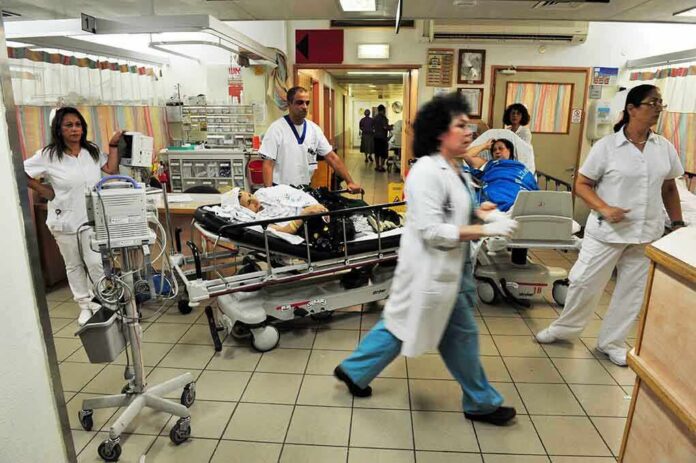
When immigration enforcement collides with a short-staffed hospital floor, the dispute stops being abstract: one detention can ripple into a facility-wide walkout and a community argument over what patient safety really means.
At a Glance
- Unionized nurses at Maine Medical Center rallied and staged a walkout after ICE detained their colleague, registered nurse Debora Kapisha, at Boston Logan Airport.
- The union framed the action as a patient-safety and due-process fight; ICE cited a visa overstay and initiated transfer and removal procedures.
- Public pressure helped block a planned out-of-state transfer; within days, Kapisha was released from ICE custody and returned to Maine.
- The episode fits recurring patterns at the intersection of immigration enforcement authority and health-care labor activism in a persistently understaffed system.
What Happened: A detention that triggered a hospital-side protest
Union nurses at Maine Medical Center (MMC) organized an emergency rally and walkout after Immigration and Customs Enforcement detained their colleague, Debora Kapisha, a registered nurse originally from Zambia, while she was traveling through Boston Logan Airport. The Maine State Nurses Association/National Nurses United publicly connected the action to her detention, identified her as an MMC nurse, and demanded her immediate release. According to the union, hundreds of nurses and supporters participated, including local officials and community allies, and the protest specifically sought to halt her transfer to an out-of-state ICE facility and to secure her return to Maine.
As the protest grew, ICE confirmed the core enforcement rationale: Kapisha entered the United States on a visa and did not depart before it expired, triggering arrest and transfer proceedings under federal immigration law. Maine media simultaneously documented the union’s claim that Kapisha was authorized to work while her asylum case was pending, illustrating a common fact pattern—lawful work authorization can coexist with removal risk if the underlying immigration status remains unresolved. Within days, and after sustained pressure, union leaders announced that a planned transfer to Louisiana had been blocked and that Kapisha would be released; she subsequently returned home to Maine.
How enforcement authority and worker protections collide in health care
Two legal tracks often run in parallel in immigration cases: the civil-removal track (including detention and transfer authority) and the employment authorization track (allowing a person with a pending asylum application to work lawfully while the case proceeds). It is entirely consistent, in other words, for ICE to assert detention and removal powers at the same time a hospital employs a nurse who holds valid work authorization. In public statements, ICE emphasized the expired visa and the agency’s transfer plans, while union leaders stressed Kapisha’s role as an essential caregiver and an asylum applicant whose due process should not be undercut by long-distance transfers that complicate legal access and family support.
Hospitals sit uncomfortably at this intersection. They depend on internationally trained clinicians—especially in regions confronting chronic shortages—yet they have limited leverage over federal immigration timelines. That dependence sharpens the stakes of any sudden detention: a single removed clinician can cascade into unsafe staffing on multiple units, which unions are quick to translate into a patient-safety argument. In Maine, the nurses’ case threaded those needles—tying one colleague’s detention to ward-level safety norms and emphasizing how abrupt removals can destabilize already thin staffing.
Why nurses took to the street: the mechanism of labor action in clinical settings
The mechanics of a nursing walkout are familiar to anyone who has watched the sector over the past decade: a rapid call for collective action, visible pickets at hospital entrances, and a message discipline that links staffing to patient outcomes. In Portland, union messaging hewed to that template—foregrounding the detained nurse’s role at the bedside and the clinical impact if she were transferred away from her support network and permanently removed. The immediate tactical objective was targeted and concrete: stop the transfer; secure release. That objective was met, at least initially. Union leaders credited the turnout and political pressure with blocking the out-of-state transfer, and subsequent reporting documented her release from custody and return to Maine.
For readers accustomed to seeing walkouts anchored in contract talks, it is useful to recognize the continuity. Maine’s hospital labor landscape has featured repeated strike notices, strike authorizations, and pickets over nurse-to-patient ratios, retention, and safety. The Kapisha case did not invent a protest culture; it slotted into a preexisting repertoire that unions deploy when they believe patient care is endangered—whether by hospital policy, legislative proposals, or, here, immigration enforcement that removes an experienced RN from the roster.
The broader pattern: immigration cases as proxy battles over institutional legitimacy
When a frontline clinician is detained, the narrative quickly expands beyond one person. Unions frame the incident as a referendum on due process and human dignity in a hospital context; enforcement agencies emphasize statutory obligations and consistent application of the law. This Maine episode followed that script. ICE supplied the legal predicate—a visa overstay—while nurses and supportive officials amplified the downstream clinical consequences, from worsening staffing ratios to the chilling effect on immigrant clinicians embedded in care teams. The resulting tug-of-war is less about the facts of one file and more about whose institutional priorities should prevail when public goods—rule-of-law enforcement and safe, continuous patient care—appear to be in tension.
That pattern recurs because the incentives are durable. Agencies protect their authority to detain and remove; unions defend their members and maintain leverage to negotiate safer staffing conditions. Both sides speak to the public in the language of responsibility—public safety for ICE, patient safety for nurses. In practice, outcomes often hinge on whether civil society and political figures rally quickly enough to impose a reputational cost on transfers that impede legal counsel and community support. In Kapisha’s case, that pressure materialized quickly and produced a near-term release.
Patient safety, staffing shortages, and the cost of sudden removals
Even absent an immigration flashpoint, Maine’s hospital systems have wrestled with persistent RN vacancies, rising turnover, and reliance on temporary staff—trends that predate this episode and complicate any sudden loss of a full-time nurse. Reported vacancy rates have roughly doubled at some systems over recent years, leaving little slack when a clinician is sidelined by illness, burnout, or, as here, detention. From an operations perspective, a removal is not just a lost shift; it is a lost preceptor, a lost culture carrier, and a forced reshuffle of assignments that pushes ratios upward and increases error risk on already stretched units.
That is why unions emphasize how seemingly “external” policy choices—immigration enforcement cadence, transfer destinations, detention timelines—become internal patient-safety variables the moment they touch a hospital’s staffing grid. It is also why hospitals, even when not organizing protests, often engage elected officials to secure humanitarian parole or rapid status clarification for critical staff, seeking to keep skilled clinicians at the bedside in communities that cannot easily replace them.
Competing claims, weighed on their evidence
On the record, three core claims anchor this case. First, ICE cited a visa overstay and exercised detention and transfer authority; that is a straightforward application of immigration law as the agency interprets it. Second, union leaders asserted that Kapisha is a practicing MMC RN and an asylum seeker with work authorization; their public releases and the on-site rally substantiate that description. Third, the outcome—blocking a transfer and achieving release—occurred after visible, sustained public pressure and political engagement; multiple outlets documented the halted transfer and subsequent release back to Maine. None of these claims are mutually exclusive; together they map the contours of the conflict with unusual clarity.
There is one prudential caveat: an arrest or detention does not prejudge the eventual immigration adjudication, and a release does not dissolve the underlying case. Those determinations proceed on their own timetable. But for the hospital workforce and the patients it serves, the immediate operational stakes—will a nurse report to her unit tomorrow, will continuity of care be preserved—are decided long before a final immigration ruling. That is the window in which labor action and public pressure are most likely to move outcomes.
A Maine Medical Center nurse detained by Immigration and Customs Enforcement while traveling through Boston Logan International Airport has been released and is back in Maine. https://t.co/ahxloF2Bdb
— FOX23 Maine (@FOX23Maine) August 7, 2026
What it means going forward
The Maine episode illustrates a durable lesson: in health care, immigration enforcement is not a side issue—it is a staffing and patient-safety issue the moment it touches a caregiver. Expect unions to keep treating detentions of clinicians as collective-action triggers, especially in understaffed markets where each lost FTE magnifies clinical risk. Expect ICE to continue asserting transfer authority, including to distant facilities that serve agency logistics but complicate legal access; that is the default unless countervailing pressure mounts. And expect hospital leaders to be drawn, willingly or not, into these fights as they balance legal compliance with the imperative to maintain safe, stable care.
Sources:
twitchy.com, nationalnursesunited.org, wgme.com, facebook.com, youtube.com, mainepublic.org
© featurednews.com 2026. All rights reserved.