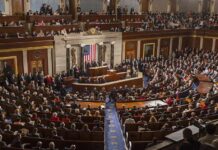
Republicans are padding a critical midterm war chest even as Democrats claim momentum from special-election overperformance.
Quick Take
- Fundraising disclosures through early spring show the NRCC ahead of the DCCC by more than $10 million overall, with a notable early-cycle edge.
- The House majority is razor-thin, making cash-on-hand and ad timing unusually decisive across a small set of swing districts.
- Democrats are arguing that special-election results and grassroots energy can outperform the money gap, at least in the near term.
- Analysts across outlets caution that history still punishes the president’s party in midterms, meaning money is a shield—not a guarantee.
What the early numbers say about 2026’s money fight
Federal Election Commission filings and committee disclosures heading into May 2026 show House Republicans’ main campaign arm holding a clear fundraising advantage over Democrats’ equivalent committee. Research compiled from multiple reporting and tracking sources indicates an early-cycle gap that has crossed $10 million overall, with first-quarter totals showing a sizable spread. In a cycle where a handful of districts can decide control, that early lead matters most for timing.
Rep. Richard Hudson, who chairs the NRCC, has publicly projected confidence while pushing back on Democratic claims that their “target map” is expanding. Democrats, through committee messaging, have countered that special elections and recent contests suggest they can outperform expectations even if they trail in dollars. The basic tension is familiar: Republicans are leaning on fundraising as a firewall, while Democrats are leaning on turnout narratives.
Why a $10M+ edge can matter in a one-seat House
The House sits on a knife edge, and that turns normal campaign mechanics into strategic leverage. Committees use early money to reserve advertising inventory, build field operations, and stabilize vulnerable incumbents before outside groups fully engage. A sustained financial edge can also deter strong challengers from jumping in late. In practical terms, the party that defines a candidate first in expensive media markets often forces the other side into catch-up mode.
That leverage is strongest in districts where a few points decide the outcome and where the presidential margin was narrow. Democratic-aligned groups are openly focusing on close seats and working to expand the battlefield, including districts that Republicans carried by small margins in prior cycles. Republicans, meanwhile, are trying to keep the fight confined to defensible terrain and avoid getting stretched thin. Money does not pick winners by itself, but it can shape which races become truly competitive.
Democrats’ counterargument: specials, state flips, and “momentum” politics
Democrats point to recent special elections and down-ballot results as proof that enthusiasm and organization can close financial gaps. Reporting on state legislative contests has highlighted Democratic flips in multiple seats, feeding a broader storyline that anti-incumbent energy can show up even when national committee fundraising trails. Strategists sympathetic to Democrats argue that candidate quality, localized issues, and volunteer intensity can blunt the impact of an early money deficit.
Republicans respond that special elections are often poor predictors of a general midterm electorate and that national committee cash is designed to endure through the grind of late summer and fall. The conservative case, grounded in basic campaign math, is that dollars raised early can be spent more efficiently: building data, funding field staff, and reserving ads before prices spike. Still, even Republican-friendly analysts acknowledge that a financial edge cannot repeal voter mood if it turns sharply.
The bigger warning sign: distrust in institutions fuels both sides
This fundraising clash is also unfolding against a deeper, bipartisan frustration: many Americans believe Washington’s incentives reward career preservation over solving real problems. Conservatives often tie that frustration to overspending, high energy costs, and border failures; liberals often tie it to inequality and perceived discrimination. Either way, committee fundraising—while legal and routine—reinforces a public suspicion that politics is becoming a permanent money chase rather than a results business.
For voters trying to cut through the noise, the most responsible takeaway is narrow but important: the GOP cash advantage is real, but it is not final, and the most consequential data will come as later filings clarify whether Democrats can surge or whether Republicans can maintain the gap. With control of Congress at stake, both parties will try to convert distrust into turnout—and both will claim a mandate that many voters no longer feel represented by.
REPORT: Six Months From 2026 Midterms, Republicans Have Outraised Democrats by More Than $10 Million https://t.co/iL8bV7DnDz
— ConservativeLibrarian (@ConserLibrarian) May 8, 2026
Sources:
Fiction? House Republican campaign chair dismisses Democrats expanding GOP target map
Dems flip 28 state legislature seats in Trump 2.0