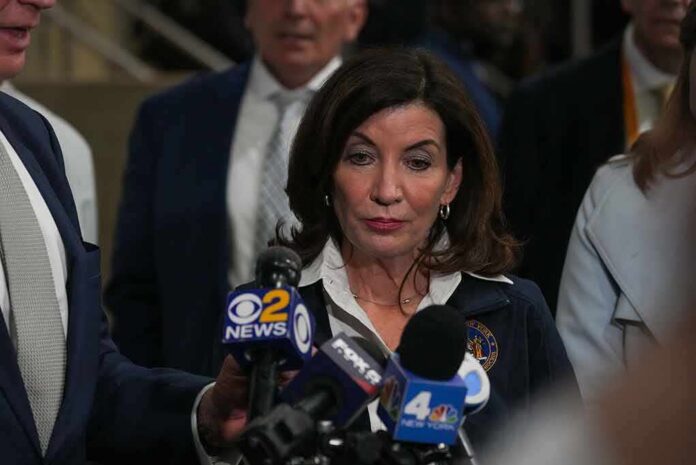
When elected officials step into houses of worship, what they wear is never just fabric; it is etiquette with political charge, a small choice that becomes a proxy for larger fights over identity, pluralism, and power.
The Short Version
- The verified fact is simple: Gov. Kathy Hochul appeared at a Muslim-community event in New York City wearing a black head covering while addressing religious and community leaders.
- The reaction was instantaneous on social platforms, framing the gesture as politically symbolic rather than routine protocol.
- This was not the first time Hochul’s head covering in a Muslim setting drew fire; a 2025 funeral appearance sparked a similar cycle of criticism and defense.
- The core dispute is interpretive, not factual: respect for religious custom versus perceived ideological signaling.
What actually happened, and what is undisputed
The record supports a narrow factual backbone. On August 30, 2026, contemporaneous coverage described Governor Kathy Hochul speaking to Muslim leaders in New York City while wearing a black head covering often labeled a hijab. Her public schedule places her in New York City that day, underscoring that this was a real event, not a manipulated image. Within hours, images and video circulated widely, and critics on partisan outlets and social media cast the choice as provocative or emblematic of political pandering rather than ordinary interfaith etiquette.
Nothing in the available record shows a formal complaint, ethics investigation, or institutional rebuke tied to the appearance. Nor is there a contemporaneous on-record explanation by Hochul specific to this August 2026 moment. That gap fuels inference, but it does not undermine the basic facts: the appearance occurred, a head covering was worn, and backlash followed quickly online.
Why this keeps recurring: the mechanism of symbolic politics
Head coverings in religious spaces function as etiquette: a practical signal of respect to the host tradition. But in polarized environments, etiquette is read as ideology. The same gesture—a scarf at a mosque, a kippah at a synagogue, a chapel veil at a cathedral—can scan either as neighborly courtesy or as capitulation to a worldview the observer opposes. When elected officials are the actors, the inference machine revs harder; symbols are treated as policy previews, not simply manners. Research on hijab politics shows this general pattern repeatedly: garments become vessels for broader conflicts over gender, secularism, and belonging, often untethered from the specific individual wearing them.
In short, small optics get loaded with big meaning. The digital environment magnifies this dynamic by rewarding emotionally charged interpretations over dry context; an image of a governor in a headscarf travels farther than a footnote about venue protocol. The cycle repeats because the symbol is familiar, the interpretive frames are pre-built, and the audience already knows the script.
The prior episode that primed the reaction
The August 2026 dispute did not arise on a blank slate. A year earlier, Hochul wore a black scarf while speaking inside a mosque at the funeral of NYPD Officer Didarul Islam. Critics, including Sen. Ted Cruz, attacked the choice publicly; Hochul responded that she wore the head covering to honor the fallen Muslim officer and that respecting a grieving family’s faith is what leaders with basic decency do. Mainstream coverage recorded the exchange, and civil-rights advocates defended the gesture as a straightforward observance of Islamic custom at a religious service.
That earlier cycle established a durable frame: to supporters, head covering in a sacred context equals respect; to critics, it signals endorsement of religious mores they oppose. Once those interpretive grooves exist, new images slot into them effortlessly. The August 2026 appearance, even without a fresh gubernatorial explanation, was interpreted through that prior lens.
Where the real disagreement lies: intent, context, and precedent
The substantive disagreement does not turn on whether a scarf was worn; it turns on what the act means. Critics claim political performance—an intentional signal to a constituency—or capitulation to illiberal norms. Supporters emphasize protocol and interfaith respect. The evidence available for August 2026 is thin on intent; we lack an invitation specifying attire, an organizer’s memo, or a podium-side request to cover hair. Those documents would help; without them, inference rests on the venue and the pattern of past practice. That past practice in the United States is mixed but legible: public officials commonly adapt modest dress inside houses of worship across traditions as a gesture of courtesy, not policy endorsement.
There is also a jurisprudential and civil-rights context in New York. The state has codified protections around religious garb, and the governor has publicly praised the right of Muslim women to choose hijab, framing it as a personal decision. These are broad commitments to free exercise and anti-harassment, not mandates on others’ attire. They supply a coherent backdrop for a governor who, in religious settings, observes host customs; they do not, by themselves, resolve whether any single act of observance carries electoral calculus.
How to evaluate symbolic gestures without getting trapped by them
An expert reading asks four questions. First, is the core fact verified by more than rhetoric? Here, yes: timing, venue, and imagery align with official scheduling and contemporaneous reporting. Second, is there credible counter-evidence on the facts themselves? No—disputes are interpretive, not evidentiary. Third, is there a plausible, non-political explanation consistent with precedent? Yes—respectful observance inside a religious setting is common practice. Fourth, are there concrete policy consequences tied to the gesture? That is less clear. Critics assert a slippery slope from scarf to sanction, but point to no regulatory action, executive order, or resource allocation triggered by the appearance.
The prudent conclusion is modest: the act is real; the interpretation is contested; the policy stakes, if any, lie elsewhere. When symbols outrun substance, the analytical task is to separate etiquette from endorsement and imagery from governance.
HIJAB HOCHUL: Governor's Headscarf Ignites Backlash! 👀
“Feminist icon NY Governor Hochul just put on a hijab for Muslim men”
Governor Kathy Hochul is facing a fresh wave of criticism after appearing in a hijab during a New York City event with Muslim leaders — an appearance… pic.twitter.com/eWHbuGhixM
— SANTINO (@TheRealSantino) August 30, 2026
What this means going forward
Expect repetition. As long as visual moments can be excerpted and stripped of setting, any official’s attire in sacred spaces will be mobilized to energize aligned audiences. The only durable antidote is context made legible: clear host protocols, on-the-record explanations, and a consistent standard across traditions. If a governor covers hair at a mosque, dons a yarmulke at a synagogue, and wears a mantilla at a cathedral, citizens can read a pattern of courtesy rather than a selective endorsement of any doctrine. Consistency blunts claims of sectarian favoritism and re-centers the question that matters: what policies follow?
Sources:
governor.ny.gov, youtube.com, worldisraelnews.com, thegatewaypundit.com, nytimes.com, newarab.com, tribuneindia.com, norwoodnews.org, gvwire.com
© featurednews.com 2026. All rights reserved.