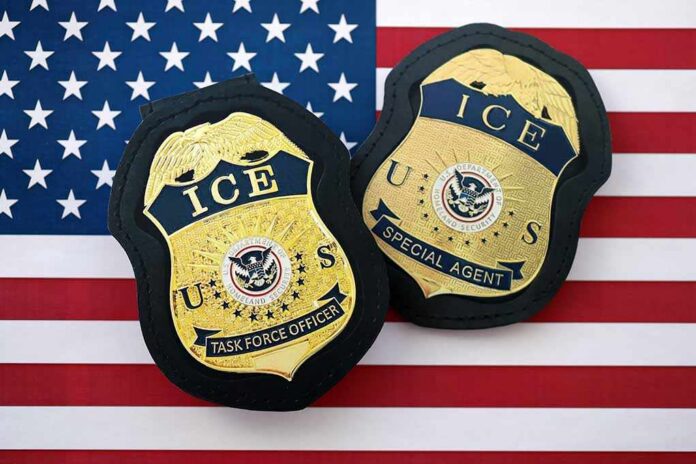
An ICE officer shot and wounded a man during a targeted enforcement operation in the Marble Hill section of the Bronx on October 8, 2026, and the Department of Homeland Security says the man was an undocumented Dominican national with gang ties and a criminal record.
Key Points
- DHS says the shooting occurred during a “targeted enforcement operation” to arrest a Dominican national with a prior conviction and ties to the Trinitarios gang
- The incident happened around 4 p.m. near West 225th Street and Marble Hill Avenue; the man was wounded but survived and remains hospitalized
- DHS says officers rendered immediate aid after firing; the FBI’s evidence response team supported the on-scene investigation
- Mayor Mamdani and Governor Hochul publicly demanded a full, transparent accounting of the shooting
- The episode lands inside a documented national pattern of rising ICE use-of-force incidents and complaints, which shapes how it will be read even as the specific facts settle
What Happened on West 225th Street
Shortly after 4 p.m. on October 8, ICE officers moved on a target in Marble Hill, a residential pocket of the Bronx wedged against the Harlem River. DHS said the operation was aimed at arresting “a man from the Dominican Republic with a prior criminal conviction”. During the encounter, an ICE officer discharged a firearm, and the man DHS identified as its target was struck. He survived. Reuters reported he was conscious and receiving medical treatment, and CBS News reported his injuries were not considered life-threatening. The NYPD was not involved in the shooting itself but responded afterward to help secure the scene, and the FBI’s evidence response team was brought in to assist DHS investigators — a standard allocation of jurisdiction, since federal agencies retain primary authority over use-of-force investigations involving their own personnel.
DHS’s account goes further than simply confirming a shooting occurred. The department said the man had “connections to the Trinitarios gang,” a Dominican-American street organization with a long history in the Bronx and Washington Heights, and that he carried “prior criminal convictions and multiple arrests”. DHS also said officers “rendered immediate aid” once the man was down — a detail agencies routinely cite to demonstrate that a use-of-force incident did not amount to abandonment of a wounded subject, and one consistent with his survival and hospitalization.
The Local Political Response
The shooting immediately drew comment from New York’s top elected officials. Mayor Mamdani’s office released a formal statement on the incident, and Governor Hochul said she had been briefed and demanded “a full and transparent accounting of the circumstances,” arguing that “New Yorkers deserve to know exactly what happened and why.” Much of the early public narrative centered on reports that a five-year-old child was in the vehicle at the time officers approached — a detail that traveled quickly through local and social media and that city officials invoked to frame the operation as reckless, regardless of the underlying allegations against the man targeted. A brief caveat is warranted here: DHS’s description of the man’s criminal history and gang affiliation, like most agency statements issued in the hours after an incident, has not yet been matched in public reporting to court dockets or correctional records identifying him by name.
That gap has not stopped the incident from becoming a flashpoint. Within hours, protesters gathered near the scene and later clashed with police barricades elsewhere in the city, a reaction that tracks a now-familiar cycle in cities where ICE has stepped up street-level enforcement: a shooting or dramatic arrest triggers immediate local-official condemnation, grassroots mobilization, and a federal agency statement that emphasizes officer safety and the target’s criminal history, with the two narratives running in parallel rather than toward resolution.
How This Fits the National Pattern
The Marble Hill shooting did not happen in a vacuum. Congressional Research Service figures show ICE recorded 78 use-of-force incidents in fiscal year 2023, against 472 for Customs and Border Protection, and oversight of both falls to agency-level Offices of Professional Responsibility alongside the DHS Inspector General. More recent reporting has tracked a climb in such incidents alongside the current administration’s expanded enforcement posture: an ACLU-affiliated analysis found agents used or threatened force in roughly a third of documented encounters, including pushing, tackling, or pinning people more than 400 times, with weapons — chemical irritants, rubber bullets, tasers — deployed about as often. A separate review of legal claims filed against ICE and Border Patrol personnel between June and December of 2025 found more than a dozen allegations of assault or detention without cause.
DHS’s standard public position is that officers are trained to use only the minimum force necessary and receive ongoing de-escalation instruction, and the governing legal standard — drawn from Graham v. Connor and DHS’s own deadly-force policy — permits lethal force only when an officer reasonably believes a subject poses an imminent threat of death or serious injury. Whether that standard was met in Marble Hill is precisely the question any formal review will have to answer, and it is not one the public record currently resolves. What the record does show is that this shooting arrives at a moment when ICE’s use-of-force record is already under sustained scrutiny from internal watchdogs, outside researchers, and the federal courts alike — context that will color how the Bronx case is received no matter how the underlying facts are ultimately documented.
🚨 BREAKING: Anti-ICE protesters push barricades toward NYPD officers in NYC, chanting, “Whose streets? Our streets!”
The confrontation follows a shooting involving an ICE agent in Marble Hill, the Bronx. pic.twitter.com/gJPfY7O7bV
— World News Alerts (@AustinBrunette5) October 9, 2026
What Comes Next
The practical path forward runs through records, not rhetoric: the arrest packet and warrant materials behind the operation, the officer’s use-of-force report and any body-camera footage, and court or correctional documentation that could substantiate or narrow DHS’s claims about the man’s conviction history and gang affiliation. Until those materials surface, the public is left with two consistent but incomplete accounts — a federal agency describing a lawful, targeted arrest of a convicted gang-affiliated noncitizen, and city officials describing a dangerous escalation in a residential neighborhood with a child nearby. Both can be true in part. Resolving which parts requires the documentary record that only DHS, the FBI, and New York law enforcement currently hold.
Sources:
nytimes.com, reuters.com, bronx.news12.com, nyc.gov, cnn.com, dailynews.com, abc7ny.com, yahoo.com, kcra.com, bbc.com, police1.com, congress.gov, americanimmigrationcouncil.org
© featurednews.com 2026. All rights reserved.