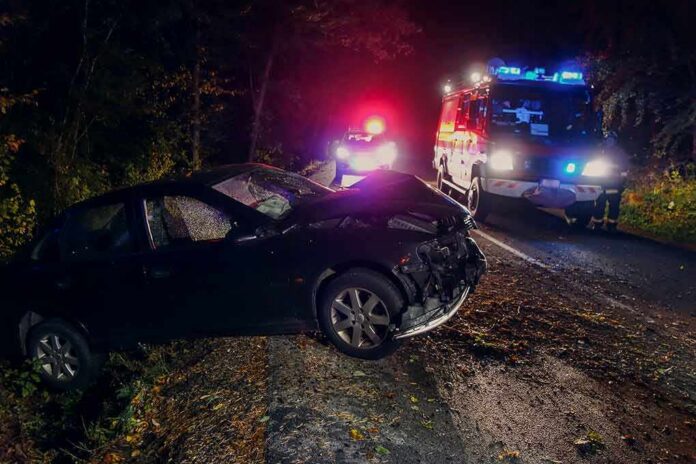
What turned a highway rollover on Interstate 5 into a knife attack was not chance but, according to investigators, intent: Washington State Patrol has said the driver purposely steered her SUV into a concrete barrier before turning on the two girls riding with her, meaning the crash and the stabbing were not two separate misfortunes but, allegedly, one continuous act.
Key Points
- A 35-year-old Steilacoom woman, later identified as Janieka Ellington, allegedly crashed her SUV into a barrier and a semi-truck on southbound I-5 near DuPont around 9 a.m. and then attacked two girls with a knife.
- A 9-year-old suffered multiple broken bones and a stab wound; a 15-year-old was hospitalized without serious injuries.
- Two soldiers from Joint Base Lewis-McChord, who stopped after witnessing the crash, intervened and got the knife away from the suspect before troopers arrived.
- Washington State Patrol has said investigators believe the crash itself was deliberate, not accidental, which reframes the case as a continuous assault rather than a crash followed by an unrelated attack.
- Charges have evolved from an initial DUI, vehicular assault, and first-degree assault investigation to later reporting of attempted murder and vehicular assault counts.
The Crash and Attack on Southbound I-5
The incident unfolded on southbound I-5 near DuPont, a stretch of highway that runs along the western edge of Joint Base Lewis-McChord, shortly before 9 a.m. Washington State Patrol’s account, relayed through multiple local outlets, describes an SUV that struck a concrete barrier, crossed lanes or rolled, and ultimately collided with a semi-truck. Outlets differ slightly on the precise mechanics — whether the vehicle rolled first or struck the shoulder barrier before reaching the truck — but every account agrees on the core sequence: a violent crash, followed almost immediately by a knife attack on the children inside and near the vehicle.
What separates this case from an ordinary multi-vehicle collision is the claim, attributed to investigators, that the crash was not an accident at all. KOMO News reported that investigators believe Ellington “purposely crashed her vehicle into a concrete barrier” before producing a knife and going after the girls — a detail that, if it holds through prosecution, would mean the collision functioned as the opening act of the assault rather than its unrelated precondition. A later King5 account adds further granularity: that an attempt to stab the older daughter occurred before the crash, that the younger girl was stabbed inside the vehicle immediately after the rollover, and that a second attempt was made on the older daughter once she was outside the SUV.
How Two Soldiers Ended the Attack
The detail that has drawn the most public attention is the intervention of two soldiers from Joint Base Lewis-McChord who happened to be driving the same stretch of highway. Having witnessed the crash, they stopped, and multiple outlets report that it was their action — getting the knife away from Ellington — that ended the attack before troopers arrived on scene. The exact physical mechanics of that intervention are described with minor variation across outlets, some emphasizing disarmament and others emphasizing physical restraint, but the substance is consistent: untrained civilian bystanders, in military uniform but acting outside any official duty, made the split-second decision to put themselves between an armed adult and two injured children.
A responding medic later described treating the teenage victim at the scene, underscoring that the intervention bought the time needed for emergency medical care to begin before the more seriously injured child could be transported. That kind of bystander action — arriving on an active roadway within moments of a crash, assessing an unfolding assault, and choosing to physically intervene without weapons or protective equipment — is rare enough that law enforcement agencies routinely cite it in press briefings precisely because it is not something departments can train the public to replicate reliably.
The Victims and the Suspect
The younger victim, a 9-year-old girl, suffered multiple broken bones along with a stab wound, injuries consistent with both the violence of the crash and the knife attack that followed. The 15-year-old girl was also hospitalized but without serious injury. The suspect, identified in later reporting as Janieka Ellington, 35, of Steilacoom, was taken to a hospital for evaluation before being booked into Pierce County Jail. Washington State Patrol’s early characterization of the case centered on three potential charges — DUI, vehicular assault, and first-degree assault — reflecting the standard framework troopers use when a crash involves both suspected impairment and injury. Subsequent reporting from KOMO News named attempted murder and vehicular assault as the charges Ellington ultimately faced, a shift that reflects prosecutors building out the case once the full picture of a premeditated attack, rather than an impaired-driving crash with incidental injury, came into focus. As with any pending criminal matter, these are allegations that will be tested in court, not a final legal determination of guilt.
Why the Official Record Takes Time to Catch Up
Washington law requires investigating officers to file a sworn collision report for any crash involving injury, death, or significant property damage, submitted to the Washington State Patrol’s Collision Records Section under a formal declaration made “under penalty of perjury.” That statutory structure — codified in RCW 46.52 and detailed in WSP’s own Police Traffic Collision Report Instruction Manual — explains why the public narrative of a case like this one builds in stages: officers brief media with the working facts available at the scene, while the signed collision report, any probable-cause affidavit, and the formal charging documents move through a separate administrative and prosecutorial pipeline that can lag the news cycle by days or weeks. That is a function of how Washington processes traffic collisions generally, not a peculiarity of this case.
What Comes Next
The case now moves into Pierce County’s court system, where prosecutors will formalize the charging decision, and where any question of intent, impairment, or mental state will be litigated through the normal channels of discovery, competency evaluation if warranted, and eventual trial or plea. The crash scene itself — a stretch of I-5 soldiers happened to be driving at the moment it mattered — has already done what roadside intervention rarely gets credit for: it ended an active threat to two children before it could become something far worse, in the seconds before any officer could physically arrive.
Sources:
foxnews.com, fox13seattle.com, kiro7.com, mynorthwest.com, komonews.com
© featurednews.com 2026. All rights reserved.