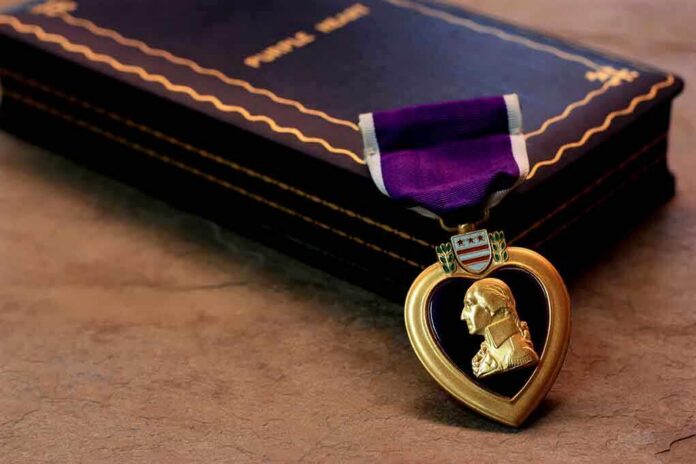
A Purple Heart on the streets of Washington, D.C. forces one unsettling question: when the homeland becomes “front lines,” what exactly did we change about the mission?
Story Snapshot
- Two West Virginia National Guard members were shot in an ambush near the White House area while on a security mission in Washington, D.C.
- Army Spc. Sarah Beckstrom, 20, died the next day; Air Force Staff Sgt. Andrew Wolfe, 24, survived severe head wounds and continues recovery with more surgery ahead.
- Defense Secretary Pete Hegseth announced both will receive Purple Hearts, a rare move for an attack on U.S. soil.
- Afghan national Rahmanullah Lakanwal pleaded not guilty to multiple charges as prosecutors pursue death-penalty eligibility.
An ambush blocks from power, and a medal built for war
On November 26, 2025, two Guardsmen on a domestic security mission near Farragut Square and the White House area took gunfire that looked less like a street crime and more like an intentional attack. Both were shot in the head and rushed to MedStar Washington Hospital Center. Beckstrom died the following day. Wolfe survived, but his injuries reshaped his life and his family’s calendar—rehab now, skull reconstruction surgery scheduled next.
The accused, 29-year-old Afghan national Rahmanullah Lakanwal, allegedly used a .357 Magnum revolver and fired roughly 10 to 15 rounds, then faced nine charges including first-degree murder and assault with intent to kill. He pleaded not guilty. Prosecutors have moved to make the case eligible for the death penalty. That legal posture matters because it signals how seriously the government views the attack’s intent, even as motive and classification remain contested in public.
Why this Purple Heart decision hits a nerve in peacetime America
Defense Secretary Pete Hegseth announced the Purple Hearts during a National Guard reenlistment ceremony at the Washington Monument on February 6, 2026. The setting wasn’t accidental. He tied the award to the idea that these troops were attacked by a “radical,” and he described their duty as “front lines.” The Purple Heart traditionally recognizes wounds from enemy action, so awarding it inside the United States instantly pulls a domestic incident into a wartime moral category.
That category shift creates two competing reactions. One side sees overdue clarity: if you get shot in the head while standing post for the country, the country should call it what it is and honor it without legalistic hedging. The other side worries that broadening “enemy action” on U.S. soil becomes a political tool—one that can outrun evidence if officials lean on labels before courts establish facts. Common sense says honor sacrifice, but precision still matters.
The D.C. mission that blurred the line between soldier and street patrol
The shooting didn’t happen in a vacuum. President Donald Trump activated more than 2,600 National Guard troops from multiple states in August 2025 after declaring a crime emergency in Washington, D.C., assigning them to support the D.C. Safe and Beautiful Task Force. That deployment placed citizen-soldiers into a high-visibility, high-consequence environment where every interaction—tourist, protester, criminal, or someone with a plan—occurs under the shadow of national symbols.
Supporters of the deployment argue that public order is a basic government obligation, and when local leadership can’t or won’t control disorder, the federal government has a duty to act. Critics counter that using Guardsmen as a standing answer to urban crime risks normalizing a military presence in civilian life. Beckstrom and Wolfe’s case lands painfully in the middle: they weren’t overseas hunting insurgents, but they also weren’t simply “helping out.” Somebody targeted them like combatants.
The Chattanooga precedent, and the bureaucracy nobody wants to talk about
Purple Hearts for attacks in the United States aren’t unheard of, but they’re rare enough to trigger a familiar fight: who counts as an “enemy” when the battlefield is a city block? The 2015 Chattanooga shootings became a case study because the attack initially sat in a bureaucratic gray zone until the FBI determined a foreign terrorist motivation, clearing the path for awards. The D.C. attack now raises similar questions, but with a key difference: public proof of terrorism ties has not been widely established.
That uncertainty doesn’t erase the reality of the wounds. It does, however, challenge policymakers to keep standards consistent. A conservative, rule-of-law approach demands two things at once: fast, public honor for service members harmed in the line of duty, and careful discipline about the language that turns criminals into combatants. If the standard becomes “whoever an administration calls a terrorist,” the medal’s meaning risks drifting with politics instead of staying anchored to documented enemy action.
What this case changes for Guard families, recruiting, and the next domestic emergency
For West Virginia, the story has names and ages: Spc. Sarah Beckstrom, 20, and Staff Sgt. Andrew Wolfe, 24. Governor Patrick Morrisey requested the awards in December 2025 and later praised the decision as long overdue. For Wolfe’s family, recovery has become its own campaign measured in small wins—eyes opening, speech returning, the next surgery date circled. The Purple Heart won’t heal him, but it publicly validates what this mission cost.
The larger ripple runs through recruitment and retention. The Guard sells a promise of service close to home, with deployments that fit a life. Domestic missions already test that promise with long hours and political crossfire; an ambush blocks from the White House adds a darker footnote: the risk profile can spike without warning. If leaders keep sending Guardsmen into these roles, they owe them clear rules, serious protection, and an honest definition of what “front lines” means.
National Guard troops shot in DC to receive Purple Hearts https://t.co/LVZjep0AZm
— Task & Purpose (@TaskandPurpose) February 7, 2026
The trial will sort guilt and intent, but the policy debate won’t wait. Americans can respect the Purple Heart award and still demand rigor about why it’s awarded on home soil. That balance reflects a durable conservative instinct: honor service, prosecute violence, secure the streets, and keep government language tethered to provable facts. Beckstrom and Wolfe’s story lingers because it feels like a warning—about D.C., about deployments, and about how quickly “routine” can turn into war.
Sources:
hegseth says national guard members shot in dc ambush by afghan national to receive purple heart
west virginia national guard purple heart
guardsmen ambushed in dc to be awarded purple heart
sarah beckstrom andrew wolfe to receive purple heart hegseth says
2025 washington, d.c., national guard shooting
wva adjutant general message following dc shooting