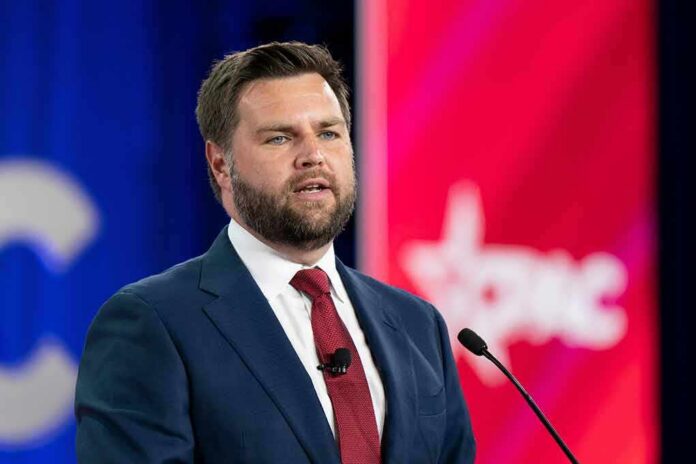
Vice President JD Vance now controls federal fraud investigations from the White House in a move that rewrites decades of rules designed to keep presidents from weaponizing the Justice Department.
Story Snapshot
- President Trump appointed Vice President JD Vance to lead a nationwide “war on fraud” task force with White House-based oversight of multi-agency investigations
- The executive order signed March 16, 2026 creates a new Assistant Attorney General position for fraud enforcement reporting directly to Vance
- The role breaks from post-Watergate norms that separated presidential control from Justice Department prosecutions
- Initial targets include Minnesota, California, New York, and Maine, focusing on Medicaid and welfare fraud schemes
- Critics warn the structure enables political targeting while supporters claim it will recover taxpayer dollars and balance budgets
The Fraud Czar Takes Command
Trump unveiled the initiative during his February 24 State of the Union address, declaring war on fraud schemes bleeding federal programs dry. The president tapped Vance to coordinate what he described as a comprehensive crackdown spanning government benefits, health care programs, businesses, and individual citizens. Vance embraced the nickname “Fraud Czar,” a label critics initially deployed as mockery but which the Vice President adopted without hesitation. The White House formalized the arrangement with an executive order three weeks later, establishing unprecedented direct control over what traditionally operated as independent prosecutorial functions.
The scope reaches far beyond existing Justice Department fraud sections. Vance oversees a new Assistant Attorney General position that operates from the White House rather than through conventional DOJ channels. Attorney General Pam Bondi publicly backed the arrangement, warning potential fraudsters not to test the administration’s resolve. CMS Administrator Mehmet Oz joined Vance at a press conference the day after the State of the Union, praising him as the ideal coordinator for government-wide anti-fraud efforts. The task force pulls resources from multiple federal agencies, creating an interagency dragnet with Vance at the helm.
Minnesota Becomes Ground Zero
Trump singled out Minnesota during his address, connecting fraud cases to immigration policies he characterized as open borders disasters. The state’s Somali community found itself in the crosshairs as Trump cited Medicaid and welfare schemes allegedly costing taxpayers millions. California, New York, and Maine joined Minnesota on the initial target list, all states showing elevated fraud indicators according to CMS data analysis. The selection process sparked accusations of political motivation, particularly given the predominantly Democratic governance in these jurisdictions.
Representative Paul Tonko dismissed the effort as political theater during recent congressional hearings. He questioned whether Vance possessed actual authority or simply provided political cover for selective enforcement. CMS officials insisted their state selections relied purely on data analytics independent of White House direction, yet the agency simultaneously realigned operations to report through Vance’s coordination structure. The contradiction raised eyebrows among observers tracking the blurred lines between data-driven targeting and rhetoric-driven priorities. No arrests have been announced since the task force became operational, leaving questions about whether investigations will produce substantive results or partisan spectacle.
Breaking the Watergate Walls
The arrangement tramples boundaries erected after Watergate to prevent presidents from directing criminal investigations. Those reforms insulated the Justice Department from White House interference, ensuring prosecutorial decisions followed evidence rather than political preferences. Vance’s role reverses that insulation, placing investigation coordination directly under presidential supervision through the Vice President’s office. Critics including analysis from The New York Times condemned the structure as a dangerous regression that invites abuse of prosecutorial power for partisan advantage.
Supporters counter that the existing DOJ Fraud Section operates too narrowly, missing organized schemes that span multiple agencies and jurisdictions. They argue Vance’s coordination fills gaps rather than replacing traditional prosecutors, enabling the government to tackle sophisticated fraud networks that exploit bureaucratic silos. Trump framed the entire effort as fiscal necessity, claiming recovered funds will help balance budgets strained by waste and theft. The economic argument resonates with taxpayers frustrated by stories of benefit abuse, yet the political implications overshadow any potential savings. The White House gains investigative tools that could serve legitimate fraud prevention or enable targeting of political opponents depending on how Vance wields his expanded authority.
The Hypocrisy Question Democrats Cannot Answer
Democratic critics accused Trump of creating a fraud czar position while allegedly profiting from office himself, pointing to business dealings and foreign payments they characterize as corruption. The attacks highlight real concerns about selective enforcement standards but lack evidence that Vance’s investigations will exclude presidential conduct from scrutiny. The allegations assume bad faith without waiting for results, a pattern that undermines legitimate oversight concerns with premature accusations. If the task force operates fairly, it should pursue fraud wherever evidence leads regardless of party affiliation or proximity to power.
The fundamental test arrives when investigations either expand beyond politically convenient targets or confirm suspicions about partisan selectivity. Health care providers, nonprofits, and businesses face heightened audit exposure under the expanded enforcement regime. Legitimate operators have nothing to fear from competent fraud detection, but the White House control structure creates justified anxiety about investigative motives. Taxpayers deserve protection from fraud schemes draining public resources, yet they also require confidence that fraud enforcement serves justice rather than political vendettas. Vance’s performance in the role will determine whether the Fraud Czar becomes a model for efficient government oversight or a cautionary tale about concentrated power untethered from institutional constraints that protect against abuse.
Sources:
Trump names VP JD Vance ‘fraud czar’: What the role means and why it’s controversial
‘Fraud Czar’ Vance Will Have His Hands Full With Rampant Corruption in Trump White House