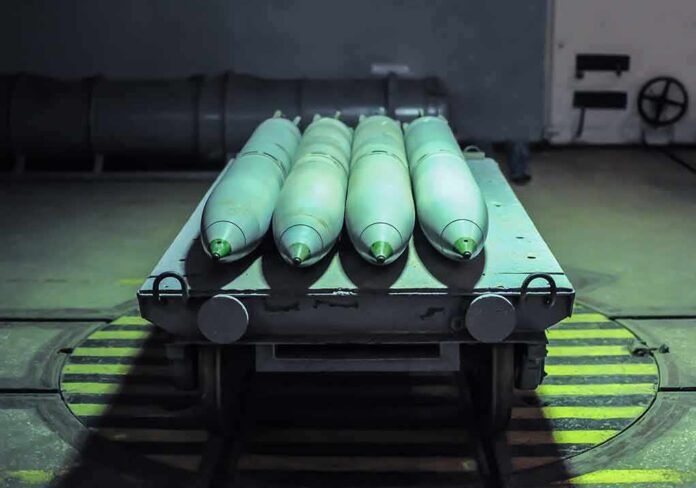
When unstable explosives and environmental law collide, risk moves on two clocks at once: the chemistry’s half-life and the public’s right to know. The Iowa lead-azide dispute lays bare that tension—emergency disposal authority exists for a reason, yet trust requires documented alternatives, transparent modeling, and the courts’ assurance that urgency is not a shortcut.
At a Glance
- EPA Region 7 issued an emergency permit authorizing in-place detonation of degraded lead azide at the Iowa Army Ammunition Plant after finding an “imminent and substantial” endangerment.
- The plan covered 68 drums and two controlled shots within a defined operating window, with mitigation and post-blast monitoring requirements.
- A federal appeals court stayed the permit amid challenges alleging inadequate consideration of alternatives and public notification.
- Justice Department filings asserted a separate emergency munitions-and-explosives exclusion could allow action despite the stay—escalating an authority clash.
What is being detonated—and why the chemistry matters
Lead azide is a primary explosive: a compound engineered to detonate under relatively modest stimulus to initiate larger charges. With age, heat/cold cycling, or loss of stabilizing media, crystals can grow and sensitization increases; friction, impact, or static may then set off the material unpredictably. EPA’s emergency permit documents the waste as both reactive and lead-toxic—two hazards, not one—and describes a stock of 68 drums whose condition triggered a finding of “imminent and substantial” endangerment to human health and the environment. In practical terms, that designation is reserved for scenarios where delay plausibly raises the chance of an uncontrolled event with serious consequences, including for first responders and nearby communities.
The Army’s case rests on a technical proposition familiar to ordnance experts: when instability is severe enough, in-place destruction can be safer than handling, repackaging, or transport. The emergency permit tracks that logic, authorizing intentional detonation on site and embedding controls to contain the blast and capture particulates as far as practicable. Yet what the public reasonably asks for—side-by-side risk comparisons of every feasible option—is only partially reflected in the public record. The chemistry explains the “why”; the documents define a compliant “how.” The gap is the quantified “why this, not that.”
What the emergency permit actually allowed
EPA Region 7’s emergency permit became effective November 13, 2026, and ran through February 11, 2027. It authorized storage and treatment by intentional, in-place detonation at the Iowa Army Ammunition Plant (IAAAP). The scope was bounded: 68 drums, two shots, and a specified operating window, with pre-, during-, and post-operation safeguards mandated to limit exposure and verify conditions after the event. The permit reflects a standard emergency framework under the Resource Conservation and Recovery Act (RCRA): when an immediate threat exists, EPA can authorize actions outside the cadence of ordinary hazardous-waste permitting, conditioning those actions on protective measures and reporting. EPA’s public materials also affirm the agency’s core conclusion—that degraded lead azide at IAAAP posed an imminent and substantial threat—anchoring the legal and technical basis for emergency treatment.
Two features of the record invite scrutiny without undermining those core facts. First, the permit’s multi-month validity coexisted with the Army’s narrow operational timeline; that mismatch fuelled questions about whether a short delay for better weather or broader notification might have reduced off-site risk without materially increasing on-site danger. Second, while the permit requires mitigation and monitoring, the public summaries do not include the underlying dispersion inputs, deposition thresholds, or baseline sampling plan indispensable to community confidence—details that live in technical appendices and contractor work plans, not press notices.
How the legal collision happened
The procedural story is as consequential as the chemistry. After environmental groups sued, the Eighth Circuit issued a temporary stay of EPA’s emergency permit—freezing the Army’s ability to rely on that instrument while the court reviewed the challenge. The Justice Department then filed a notice arguing that a distinct emergency munitions-and-explosives exclusion under RCRA regulations would allow the Army to proceed even without the EPA permit, given the asserted immediacy of the hazard. In effect, the government presented two paths to the same endpoint: EPA-authorized emergency treatment, or an independent emergency exclusion designed for munitions scenarios where immediate response is paramount.
That stance is not a mere press line; it appeared in on-record filings that stated the Army intended to act within days to avoid the higher risk of an uncontrolled explosion. But a noticed intention is not a judicial holding. The appeals court’s stay created a visible conflict between executive urgency and judicial review that could not be resolved by assertion alone. Regardless of technical merit, this separation-of-powers moment shaped perception: was the government solving a fast-moving safety problem or sidelining the court? The answer depended less on statute-citation contests and more on whether the underlying technical showing was made public, specific, and testable.
Competing risk narratives: plume fears versus blast control
Downwind risk sits at the center of public concern because the waste is lead-toxic. Illinois environmental and health officials warned that airborne lead could cross into western and even central Illinois depending on weather, citing modeling corridors that extended roughly 100 miles. Their communications emphasized two truths that can coexist uncomfortably: lead is a potent neurotoxin with no safe exposure level for children, and dispersion modeling shows wide potential footprints even when concentrations diminish with distance. Network reporting amplified that corridor framing; environmental groups leaned on the same maps to argue that detonation externalizes risk onto farms, homes, and the Mississippi River watershed.
The Army’s mitigation plan—earthworks, wetted covers, timing for favorable winds, and required air and soil monitoring—addresses the mechanism by which particulates are generated and transported. EPA’s permit anticipates some airborne dust and requires post-detonation sampling and a final report, a tacit acknowledgement that models must be checked against measurements. Still, in the absence of publicly released plume inputs, particle-size assumptions, mixing heights, and deposition thresholds, the community’s “show me” reaction is both rational and predictable. Illinois’ explicit warning that Mercer County could be affected is a reminder: interstate externalities change the politics and raise the bar for transparency.
What the record establishes—and what would close the gaps
On the evidence, several propositions are well supported. First, the material at IAAAP was both reactive and lead-toxic, and EPA concluded it posed an imminent and substantial threat; an emergency permit legitimately followed from that finding. Second, the operational concept was defined—68 drums, two shots—and conditioned by mitigation and monitoring requirements. Third, the legal picture includes a live, unresolved clash: a federal appeals court stayed the permit while the government pointed to an emergency exclusion pathway; that authority question remained contested in the sources at hand.
Two issues remain under-evidenced in the public domain and are fixable with documents the government already holds. One is comparative risk: a sworn, technical analysis that ranks in-place detonation against monitored storage, repackaging, relocation, or neutralization, with explicit failure modes, time-to-instability estimates, and uncertainty bounds. The other is plume credibility: disclosure of dispersion inputs, particle-size distributions, meteorology, and deposition triggers, plus baseline sampling locations and detection limits. Those exhibits would not only inform judicial review; they would equip downwind counties to plan rationally rather than react to shaded maps without scales.
The durable lesson: emergency power earns trust only with measurable proof
This episode is not an outlier; it fits a recurring pattern in aging-munitions management. As energetic materials degrade, the window for ordinary permitting closes and emergency pathways—designed to prevent catastrophes—open. The regulations allow that pivot. But legitimacy in a cross-border, toxics-laden context requires more than a correct citation; it requires the comparative analysis and monitoring design that let independent eyes verify that the least-bad choice won. EPA’s emergency framework can hold both urgency and accountability, if its technical spine is made public in time for scrutiny, not after the blast.
Sources:
washingtontimes.com, epa.gov, edition.cnn.com, response.epa.gov, hhs.iowa.gov, nbcchicago.com, rmb.reuters.com, 6abc.com
© featurednews.com 2026. All rights reserved.