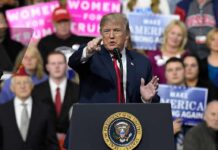
The episode is not about a flag; it is about how a split-second, unverified certainty collides with a polarized attention machine that rewards speed, outrage, and tribal cues more than accuracy—and how even a prompt correction struggles to catch up.
The Short Version
- Amy McGrath publicly misidentified a Philippine flag as Russian in a post criticizing President Trump, then explicitly acknowledged the error, deleted the post, and took responsibility.
- Her first correction named the Philippine flag but paired it with a renewed insinuation about Trump and Russia, which critics cast as deflection.
- Independent contemporaneous coverage affirmed the image context: Trump had been handed a Philippine flag after arriving in Manila.
- The incident exemplifies a broader pattern: categorical, out-group-focused claims drive engagement and often outpace later corrections in reach and memory.
What actually happened—and what is firmly established
On X, Amy McGrath first asserted that an image showed President Trump waving American and Russian flags together. She later posted a direct admission: “I got this one wrong. The flag Trump was waving was the Philippine flag, not the Russian flag. I should have checked more carefully before posting.” She also said she deleted the original post and that the mistake was hers. Those are explicit, contemporaneous statements from the principal herself, not reconstructions by commentators. In a separate post, she identified the flag as Philippine sooner, signaling a public correction path rather than digging in on the original claim.
Coverage the same day situated the image: the flag was indeed Philippine and had been given to Trump by a child greeting him after his arrival in the Philippines—context that obviously contradicts the idea that he was pairing American and Russian flags for effect. None of the available record demonstrates that McGrath intended to mislead; the record shows a misidentification, a categorical criticism built on that error, and a prompt, direct correction.
How the mistake traveled faster than the fix
The mechanics are familiar to anyone who studies political information flows. A striking visual, a categorical accusation, an out-group target: this is engagement rocket fuel. Large-scale analyses of social media show that language about the political out-group is a strong predictor of sharing—each such term can lift sharing odds dramatically, meaning the very phrasing that feels most righteous often travels the fastest regardless of its evidentiary quality. Corrections, by contrast, struggle to recapture attention even when the author takes responsibility, as McGrath did. Once screenshots and quotes of the initial claim propagate, they keep working the algorithmic gears long after a deletion.
Empirically, corrections can have mixed downstream effects on behavior. Field experiments and observational studies on platforms like X/Twitter find that being publicly corrected can reduce subsequent content quality and increase partisan heat for some users, especially when the correction is perceived as adversarial rather than informative. Other research is more sanguine about “backfire effects,” suggesting they are rarer than feared, but it remains clear that corrections rarely spread as far or as vividly as the initial improvised certainties they seek to dislodge. McGrath’s experience maps onto this literature: the fix was prompt and explicit; the first post still owned the narrative oxygen.
Where judgment properly applies—and where it doesn’t
Critics argued that the episode revealed confirmation bias and poor discipline. They point to the certainty of the original post, the obvious differences between the Russian and Philippine flags, the Manila context, and the fact that McGrath’s follow-up kept a partisan swipe alive even as it corrected the fact pattern. Some outlets also highlighted that a child handed Trump the flags, undermining any insinuation of a deliberate American–Russian pairing. These are fair criticisms of process and rhetoric: when you assert a vivid claim on a contested topic, verification discipline matters, and pairing a correction with speculation invites the charge of deflection.
What the record does not support is a confident leap to motive. We do not have evidence of deliberateness, nor a documented account of how the error arose—whether from image quality, haste, unfamiliarity with the Philippine flag, or the cognitive tunnel that political contexts can produce. The clean facts are narrower: she got it wrong, she said so, she deleted the post, and she identified the correct flag. Everything else—about ideological blindness or intent—is interpretive framing, not established cause.
Why this keeps happening: incentives, cognition, and context
Politically charged misidentifications are not random accidents; they are byproducts of structural incentives and human cognition. On social platforms, velocity is status, and virality often tracks emotional charge. Out-group language outperforms neutral description; categorical assertion outperforms careful framing; a sharp image with a simple story outperforms caveats that slow the reader down. Add confirmation bias—the tendency to overweight evidence that fits our priors—and you have a repeatable pattern. Even well-intentioned users can over-read a scene because the narrative feels obvious in the moment.
Attempts to correct can themselves be shaped by the same dynamics. Social corrections sometimes improve beliefs but can also trigger defensive reactions or shift attention from accuracy to reputational stakes, depending on tone, community, and timing. In practice, the most effective corrections are specific, sourced, and unadorned; they avoid partisan countermessaging in the same breath. McGrath’s final admission followed that model. Her earlier correction—fact plus speculative jab—did not.
Amy McGrath Deletes Ratioed Post on Trump Waving a 'Russian Flag' but the Excuse Is PEAK TDS https://t.co/PvBMW6UVxZ
— TinaPM American (@TpmPeiser) November 20, 2026
Practical lessons for political actors and engaged citizens
First, treat striking visuals like anonymous tips: plausible until verified. Verification in this context can be as simple as checking location and timing, comparing the visual to canonical references (e.g., flag designs), or looking for pool captions before hitting “post.” Second, separate the correction from the critique. If you get a fact wrong, keep the fix clean; do not yoke it to a new insinuation that invites the perception you are hedging rather than owning.
What endures beyond the news cycle
This case will not make the history books. But it is a durable lesson in how attention markets and human psychology conspire to privilege confident error over conscientious accuracy. The episode’s facts are settled: misidentification, deletion, explicit responsibility, and corroborated context of a Philippine flag handed to the president in Manila. The broader stakes are method, not partisanship. In a system that rewards speed and certainty, the only sustainable countermeasure is the habit of disciplined verification—and, when you miss, a correction that is both fast and unentangled with new claims.
Sources:
townhall.com, x.com, wnd.com, theblaze.com, ethicsalarms.com
© featurednews.com 2026. All rights reserved.