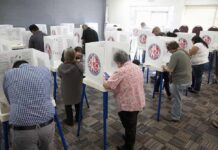
When politicians and journalists collide in public, what looks like a spat about manners is usually a struggle over power: who sets the terms of accountability, and for which audience. The El-Sayed–Matthews exchange outside a Detroit polling place is a textbook case—one that exposes the fault lines between local electoral mandates, global media scrutiny, and the viral incentives that turn a two-minute quarrel into a defining narrative.
At a Glance
- The clash centered on competing claims to relevance: Michigan voters versus an international news audience.
- Video and coverage confirm heated rhetoric and brief physical contact; intent and propriety remain contested.
- Both men argued from plausible first principles—local democratic accountability versus global consequence of U.S. power.
- Social distribution favored confrontation over context, accelerating reputational risk far beyond the initial moment.
What actually happened, and why it resonated
Outside a Detroit polling center, Sky News correspondent James Matthews approached Abdul El-Sayed, then a Michigan Senate candidate. On camera, El-Sayed pressed Matthews on whether he was registered to vote in Michigan, contrasted the value of Michigan voters with viewers in the United Kingdom, and declared he sought “zero” UK votes. The exchange grew tense, with both men talking over each other; multiple outlets reported that El-Sayed placed both hands on Matthews’s shoulders during the back-and-forth. Sky News ran the footage and a first-person account by Matthews soon after, amplifying the moment’s visibility and framing it as a misstep under pressure.
Two arguments crystallized in seconds. El-Sayed asserted a local mandate—his obligation runs first to Michigan voters—and treated the unsolicited questioning as outside that frame. Matthews made the opposite case: a U.S. Senate seat affects the world; those who wield power on Capitol Hill owe answers to an international public, not just to an electorate within state lines. Both propositions are intelligible. The friction comes from trying to resolve them in a live, adversarial sidewalk interview with cameras rolling.
Mechanism: accountability, access, and the choreography of on-the-street encounters
Street interviews compress three negotiations into one: consent to engage, scope of questions, and control of tone. Politicians typically seek message discipline and favorable venues; journalists seek proximity to decision-makers and unfiltered answers. Scholarship characterizes the relationship as a tug-of-war in which both sides try to manage each other—sources aim to shape coverage, reporters to extract information of public value. When either party refuses the choreography—by declining relevance, interrupting, or escalating with touch—norms feel violated. That stored-up tension is why brief lapses become moments.
In Detroit, El-Sayed’s insistence on Michigan voters as the locus of accountability is consistent with campaign rhetoric grounded in state issues, yet it does not negate the press function. Matthews’s assertion of worldwide consequence is accurate in a structural sense—U.S. senators vote on foreign policy, trade, and defense—but it does not create an obligation to accept any encounter on any terms. What is not meaningfully disputed by coverage is the heat of the exchange and the physical contact; what remains disputed is intent and necessity. The video shows contact; the record does not establish a safety imperative or prior consent, and the parties differ on whether Matthews was “chasing” him.
Competing claims, weighed on evidence rather than volume
On the narrow question of whether a journalist’s lack of local voter registration makes his questions irrelevant, the evidence favors the counter-case. Journalism is not an act of voting; it is a proxy for publics who cannot be present. Matthews explicitly noted Sky’s international audience and the global stakes of a U.S. Senate race; El-Sayed did not substantively engage that claim in the exchange shown, instead returning to the “zero votes in the UK” line. As an argument about democratic accountability, restricting press engagement to registered voters is nonstandard, and nothing in the record supplies a rule that would justify it.
On setting boundaries in a live setting, El-Sayed did have one defensible point: candidates are not obliged to accept every question, every time. Declining is legitimate; doing so with repeated interruptions and shoulder contact increases reputational risk and invites a story about temperament rather than message. Multiple outlets independently described the two men talking over each other and El-Sayed placing both hands on Matthews’s shoulders; some observers later suggested prior familiarity could have softened the gesture’s meaning, but that is interpretive rather than evidentiary. The visible image tends to dominate the nuance.
Why this went viral: the economics of outrage and out-groups
Short, emotionally charged clips outperform context. Studies across platforms have shown that posts invoking an out-group or expressing moral outrage are shared at substantially higher rates; users learn, through feedback, to adopt language and frames that drive engagement. The Detroit clip had the ingredients: a confrontation, a national politician dismissing a foreign media brand, and an ambiguous physical moment. Distribution choices mattered too. Sky’s platform advantage ensured rapid propagation; other outlets then echoed the “grabbed” or “hands-on-shoulders” framing, which emphasizes physicality over abstract debates about press relevance. Once sentiment curdles, corrections rarely outrun the first cut.
Virality also explains asymmetry in reputational exposure. A single moment outside a polling place can overshadow months of message discipline because the incentives of social platforms privilege heat. That is not a counsel of resignation but a design constraint any modern officeholder must master: the most dangerous five seconds of a day are often the ones with the least preparation.
Abdul El-Sayed clashes with Sky News reporter in heated exchange #shorts https://t.co/xOLizNk9si via @YouTube
🔥🔥🇺🇸🇺🇸
— GuyHultsdorf (@GuyHultsdorf) November 5, 2026
Practical lessons: how candidates and correspondents can lower the temperature without losing ground
For politicians, the rule is simple but hard: assert boundaries without disparagement. “I’m focused on Michigan voters today; happy to schedule with your team” is a firm refusal that sidesteps the registration red herring and avoids the jurisdictional insult. Never use touch to control space unless clear safety concerns exist; if you feel crowded, say so and step back on camera. The public is more forgiving of a refused interview than of a clip that reads as personal hostility.
For journalists, clarity and proportionality help. Identify outlet, subject, and why the audience has standing in one sentence at the top of the approach: “Sky News for viewers in the U.S. and UK; this Senate seat could influence foreign policy—can we ask about X?” That frames the legitimacy of the encounter and limits claims of irrelevance. If a subject refuses, consider whether continued pursuit improves the story or merely creates one. The goal is accountability, not a viral standoff that eclipses substance.
The broader meaning going forward
The Detroit moment will not be the last of its kind. U.S. politics operates on a local-to-global conveyor belt: state-level elections feed national power, and national power projects globally. Journalists abroad will continue to question American officials; American officeholders will continue to prioritize home constituencies. The durable insight from this exchange is not that one side is categorically right, but that both can ground their claims in democratic theory—yet both can lose the audience when heat displaces clarity. Mastery, for both professions, lies in lowering the emotional load while keeping the stakes legible.
Sources:
redstate.com, news.sky.com, thehill.com, thenational.scot, themirror.com
© featurednews.com 2026. All rights reserved.