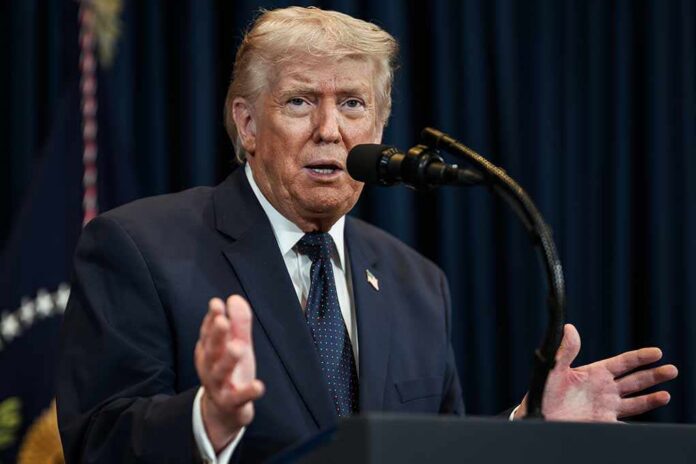
When Washington contemplates striking a foreign regime’s senior leadership, it is not merely weighing a military target set; it is testing a theory of coercion under the harshest conditions—can visibly credibly threatening a state’s top decision‑makers compel an adversary to change course faster than grinding battlefield attrition or sanctions ever could.
At a Glance
- U.S. officials debated targeting senior Iranian regime figures as part of a broader menu of strike options designed to end the conflict.
- Advocates contend leadership strikes could demonstrate reach, fracture hard‑line resistance, and force negotiations.
- Opponents inside the government warned of escalation risks, hardened resolve in Tehran, and damage to diplomatic off‑ramps.
- The discussion unfolded within an overt policy of using force against Iran under Operation Epic Fury and amid active strikes on Iranian military infrastructure.
What was under discussion and why it mattered
Senior U.S. officials considered, and actively debated, adding Iran’s top regime leaders to the target set as part of a strategy to hasten an end to the war. Reporting attributes the deliberations to a current U.S. official and a person with direct knowledge of the talks. Proponents argued that demonstrating the capability and willingness to target the architects of Tehran’s war policy—hard‑liners who shape military and security decisions—could puncture the regime’s sense of sanctuary, reorder its internal calculus, and create space for negotiations on acceptable terms. The idea was not floated in isolation; it sat alongside more traditional options against nuclear, missile, and drone infrastructure that had already featured in U.S. strike planning and execution.
This debate carried weight because it unfolded within a declared framework of coercive force. The White House had already cast U.S. operations as designed to “crush” the Iranian regime’s capacity to threaten the United States and to end the nuclear danger, placing leadership‑focused options on a continuum of pressure rather than as an out‑of‑the‑blue escalation. It also played out amid Iranian attacks and U.S. responses in and around the Strait of Hormuz, including strikes on Qeshm Island launch sites—evidence that both sides were operating at a wartime tempo with significant regional exposure.
How leadership targeting is supposed to work
The theory behind leadership strikes is straightforward: remove or credibly threaten the individuals who integrate strategy, command, and political resolve; degrade the enemy’s decision cycle; and force a reassessment by those who remain. In organizational terms, the gambit seeks to break the adversary’s “central node” rather than whittle away at its periphery. Advocates inside the administration reportedly believed that unmistakable vulnerability at the apex of power—signaled through precision—could pry open a diplomatic pathway faster than incremental attrition against facilities alone.
But states are not insurgent bands, and the regime in Tehran is not leaderless without a script. Its security architecture—Supreme Leader’s office, Islamic Revolutionary Guard Corps (IRGC), Supreme National Security Council—was built for redundancy and succession. The open question in any leadership‑targeting concept is not whether you can strike; it is whether removing specific actors measurably advances war termination at acceptable cost, given the target’s institutionalization and capacity for retaliation.
The internal debate and its risks
The same reporting that captured the case for leadership strikes recorded resistance from within the U.S. government and military. Critics warned that killing or attempting to kill senior figures could harden Iranian resistance, compel more expansive retaliation against U.S. and allied targets, and narrow the administration’s bargaining latitude. They also questioned whether threatening the top echelon, absent a clearly articulated political endgame and legal theory, would cohere with diplomatic efforts underway with partners and competitors alike.
Those concerns were not theoretical. Tehran’s public messaging signaled a readiness to expand the battlespace; a directive attributed to Supreme Leader Mojtaba Khamenei warned that any renewed attacks would invite a response without geographic limits. Such statements—while part of coercive signaling—are also operational guidance to the IRGC and its networked partners, raising the ceiling on potential reprisals and the scope of assets at risk. Inside Washington, the strategic question sharpened: would leadership strikes accelerate war termination, or shift the conflict into a more volatile phase with a less controllable escalation ladder?
The policy setting: force as a lever for negotiation
The March 2026 White House framing of Operation Epic Fury established a public predicate for coercion: targeted military force in service of eliminating the Iranian nuclear threat and compelling strategic change in Tehran. That policy articulation matters, because it locates leadership‑targeting discussions within an extant presidential approach—peace through strength rather than purely punitive raids. For practitioners, the operational corollary is the need to integrate kinetic options, legal authorities, and diplomatic channels so that each strike or threat of strike advances a defined political objective rather than simply registering costs.
To that end, the leadership‑targeting proposal sat alongside continued options development against Iran’s enabling systems—missile and drone production, launch infrastructure, command‑and‑control—where proven patterns of effectiveness and proportionality are stronger and escalation management is easier to model. The question officials faced was therefore comparative as much as absolute: not “do we strike,” but “which strike produces the greatest leverage per unit of escalation risk.”
What the historical and legal lenses contribute—and what they don’t
Outside the immediate crisis, two bodies of knowledge bracket the judgment call. First, the empirical record on “decapitation” is mixed and context‑dependent. Studies of insurgent and terrorist organizations show variable outcomes; leadership removal can cripple some groups while leaving others largely intact or even more violent, depending on institutionalization, ideology, and succession depth. That variability cautions against assuming a uniform effect when the target is a sovereign state with entrenched security organs and practiced continuity mechanisms.
Second, the law of armed conflict draws sharp lines around who may be targeted and when. Political leaders, as such, are not lawful targets merely by virtue of office; they are targetable only when they qualify as combatants or for such time as they directly participate in hostilities, and then only within the bounds of necessity, distinction, and proportionality. Any leadership‑targeting concept therefore lives or dies not only on strategic efficacy but also on its legal theory—self‑defense, immediacy, and the direct participation nexus.
🚨 TRUMP ADMIN WEIGHS STRIKES ON IRAN LEADERS
U. S. officials in the Trump administration are discussing possible military action against top Iranian figures.
This follows the tariffs and prompts claims of too much winning for the president. pic.twitter.com/Z6kRNrTlyu
— Crypto Beacon 🗽 (@CryptoBeaconUS) November 24, 2026
Strategic implications if leadership targeting moves from debate to decision
If leadership strikes were adopted, three dynamics would shape outcomes. First, regime cohesion versus factional fracture: removing a polarizing hard‑liner could, in some scenarios, empower pragmatists; in others, it could consolidate authority under more militant successors. Mapping those pathways requires disciplined intelligence on succession triggers and IRGC‑clerical relations—not generic assumptions. Second, the escalation ladder: Tehran’s demonstrated capacity and willingness to retaliate regionally, coupled with its stated doctrine of geographically unconstrained response, would push U.S. and allied planners to posture air and missile defenses, harden bases, and prepare for proxy activation across multiple theaters.
Third, diplomacy under fire: coercion succeeds only when it opens a credible off‑ramp. That means synchronizing any leadership‑focused kinetic action with a deliberately messaged settlement framework—objectives, sanctions architecture, verification, and third‑party guarantors—so adversaries perceive a way to stop the bleeding without regime suicide. Absent that, leadership strikes risk becoming demonstrative punishment rather than instruments of compellence.
Bottom line
The administration’s debate over targeting Iran’s top leaders was a serious exploration of a hard instrument within an already force‑forward strategy. Its promise—rapid strategic leverage through acute vulnerability at the apex of power—is real but conditional. Its perils—escalation, hardened resolve, legal friction, and diplomatic foreclosure—are equally real. For decision‑makers, the standard is uncompromising: marry precise intelligence to a lawful target set, fit the option to a defined end state, and ensure that every strike is a rung on the ladder out of war, not simply a louder step deeper into it.
Sources:
foxnews.com, whitehouse.gov, timesofisrael.com, tribune.com.pk, wbrz.com, nbcnews.com, en.royanews.tv, academic.oup.com
© featurednews.com 2026. All rights reserved.