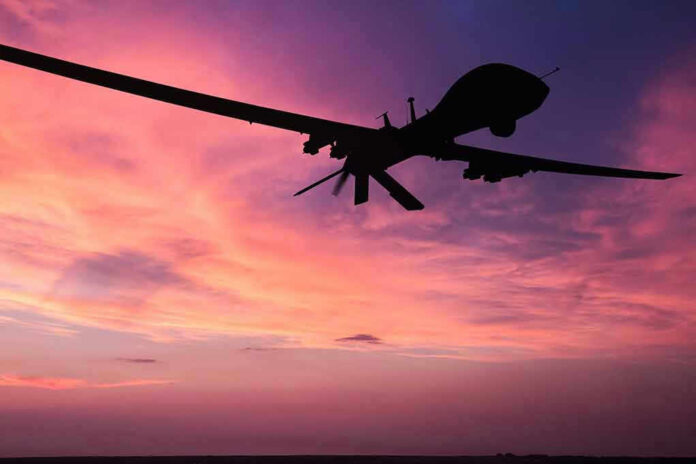
Walmart’s massive drone delivery expansion signals a technological revolution that could reshape American retail logistics while raising serious questions about privacy, government oversight, and the future of traditional jobs.
Story Snapshot
- Walmart partners with Alphabet’s Wing to expand drone delivery to 150 additional stores, reaching over 40 million Americans
- Service promises 30-minute delivery of groceries and essentials, directly challenging Amazon’s logistics dominance
- Expansion represents the world’s largest drone delivery rollout, scaling from 18 to 270+ stores by 2027
- Customer adoption has tripled in six months, with top users ordering three times weekly through the Wing app
Corporate Giants Battle for Sky Supremacy
Walmart and Alphabet subsidiary Wing announced their massive drone delivery expansion on January 11, targeting 150 additional stores across major metropolitan areas including Los Angeles, St. Louis, Cincinnati, and Miami. This partnership directly challenges Amazon’s Prime Air service, positioning Walmart as the frontrunner in commercial drone logistics. The collaboration leverages Walmart’s 4,600-store network against Amazon’s centralized warehouse model, potentially giving the Arkansas-based retailer a decisive advantage in the last-mile delivery wars that have intensified since the pandemic.
The expansion builds on proven success metrics that validate conservative concerns about rapid technological adoption. Customer usage has tripled in six months, with 25% of users ordering three times weekly. Popular items include everyday essentials like eggs, ground beef, avocados, and snacks, delivered within 30 minutes via drones capable of carrying five-pound payloads at speeds up to 60 mph. This data-driven approach demonstrates genuine market demand rather than Silicon Valley speculation.
Regulatory Framework Raises Oversight Questions
The Federal Aviation Administration’s 2019 approval for commercial beyond-visual-line-of-sight operations enabled this expansion, but questions remain about government oversight of widespread drone surveillance capabilities. While Wing operates under established safety protocols, the proliferation of commercial drones equipped with cameras and tracking technology across suburban neighborhoods raises legitimate privacy concerns for American families. Conservative communities have historically valued property rights and personal privacy, making this technological intrusion a potential flashpoint for local resistance.
Greg Cathey, Walmart’s Senior Vice President of Digital Fulfillment Transformation, emphasized that “strong adoption confirms this is the future of convenience.” However, the rapid scaling from two Dallas-area stores in 2023 to 270+ locations by 2027 demonstrates how quickly corporate-government partnerships can transform daily life without meaningful public input. This trajectory mirrors other technological impositions that bypass traditional democratic processes and community consent.
Economic Implications for American Workers
While drone delivery offers undeniable convenience, the long-term employment impact deserves scrutiny from working-class conservatives who value stable, well-paying jobs. Traditional delivery drivers, warehouse workers, and logistics personnel face potential displacement as automation scales across Walmart’s network. The company’s emphasis on efficiency and speed prioritizes corporate profits over employment stability, a pattern that has historically harmed American manufacturing communities.
The partnership also reinforces Big Tech’s growing influence over essential services, with Alphabet leveraging its technological capabilities to dominate yet another sector of the American economy. This consolidation of power among Silicon Valley giants contradicts conservative principles of distributed economic authority and local business autonomy. As drone delivery normalizes, smaller retailers may find themselves unable to compete without similar technological partnerships, further concentrating market power among a few corporate behemoths.
Market Competition Benefits Consumers
Despite legitimate concerns about technological overreach, the Walmart-Wing partnership demonstrates healthy market competition that ultimately benefits American consumers. Unlike government-mandated solutions, this expansion responds to genuine customer demand and market forces. The service operates through private infrastructure without taxpayer subsidies, embodying conservative economic principles of entrepreneurship and innovation. Competition between Walmart and Amazon drives improved services and lower costs, proving that free-market solutions often outperform bureaucratic alternatives in meeting consumer needs efficiently.
Sources:
CBS News – Walmart drone delivery service Wing 150 stores
TechCrunch – Wing to expand drone delivery to another 150 Walmart stores
Supply Chain Dive – Walmart Wing drone delivery coverage expansion
Wing – Wing Walmart expand drone delivery coast to coast