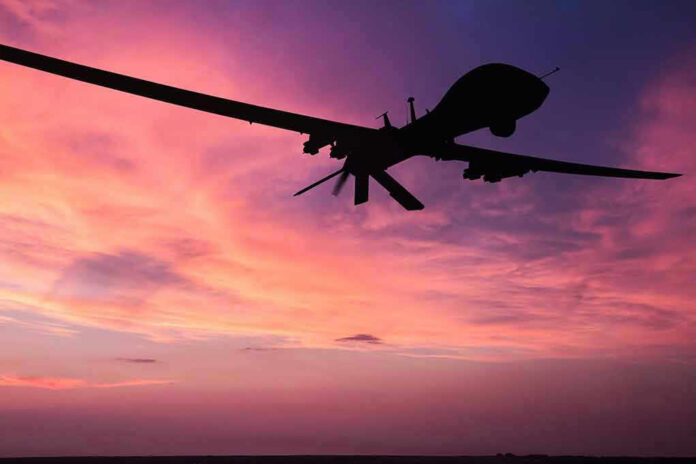
Shield AI’s groundbreaking autonomous flight of a U.S. Navy target drone marks a historic leap forward in America’s military supremacy, delivering cutting-edge AI capabilities that will keep our forces ahead of global threats.
Story Highlights
- First beyond visual range autonomous flight of Navy’s BQM-177A drone using AI technology
- Shield AI’s Hivemind software successfully integrated with military platform at Naval Air Station Point Mugu
- Demonstration advances Trump administration’s focus on American technological dominance in defense
- Cost-effective testing approach reduces risk while accelerating military innovation capabilities
Historic Military Aviation Breakthrough
Shield AI achieved a remarkable milestone in August 2025 by successfully flying the U.S. Navy’s BQM-177A target drone autonomously beyond visual range at Naval Air Station Point Mugu, California. This groundbreaking demonstration marked the first time this high-speed platform operated under complete AI control, showcasing American innovation in military technology. The achievement represents a significant advancement in the Navy’s Experimental Platform for Intelligent Combat project, designed to accelerate autonomous system integration across military platforms.
Strategic Technology Integration Success
The demonstration showcased seamless integration between Shield AI’s Hivemind autonomy software and Kratos Defense’s Advanced Vehicle Control Laws on the BQM-177A platform. Naval Air Systems Command’s PMA-281 and PMA-208 programs coordinated the effort, with additional support from Coherent Technical Services for mission planning interfaces. Christian Gutierrez, Shield AI’s VP of Hivemind Solutions, emphasized that this milestone reinforces their company as “a highly advanced, low-risk, mission-focused partner capable of rapidly integrating autonomy onto new platforms.”
Cost-Effective Defense Innovation Strategy
The Navy’s choice of the BQM-177A for this demonstration reflects smart fiscal management and strategic thinking that conservative Americans can appreciate. Using this cost-effective, threat-representative platform allows military leaders to test and refine autonomous concepts without risking expensive operational assets. This approach reduces development costs while maintaining rigorous safety standards, enabling faster innovation cycles that keep America ahead of potential adversaries. The strategy demonstrates responsible stewardship of taxpayer dollars while advancing critical national security capabilities.
Shield AI’s proven track record includes successful autonomous flights on other platforms like the V-BAT and Nova, building confidence in their technology’s reliability. The company, founded in 2015, has consistently delivered AI-driven solutions that enhance American military capabilities without unnecessary bureaucratic delays. Their rapid integration approach aligns with the Trump administration’s emphasis on cutting through red tape to deliver results for our armed forces.
Future Combat Readiness Implications
This successful demonstration paves the way for autonomous Collaborative Combat Aircraft and enhanced manned-unmanned teaming in future military operations. The technology supports the Department of Defense’s push for interoperable, scalable autonomy across multiple platforms, ensuring American forces maintain technological superiority. Defense experts recognize this achievement as validating AI use for beyond visual range operations on fast-moving platforms, a critical capability for modern warfare scenarios.
The Navy plans a follow-up demonstration later in 2025 featuring two BQM-177As flying autonomously together, further advancing multi-platform coordination capabilities. This progression demonstrates America’s commitment to maintaining military technological leadership while other nations struggle to match our innovation pace. The integration with government reference architectures ensures future interoperability and cost-effective scaling across defense platforms.
Sources:
Shield AI Demonstrates Hivemind on BQM-177A Supporting Navy Manned-Unmanned Teaming Goals
Shield AI Flies BQM-177A Target Drone With Hivemind
Shield AI Achieves Autonomous Flight of BQM-177A Target Drone Using Hivemind Software
U.S. Navy Demonstrates AI Autonomy on BQM-177A Through Shield AI Partnership
U.S. Navy and Shield AI Demonstrate Autonomous Flight with BQM-177A Aerial Target in California
Navy Demonstrates AI Autonomy on BQM-177A Target