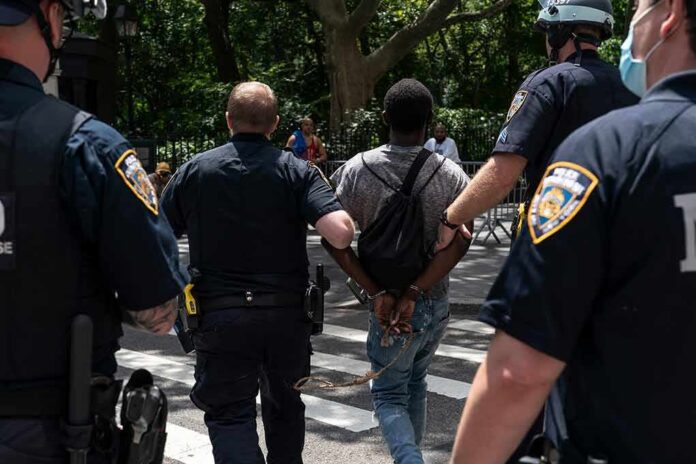
When Costa Rica finally put handcuffs on Alejandro Arias Monge, alias “Diablo,” it did more than end a decade-long manhunt; it exposed the mechanics, risks, and international reach of modern transnational drug enforcement in a small democracy that has long seen itself as a peaceful exception in Central America.
At a Glance
- “Diablo,” Costa Rica’s most wanted fugitive, was captured in a pre-dawn, heavily armed police operation after roughly a decade on the run.
- The confrontation involved an extended gunfight, multiple wounded officers, at least one dead suspect, and the seizure of military-grade weapons.
- U.S. authorities had posted a reward of up to $500,000 for information on Arias Monge, reflecting his alleged role in a violent transnational criminal organization.
- The case illustrates how a traditionally tranquil country became a node in high-volume cocaine trafficking and how its institutions adapted under fire.
From Quiet Tourist Haven to Hunting Ground for “Diablo”
To understand why the capture of Alejandro Arias Monge matters, you have to set aside the postcard image of Costa Rica and look at the geography of cocaine. For at least two decades, Central America has functioned as a key transit corridor for multi-hundred-kilogram shipments of Colombian cocaine moving north toward Mexico and the United States. Costa Rica, with its long coasts, porous rural borders, and relatively strong infrastructure, became attractive terrain for mid-level trafficking organizations that could operate in the shadows of a country better known for eco-tourism than drug wars.
Within this landscape, Arias Monge—born in Guápiles, in the Caribbean province of Limón—emerged as exactly the sort of figure law-enforcement agencies worry about most: a local operator who allegedly built a network capable of moving large quantities of cocaine across borders while using lethal violence to protect territory and silence rivals. Over time, Costa Rican investigators linked him to homicides, money laundering, robberies, and drug trafficking, and national media began labeling him the country’s most wanted man.
The Rise of a Violent Transnational Organization
The U.S. State Department’s formal characterization of Arias Monge is unusually stark. Its fugitive profile describes him as the head of a “violent transnational criminal organization” and “the most wanted fugitive in Costa Rica,” with multiple national warrants for drug trafficking, aggravated homicide, robbery, and money laundering. That language is not drafted lightly; it reflects a joint evidentiary process between Costa Rican authorities and U.S. agencies, primarily the Drug Enforcement Administration (DEA), which share intelligence and case files when they elevate a target through Washington’s Transnational Organized Crime Rewards Program.
DEA summaries cited in press coverage state that Arias Monge conspired with numerous traffickers and drug-trafficking organizations to transport “multi-hundred-kilogram” loads of cocaine, moving product from Colombia through Central America and Mexico toward the United States. In practical terms, that means he was not a street dealer, but part of the logistical machinery that makes wholesale trafficking possible: arranging maritime and overland routes, securing storage locations, managing armed protection, and coordinating with upstream and downstream partners. It also means that his operations could exert disproportionate pressure on local communities, drawing violence to areas otherwise far from the headlines.
Costa Rican reporting over the years captured that shift. Insight Crime, which specializes in regional organized crime analysis, framed him as a central figure in a bloody feud that caught national authorities off guard, underscoring how his group’s internal conflicts and battles with rivals drove local homicide spikes. Domestic outlets traced his footprint across regions such as Turrialba, southern San José, and Guanacaste, painting a picture of a mobile network rather than a static neighborhood gang.
The Reward: Why Washington Put Up Half a Million Dollars
In April 2025, the State Department announced a reward of up to $500,000 for information leading to Arias Monge’s arrest or conviction in any country. That figure is notable on two fronts. First, it is the largest reward the United States has ever offered for a Costa Rican national. Second, it signaled that U.S. authorities viewed him not simply as a local problem but as an operational threat to broader hemispheric drug-control efforts.
Rewards at that level serve several purposes. They aim to flush out informants in the suspect’s inner circle, compensate for the difficulty of penetrating organizations that rely on family ties and localized loyalties, and send a public signal that Washington is watching. The offer followed meetings between the DEA, Costa Rica’s Attorney General’s Office, and the Judicial Investigation Agency (OIJ), suggesting months of shared planning on both intelligence-gathering and eventual arrest scenarios.
For Costa Rica, accepting this level of partnership meant owning the reality that organized crime had reached a scale that warranted U.S. bounty money. For the Arias organization, it was an unambiguous warning: the quiet years of hiding in rural safe houses and neighboring countries were ending.
Operation “Némesis”: How the Capture Unfolded
The arrest did not come in a quiet traffic stop; it arrived in the form of a pre-dawn raid that turned a rural property into a battlefield. Costa Rican accounts converge on a basic sequence: OIJ tactical teams and supporting police units moved on a farm in the Río Frío de Sarapiquí area—sometimes described as San Bernardino, Bambusal, or Orquetas—at first light, aiming to surprise a small group of armed suspects.
As officers entered the property, they were met with gunfire. The exchange lasted roughly 45 minutes to an hour, with estimates of at least 2,500 rounds fired, according to OIJ director Michael Soto in a later television interview. During the confrontation, several officers were wounded; reporting varies between five, six, and eight injured, with at least one in critical condition evacuated to San José. One suspect, identified in local coverage as Rodney Ríos Soconitrillo, alias “Coco” or “Cocuáimo,” was killed in the shootout.
What makes the operation stand out is the level of armament and preparation on both sides. Authorities report seizing multiple high-caliber assault rifles—FALs, AK-47s, AR-15s—along with pistols, thousands of rounds of ammunition, and surveillance equipment including drones. The house itself was rented through an intermediary and equipped for perimeter monitoring, an arrangement designed to mask occupancy and provide early warning of law-enforcement movement.
Despite that, the suspects were ultimately pinned down. Soto describes a dynamic in which negotiators engaged the occupants while tactical teams maintained pressure, leading Arias Monge and another ringleader, known as “Tang” or “T,” to surrender separately during lulls in the exchange. The scene was complicated further by bad weather that initially hampered helicopter access for medical evacuations, forcing officers to manage casualties in real time under considerable strain.
Legal Process, Custody, and Extradition Questions
Once “Diablo” was in custody, Costa Rican authorities moved quickly to secure him physically and legally. He was transported in an armored tactical vehicle to the maximum-security wing of the Jorge Arturo Montero Castro penitentiary complex, better known as La Reforma, in San Rafael de Alajuela, under escort from special tactical units. Attorney General Carlo Díaz confirmed the detention publicly and tied it to existing warrants and an ongoing homicide trial he had previously evaded.
From there, the case entered the formal judicial phase: precautionary measures hearings to determine pretrial detention conditions, prosecutorial filings consolidating the charges, and likely efforts to trace financial flows and weapons back to the broader organization. Costa Rican officials and commentators emphasized that Arias Monge was thought to be responsible, directly or indirectly, for roughly 100 deaths, framing the proceedings not just as a drug case but as a reckoning for a prolonged wave of violence.
The extradition dimension is more nuanced. While the U.S. reward and fugitive designation clearly contemplated prosecution linked to cocaine trafficking toward U.S. territory, OIJ leadership has indicated that, at least at the time of arrest, there was no active extradition request and that Arias Monge was not “currently wanted” for extradition. Practically, that reflects a common tension in transnational crime cases: local authorities must balance the desire to satisfy powerful partners abroad with the imperative to impose accountability at home for murders and other domestic offenses.
Information Gaps and the Nature of Enforcement Narratives
On the core facts—Arias Monge’s capture after an armed confrontation in Sarapiquí, his status as Costa Rica’s most wanted fugitive, the existence of a U.S. reward, and his alleged leadership of a violent trafficking organization—the record is consistent across multiple outlets and official statements. Costa Rican officials, the U.S. State Department, and a wide range of international media agree that he was detained by national authorities after a long manhunt and that several officers were injured in the process.
Where the public record is less precise is in the granular details that matter more to lawyers than to headline writers: the exact number of injured officers, the full inventory of seized weapons and equipment, the specific judicial warrants authorizing the raid, and the chain-of-custody documentation for evidence removed from the property. Injury counts fluctuate—five, six, or eight wounded—and not all reporting clearly distinguishes between OIJ agents and other police personnel. Seizure descriptions mention assault rifles, pistols, and drones, but the underlying forensic and ballistic reports are not in open sources.
This is not unusual in high-profile arrests. Early narratives are shaped by press conferences and rapidly syndicated coverage, which tend to compress complex operations into digestible numbers and dramatic arcs. In the months that follow, case files, court proceedings, and investigative journalism may refine the picture; until then, observers operate in a space where some facts are firmly established and others are best understood as official characterizations awaiting documentary confirmation. Recognizing that distinction is part of taking these stories seriously without either cynicism or naivety.
What the Capture Means for Costa Rica and the Region
The fall of “Diablo” is not the end of organized crime in Costa Rica, but it is a structural moment. Removing a leader of a network that controlled trafficking routes and deployed lethal force can fragment an organization, trigger succession struggles, or create openings for rivals; each outcome carries its own risks. For law enforcement, the operation validated years of intelligence work and demonstrated that even heavily armed fugitives can be confronted and apprehended without the military, a point of constitutional principle in a country that abolished its army in 1948.
Politically, the case has already been used to argue for stronger support for the judiciary and investigative agencies, particularly on budget questions. When President Laura Fernández publicly praised the OIJ and linked the success of Operation “Némesis” to inter-agency coordination, she was not just congratulating officers; she was asserting that institutional investment translates directly into the capacity to tackle criminals once thought untouchable.
Regionally, the episode reinforces a broader reality: no Central American country is insulated from the pressures of the cocaine trade, and even nations with relatively strong institutions must actively adapt when local actors plug into transnational markets. The collaboration between Costa Rican authorities and U.S. agencies in this case is a template—imperfect, contingent, but instructive—for how mid-size democracies can engage with larger partners without surrendering their own prosecutorial priorities.
Costa Rica: After over a decade on the run, Alejandro Arias Monge, alias Diablo, identified as Costa Rica’s most wanted drug lord and alleged head of a transnational criminal organization tied to at least 100 murders, was captured during a one-hour operation in Sarapiquí.
The… pic.twitter.com/n3fWOx2Etx
— Crime Intel (@WorldCrimeIntel) July 25, 2026
Looking Ahead: Enforcement, Accountability, and Public Trust
For readers trying to make sense of stories like this, a few guiding questions help. First, separate the uncontested core—here, the fact of Arias Monge’s capture and the basic shape of his alleged role—from the institutional narrative about what that role implies. Second, watch how the case evolves in court: convictions, plea deals, and evidentiary rulings will tell you more about the strength of the underlying file than any press conference. Third, pay attention to what happens in the territories he once controlled; homicide patterns, new arrests, and community responses will reveal whether his removal brought genuine relief or simply rearranged the criminal map.
Costa Rica’s confrontation with “Diablo” is, in the end, a story about how a small country meets a large challenge. It is about tactical teams running toward gunfire at dawn, prosecutors assembling complicated transnational cases, foreign governments putting hard cash behind intelligence leads, and citizens insisting that the institutions built for a more peaceful era rise to meet a harsher one. The manhunt is over; the harder work of proving, judging, and learning from what it uncovered has only begun.
Sources:
pjmedia.com, cbsnews.com, state.gov, freemalaysiatoday.com, youtube.com, infobae.com, facebook.com, es.wikipedia.org, insightcrime.org
© featurednews.com 2026. All rights reserved.