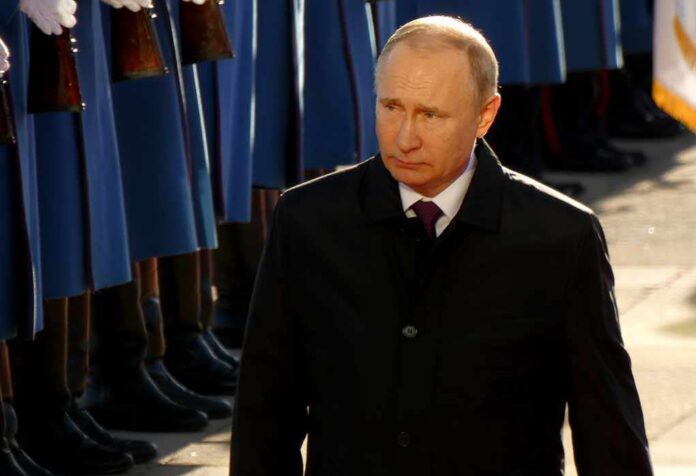
High-stakes diplomacy often turns on a single conversation; in Stephen Hubbard’s case, a direct ask from President Trump to Vladimir Putin preceded Russia’s decision to free a long-detained American without a declared prisoner swap, illustrating how leader-to-leader engagement can sometimes unlock outcomes that formal channels struggle to deliver.
At a Glance
- Russia released American citizen Stephen Hubbard after President Trump said he asked Vladimir Putin to free him during a call the prior week.
- Trump asserted there was no prisoner exchange and “no swap” was required to secure Hubbard’s return.
- The release surfaced publicly alongside a meeting in St. Petersburg between Putin and U.S. special envoy Steve Witkoff; Witkoff thanked Putin for the decision.
- Hubbard returned to the United States and met with President Trump at the White House after landing.
What Happened and Why It Matters
Stephen Hubbard, an American teacher serving a seven-year sentence in Russia after prosecutors accused him of working with Ukraine as a mercenary—a charge he denied—was released by Russian authorities and returned to the United States. President Trump publicly attributed the outcome to a direct request he made to Russian President Vladimir Putin in a phone call the week prior, and he emphasized that the United States did not trade prisoners or make a formal “swap” to secure Hubbard’s freedom. The sequence underscores a recurring fact in detainee diplomacy: when national leaders decide to intervene personally, outcomes can shift quickly, sometimes outside the choreography of standard negotiation tracks.
The timing and theater of public diplomacy added texture. Hubbard’s release was announced during a meeting between Putin and U.S. special envoy Steve Witkoff in St. Petersburg, where Witkoff explicitly thanked Putin for the action. After returning home, Hubbard visited the White House; Trump met him in the Oval Office and framed the case as a personal priority—“He was somebody I wanted to get back”—linking the individual relief to a broader commitment to pursue releases of Americans still held abroad.
How the Channels Worked: Leader Calls, Envoys, and Public Signaling
Mechanically, releases like Hubbard’s tend to move through three concentric channels. First is the head-of-state lane, where a single, unambiguous ask—paired with whatever relationship capital exists—can clarify intent and compress timelines. Trump described precisely that: a direct request on a recent call followed by an agreement from Putin and swift execution on the Russian side. Second is the envoy lane, where a trusted intermediary can be physically present to translate high-level assent into operational steps and provide a stage for reciprocal public messaging; Witkoff’s appearance with Putin performed both functions, including a visible thank-you that reinforced Russia’s sovereign decision to act. Third is the domestic lane, where a White House meeting validates the government’s role and signals to other detainees’ families that their cases have a path to the Resolute Desk.
The absence of a declared exchange is material. Washington has at times traded high-value Russian prisoners for Americans—including the 2022 Brittney Griner–Viktor Bout swap and the complex August 2024 multilateral exchange that returned multiple Western detainees—so a unilateral release is strategically distinct. Trump’s assertion that no swap was needed places Hubbard’s case in the narrower category of discretionary releases, where a counterpart decides to grant a request without extracting a matching custody concession.
What Russia Alleged, What the Family Said, What Was Resolved
Russian prosecutors accused Hubbard of acting as a mercenary supporting Ukraine; reports note that he denied the allegation, and NBC characterized him as a retired teacher who maintained his innocence throughout. His family described the human toll after detention and during transit, including profound exhaustion following release. What the release does resolve is simple but consequential: an American who had been sentenced under Russian criminal law is no longer in Russian custody. What it does not attempt to adjudicate is culpability; this was a diplomatic outcome, not a legal reversal of the charges in a Russian court. That distinction is common in detainee cases, where the aim is repatriation, not a foreign judiciary’s doctrinal correction.
How This Fits the Broader Pattern of Detainee Diplomacy
Hubbard’s return aligns with a well-established, if unwelcome, reality: adversarial states sometimes detain foreign nationals to accumulate leverage, then monetize that leverage in negotiations that may be explicit exchanges or softer concessions. The United States has in recent years secured releases via one-for-one swaps, multilateral packages spanning several jurisdictions, and occasional unilateral gestures. The August 2024 exchange—one of the largest since the Cold War—illustrated the multilateral variant; the Griner-for-Bout deal exemplified a one-for-one trade. Each approach carries trade-offs. Swaps can bring multiple Americans home but risk reinforcing the incentives to seize them; unilateral releases spare Washington the optics of trading but rest on a leader’s willingness to say yes without compensation, a rarer event.
In that landscape, the Hubbard case shows the utility of multiple tools deployed in concert: the principal-to-principal request; a credible envoy with access and a public platform; and a domestic close that elevates the case’s salience. It also underscores why administrations talk about wrongfully detained Americans as an enduring mission rather than a one-off: even successful releases leave others behind, and each case can require a different configuration of leverage and relationship management.
The No-Swap Claim and the Sanctions Question
Trump drew a sharp line around the nature of the price paid, asserting there was no swap and “we gave nothing in exchange.” Reporting on the episode captured that claim while also noting that the White House decision to halt new sanctions on Russia was part of the diplomatic backdrop being discussed as the release unfolded. That distinction matters. In the grammar of hostage negotiations, a prisoner-for-prisoner trade is different from a policy de-escalation, even if both can be viewed as concessions. Here, the public record supports the narrow point Trump emphasized: there was no announced prisoner exchange to secure Hubbard’s return.
President Trump Slams Calls to Sanction Moscow During Meeting With Freed American#donaldtrump #russia #sanctions #moscow pic.twitter.com/mm4yXkum0l
— M World (@themworldnews) October 30, 2026
Implications for Americans Still Detained Abroad
Two takeaways travel beyond this one case. First, leader engagement remains a powerful—if scarce—resource. When a president is willing to personally ask and a counterpart is willing to personally grant, the bureaucratic friction that slows casework can disappear overnight. Second, the menu of tools is broader than swaps alone. Families should press for high-level attention and creative channel use, knowing that the most effective approach for their loved one may differ from the last headline deal. The Hubbard outcome shows that even amid a climate shaped by large exchange packages and hard bargaining, there is still space for a discretionary yes—especially when the request is clear, timely, and carries political upside on both sides of the line.
Sources:
facebook.com, cbsnews.com, yahoo.com, apnews.com, nationpress.com, thehill.com, iheart.com
© featurednews.com 2026. All rights reserved.