When political passions spill into physical contact at a polling place, the breach is more than a lapse in civility; it is a violation of the bright-line norm that protects the franchise, the volunteers who sustain it, and the public’s confidence in both.
At a Glance
- A video shared by a New Hampshire mayor and amplified by news outlets shows a heated exchange outside a Laconia polling site culminating in an apparent backhand slap of an 18-year-old Turning Point Action participant.
- Laconia police opened an investigation into an alleged assault at the Woodland Heights School polling location; no charges were reported at that time.
- New Hampshire’s Secretary of State condemned assaults at polling places and confirmed he had spoken with the young activist minutes before the incident.
- Both county Republican and Democratic organizations condemned the conduct, signaling cross-partisan rejection of violence near the polls.
What the video shows and what authorities are doing
The public record begins with a contemporaneous video that captures the arc of a confrontation outside Woodland Heights School in Laconia: an older man arguing animatedly, raising his middle finger, and then delivering what appears to be a backhand to the face of a Turning Point Action participant. Local television and national digital outlets described the same sequence from the clip, which was shared by Laconia’s mayor and circulated widely on social platforms. Police treated the episode as a potential crime scene rather than a viral curiosity, confirming an investigation into an alleged assault at the polling location; at that point, no charges had been filed, a procedural status that often reflects routine evidence-gathering rather than exoneration or doubt.
The young man at the center of the clip was consistently described as an 18-year-old participating with Turning Point Action. The state’s chief elections official, Secretary of State David Scanlan, added weight to the factual spine: he had spoken with the young activist just minutes beforehand and later received an alert about the incident. He stated plainly that there is no place for assaults at polling places—an institutional rebuke that matters because it frames the conduct as an attack on the polling environment itself, not merely hot-headed bickering between private citizens.
How this fits the way election spaces are supposed to work
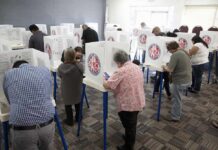
Polling places are designed as high-friction spaces made orderly by hard rules: electioneering boundaries, defined roles for officials, and law enforcement ready to respond if speech becomes intimidation or violence. Campaign advocates and issue volunteers can operate outside the buffer lines, engage voters, and press their case—but they cannot touch, obstruct, or threaten. When someone crosses into physical contact, the problem is not semantic (“slap,” “backhand,” “assault”); it is categorical. The law distinguishes protected persuasion from unlawful force for a reason: voters deserve to approach, enter, and exit the polls without the ambient fear that arguments could turn into blows.
Institutions closest to the scene responded accordingly. The Belknap County Republican Committee decried the older man’s shift from verbal sparring to a “violent act,” while local reporting noted that county Democrats also condemned the behavior, signaling consensus around the norm that violence near the polls is intolerable regardless of partisan loyalties. Cross-partisan condemnation is not window dressing; it is the mechanism by which communities keep election rules culture-wide rather than faction-specific.
The limits of the clip—and why they don’t blunt the core facts
As with nearly every public confrontation caught on a phone, the recording does not present the entire prelude or aftermath. The names of the two principals were not immediately public, and police had not yet filed a charging document when the initial reports ran. Those are ordinary features of an active local investigation, not gaps that relocate the burden to the victim or the public to prove what the camera already depicts: an argument escalating into a strike. The footage’s central sequence—verbal confrontation, obscene gesture, backhand to the face—anchors the event in observable behavior that authorities can corroborate with witness statements and, if available, additional video.
The underlying dispute—statistics cited, who said what first—is ultimately peripheral to the legal question. Contentious speech outside a polling place is common and protected; physical contact is not. That is why best practice for political organizations is to train volunteers on de-escalation, space, and disengagement thresholds, and why police routinely emphasize that anyone feeling threatened should step away and call for assistance. Those operational habits, not rhetorical sparring skill, are what keep a campaign day from turning into a criminal case.
Why the setting matters more than the labels
Some outlets framed the older man as an “angry voter” or “liberal,” others cast the young participant as a “conservative activist,” and the clip’s rapid circulation invited all the usual tribal shortcuts. Strip away the adjectives and the category remains the same: physical contact near a live polling site, aimed at a clearly identified political participant. That is disqualifying conduct, full stop. It is telling that the most relevant public authority here—the Secretary of State—did not parse ideology. He defended the integrity of the polling space and the people working in it, and he did so without hedging.
This emphasis on place over partisanship is sound governance. The social contract inside the election perimeter is not negotiated anew each cycle; it is a standing rule that keeps elections legitimate. Whether the target is a Turning Point staffer, a union canvasser, or a local party volunteer, the same boundary applies: you can argue firmly; you cannot strike.
Connecting a local incident to a national pattern
Since 2020, the background radiation around American elections has become more hostile. Surveys of local election officials—distinct from campaign advocates but central to the election ecosystem—show that 38 percent report threats, harassment, or abuse tied to their work, and more than half worry about colleagues’ safety. Those data do not establish a national rate for assaults on campaign or advocacy workers; the populations differ. But they do capture the atmosphere that surrounds polling places: heightened mistrust, lower inhibitions, and a more porous line between argument and menace.
Communities can counter that drift with simple, durable practices. Election administrators and local parties should align on clear signage and staging that keep advocates visible but separate from voter flow. Campaigns should equip young volunteers—especially first-timers—with escalation checklists, reporting protocols, and a bias for stepping back rather than “winning” a curbside debate. Police should treat calls from polling perimeters as priority responses not because they foretell catastrophe, but because quick presence restores the understood rules of the space. Those measures are not cosmetic; they are how a jurisdiction makes the next smartphone clip less likely.
The bottom line
The Laconia video captures a bright-line breach: a heated exchange becomes a strike against an 18-year-old political participant outside an active polling site. Police opened an investigation; the state’s top election official condemned the conduct; and county organizations across the aisle rejected it without qualification. That is the system working as designed. Elections can survive sharp words and passionate argument. What they cannot normalize—anywhere near the polls—is a hand to the face.
Sources:
mediaite.com, wmur.com, ground.news, dailymail.com, the-express.com
© featurednews.com 2026. All rights reserved.