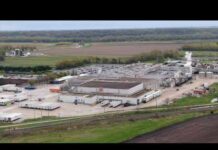
Operations don’t just rise or fall on tactics; they ride on the physics of the structures officers must traverse, and when those structures fail, the risk profile shifts in an instant from suspect-driven to environment-driven.
The Short Version
- A second-floor deck collapsed during a high-risk warrant operation in Huntsville, Missouri, injuring seven officers, including four Deputy U.S. Marshals.
- Body-worn camera video shows the wooden platform dropping almost straight down as the team staged to make contact.
- Authorities characterize the event as an unexpected structural failure during lawful warrant service; injuries were serious but not life-threatening.
- The incident underscores a recurring hazard in warrant work: building condition and load-bearing uncertainty can be as dangerous as armed resistance.
What Happened: A Structural Failure During a Warrant Operation
During a coordinated warrant service in Huntsville, Missouri, members of a task force—including Deputy U.S. Marshals and Randolph County deputies—assembled on an exterior second-floor deck to contact suspects. As the team stacked on the platform, the deck failed abruptly, dropping officers to the ground below. Local authorities reported seven injured, four of them Deputy U.S. Marshals, with none of the injuries life-threatening. Video reviewed by regional outlets captures the deck giving way “almost like a trap door,” a straight-down failure that afforded little reaction time.
Local reporting places the operation at a multi-unit apartment address and describes it as a high-risk warrant service tied to sex-offender registration enforcement. Two individuals were taken into custody immediately, with an additional arrest later the same day, according to interviews with task-force leadership and a sheriff’s office release summarized by ABC 17 News.
Mechanics of the Collapse: Why Decks Fail Under Dynamic Loads
Exterior decks are deceptively complex structural systems. They rely on the integrity of ledger attachments, joist hangers, posts, and guard connections—each an independent failure point when materials degrade or connections are compromised. A deck that appears serviceable in daily residential use can become overstressed when a compact team concentrates weight at a single span, shifts position in unison, or executes commands that create dynamic loading. In the bodycam footage described by multiple outlets, the platform does not peel off the structure; it drops nearly vertically. That pattern is consistent with connection failures at joist hangers or ledgers, or with a post/beam system that shears at multiple points simultaneously, leading to a near-synchronous collapse rather than a slow rotation off the wall.
Age, moisture intrusion, undersized fasteners, corrosion, or prior unpermitted modifications all increase risk. The operational reality is unforgiving: a stack of eight to nine armored officers, each carrying gear, can easily impose localized loads exceeding typical residential live-load design assumptions. OSHA’s structural-collapse guidance emphasizes how vibration, concentrated load, and secondary movements can precipitate a sudden failure once a system crosses a hidden threshold—a risk classically underestimated because the structure “looked fine” a moment earlier.
How Warrant Work Confronts Environmental Risk
Fugitive apprehension is often framed through the lens of armed confrontation, but the data are clear: structure operations carry a wide band of non-gunfire hazards, from falls to building failures. The U.S. Marshals Service’s recent incident reviews catalog not only shooting incidents but also non-gunshot injuries arising from structure entries and movements—reminders that the physical environment injures officers with numbing regularity and without malice or intent. The Huntsville collapse slots squarely into that pattern: the highest threat in that instant was not a suspect, but gravity acting on compromised wood and metal.
Teams counter environmental risk through pre-raid planning, reconnaissance, and route selection, but apartments, duplexes, and aging rentals insert uncertainty that is hard to eliminate. Even when aerial or street-level views are available, the state of fasteners, water ingress, or hidden rot is unknowable without invasive inspection. And in a warrant service, time, concealment, and control of the scene constrain options; the “safest” approach may still require using stairs, balconies, or landings that were built to minimum residential code decades earlier—if they were built to code at all.
Legal and Accountability Context: Damage, Injury, and the Law’s Carve-outs
When operations injure officers or damage property, the aftermath often turns on legal categories unfamiliar to lay observers. Courts have repeatedly distinguished damage incurred during lawful police activity from ordinary property damage; several federal circuits have held that necessary damage in the course of policing is not a compensable “taking” under the Fifth Amendment. The holdings vary in rationale and scope, but the through-line is consistent: operational necessity and public safety can displace what many would assume are straightforward property claims. Those doctrines don’t directly answer questions about structural negligence or code compliance, but they frame the territory in which any future disputes might be argued.
That legal backdrop matters here for two reasons. First, law enforcement’s exposure when an officer is injured by a structural failure is primarily occupational—managed through workers’ compensation and agency risk programs—rather than through third-party tort recoveries. Second, potential claims about premises safety or code enforcement sit in a different lane entirely, governed by state and local inspection regimes and landlord-tenant statutes. In short, the operational facts are clear; the accountability pathways, if pursued, would run through separate legal channels that routinely diverge from public expectation.
Operational Takeaways: Training, Load Discipline, and Approach Alternatives
The Huntsville incident reinforces several operational heuristics. Load discipline on marginal structures is not merely polite practice; it is risk control. Spreading personnel onto stairs, landings, and ground positions—accepting the trade-off with command and control—can reduce point loads that precipitate failure. Where feasible, contact teams can anchor from grade-level thresholds while containment elements cover upper egress points from safer standoff positions. None of these choices eliminates risk; they rebalance it. But in environments with visibly weathered decks, questionable fastener patterns, or makeshift repairs, the calculus should tilt toward load dispersion and alternative approach vectors.
The other durable lesson is recording and review. Body-worn camera video, which in this case captured the precise failure sequence, is more than a transparency tool; it is an engineering asset. Frame-by-frame review supports after-action analysis that can inform training modules on structural cues: spongy bounce, audible creaks at the ledger line, unusual deflection at rail posts, or diagonal cracks near joist ends. Incorporating those signatures into scenario-based training—alongside traditional firearms and room-clearing evolutions—elevates structural awareness to the same tier as ballistic threat recognition.
Stunning video shows a deck collapse underneath U.S. Marshals as the task force serves a warrant during a Missouri raid.
The Marshals were targeting a convicted sex offender wanted for failing to register as part of Operation Adam’s Watch.
The fugitive was taken into custody…
— Prince Olamilekan Ademarati (@AdemaratiOla) August 20, 2026
Why It Matters Beyond One Address
Warrant service will always entail uncertainty. Even as agencies refine intelligence pipelines and tactical doctrine, they remain hostage to the built environment they don’t control. The Huntsville deck collapse is a stark, visual reminder that the map is not the terrain: an operation greenlit on sound legal grounds and executed by seasoned personnel can still be ambushed by a compromised ledger board. For line officers, that argues for habits of mind—scan, disperse, test, re-route—that treat structures as potential adversaries. For agencies and policymakers, it argues for investment in training that blends tactics with structural literacy, and for interlocks with local code authorities where chronic hazards surface around repeat-offender addresses.
The bottom line is not complicated: risk in fugitive operations is multi-vector. On some days, bullets are the problem; on others, wood screws are. Treating the latter with the same disciplined attention as the former is how teams come home intact—and how scenes like Huntsville remain rare enough to shock when bodycam footage makes the rounds.
Sources:
facebook.com, youtube.com, krcgtv.com, reddit.com
© featurednews.com 2026. All rights reserved.