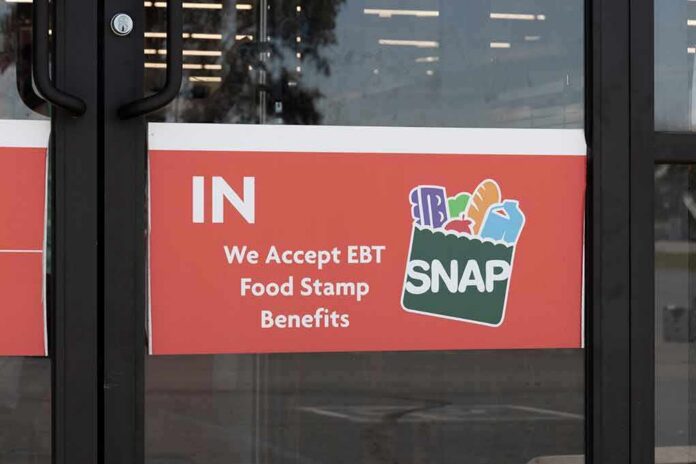
SNAP trafficking is not a vague policy worry; prosecutors say it can look like a cash-for-benefits exchange at a corner store, move through bulk purchases of resale goods, and add up to hundreds of thousands of dollars in diverted aid.
At a Glance
- Federal prosecutors charged Hollywood convenience store owner Al Amin with two conspiracies tied to unauthorized SNAP-benefit use and wire fraud.
- The government alleges a cash-for-EBT scheme: recipients sold card value for roughly half its face amount; conspirators allegedly used the cards to buy bulk goods.
- An undercover exchange cited in court materials allegedly moved about $64,388 in benefits for $29,474 in cash.
- The case sits within a broader federal push on SNAP integrity and a long-documented pattern of retailer-level trafficking.
What prosecutors allege happened, and why it matters
Federal prosecutors have charged Al Amin, owner of Kwik Stop 72 in Hollywood, with conspiring to traffic Supplemental Nutrition Assistance Program (SNAP) benefits and conspiring to commit wire fraud. According to the U.S. Attorney’s Office for the Southern District of Florida, the criminal complaint describes a scheme in which Amin and others allegedly bought Electronic Benefit Transfer (EBT) cards from SNAP recipients for approximately half of the cards’ available benefit amounts in cash, then used those balances to purchase bulk merchandise they could stock or resell. The government pegs the alleged diversion at more than $500,000, a figure that, if proven, would represent a substantial theft of nutrition aid intended for groceries for low-income households.
The complaint identifies a defined period—October 2023 through March 2026—and a business locus in Hollywood, Florida, providing specificity that distinguishes a criminal case from an administrative sanction. In a particularly concrete episode, investigators allegedly conducted an undercover exchange in which cards with about $64,388 in benefits were traded for $29,474 in cash. In the government’s telling, these are not bookkeeping anomalies; they are transactional proof-points of trafficking, which federal law treats as a felony conspiracy when done in concert and with intent to defraud.
The legal architecture: why these charges and these statutes
Prosecutors charged two conspiracies grounded in well-developed federal fraud law. First, a conspiracy involving the unauthorized acquisition or use of SNAP benefits, pled under 18 U.S.C. § 371, captures agreements to commit an offense against the United States—in this context, trafficking SNAP benefits. Second, a conspiracy to commit wire fraud under 18 U.S.C. § 1349 covers schemes to obtain money or property by false pretenses using interstate wires; EBT transactions, retailer redemptions, and payment networks provide the necessary jurisdictional hooks. This pairing is common in benefits cases: the first charge targets the program-specific trafficking conduct; the wire-fraud conspiracy anchors the broader deceit and use of electronic systems to monetize the proceeds.
The U.S. Attorney’s Office emphasized that Amin is charged, not convicted; guilt must be proven beyond a reasonable doubt. But the choice to proceed criminally, rather than solely through USDA’s administrative disqualification track, signals prosecutors’ view that the evidence shows deliberate, monetized misuse of public funds at a scale and with methods—undercover buys, bulk purchase pathways—commensurate with felony exposure.
How retailer-level SNAP trafficking typically works
Retailer trafficking has a recognizable pattern. Recipients facing cash constraints sell a portion of their EBT benefits to a willing intermediary—often a small store—at a steep discount, typically around fifty cents on the dollar. The store then seeks to convert those electronic balances into value: by swiping the cards for sham food sales and claiming reimbursement, by using the benefits to buy bulk goods at other retailers to stock shelves, or by reselling that merchandise to additional stores for cash. Each step converts a nutrition subsidy into fungible money, while leaving a digital trail in EBT systems and wholesale invoices that investigators can reconstruct.
USDA’s series of trafficking studies across decades describes this pattern consistently and quantifies it at a national level. The 2015–2017 study estimated about 1.6% of SNAP benefits were trafficked annually, roughly $1.27 billion at the time; it also found that smaller stores account for a disproportionate share of violations compared with larger supermarkets. GAO has cautioned that while the order of magnitude is clear—around a billion dollars a year—the true scope likely ranges wider given measurement limitations. These aggregate figures neither prove nor disprove any one case, but they help explain why federal authorities invest in undercover buys, data analytics, and joint task forces to pursue retailer schemes.
The Hollywood case within a larger enforcement push
The South Florida charges arrive alongside a DOJ–USDA emphasis on SNAP integrity in the region, including a pilot initiative geared to trafficking detection and prosecution. Local reporting has placed the Amin complaint within that effort, which often pairs criminal cases with outreach to remind recipients and retailers that cash-for-benefits exchanges violate law and jeopardize program access. Enforcement typically combines three pillars: undercover operations to validate the modus operandi; EBT transaction analysis to spot irregular redemption patterns; and financial or inventory records to show where the benefits went after the initial exchange.
In this matter, the government’s narrative tracks that triad: a defined store and time window, an undercover transaction with precise dollar figures, and an alleged merchandise pathway—bulk purchases used to stock Amin’s store and resold to other owners. Those specifics, if backed by recordings, EBT histories, and invoices, are the elements that translate a statistic about national trafficking into a prosecutable, local fraud.
Consequences if the allegations are proven
Conspiracy to traffic SNAP benefits carries up to five years in prison; wire-fraud conspiracy carries up to twenty. Sentencing, however, turns on the U.S. Sentencing Guidelines and evidence-driven calculations of loss amount, number of victims, use of sophisticated means, and the defendant’s role in the scheme. Restitution to the government is standard in benefits fraud cases, and administrative penalties—store disqualification from SNAP, civil monetary penalties—often accompany or follow criminal resolutions. For other retailers, the case is a caution: EBT audit anomalies that once triggered only administrative reviews can become criminal exposure when evidence shows coordinated discount-for-cash exchanges and monetization through bulk purchasing.
For the program itself, cases like this serve two functions. They protect taxpayer dollars by extracting ill-gotten gains from the system, and they protect the program’s legitimacy among the public by demonstrating that subsidies intended for groceries are not a permissive cash alternative. The risk, always, is conflation: using a vivid local prosecution to generalize about the entire caseload. The evidence says both things are true at once—trafficking is real and costly, and the vast majority of benefits are redeemed as intended.
Hollywood Convenience Store Owner Charged in Alleged $500,000 SNAP Fraud Scheme https://t.co/ouy3SvlSyl
— 🌺🌿kam🌿🌺 (@pjkate) November 2, 2026
What to watch next
Early case stages move quickly: a complaint can be followed by an indictment that refines charges; detention, discovery, and plea negotiations follow. If the matter proceeds, expect litigation over the scope and admissibility of undercover evidence, EBT data analyses, and any cooperator testimony. For readers who follow SNAP policy, track parallel developments in USDA’s retailer monitoring and DOJ’s regional initiatives; enforcement strategies tend to proliferate when a pilot yields prosecutable files, and small-store participation rules can tighten accordingly.
Sources:
townhall.com, justice.gov, cbsnews.com, sun-sentinel.com, storage.courtlistener.com, cubitanow.com
© featurednews.com 2026. All rights reserved.