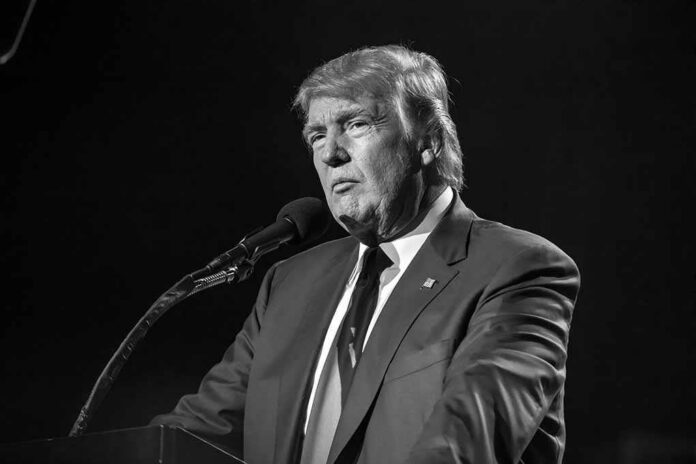
Anthony Constantino’s path to Congress ran directly through Donald Trump’s endorsement, and it ran against the wishes of much of his own party’s establishment — a combination that makes New York’s 21st Congressional District one of the clearest test cases in recent memory for what a presidential endorsement can and cannot buy.
Key Points
- Anthony Constantino, CEO of Sticker Mule, won the Republican primary for NY-21 with roughly 59% of the vote over Robert Smullen, who had the backing of the state party apparatus
- Trump endorsed Constantino by video, calling him “a very good friend of mine” with “my complete and total confidence”
- Constantino led Democrat Blake Gendebien in unofficial general-election returns, with preliminary margins reported between roughly two and four points depending on the outlet and the hour
- Gendebien acknowledged Constantino appeared likely to win while the race awaited a full count and an Associated Press call
- Research on Trump endorsements nationally shows a consistent primary-election boost but little to no benefit — and sometimes a modest penalty — in general elections
A Decisive Primary, an Establishment Rebuffed
Constantino’s nomination was never in doubt by the time votes were counted. NBC News projected him the winner of the Republican primary with 26,608 votes, 59.2% of the total, against Robert Smullen’s 18,075 votes, or 40.2%, with nearly all expected returns tabulated. The New York Times’ independent tally told the same story almost to the decimal point: 59.2% to 40.3%. That is not a nail-biter; it is a rout, and it came despite Smullen entering the race with institutional advantages Constantino lacked.
What made the primary notable was not just the margin but who was on which side of it. City & State reported that the state Republican Party, numerous county committees, and the state’s sitting Republican congressional delegation lined up behind Smullen, while Trump backed Constantino. A first-time candidate and sticker-and-label company founder outpolling the organized party’s chosen successor to Elise Stefanik’s old seat is the kind of result that reshapes how local operatives think about where real power in the party resides.
The Endorsement Itself
Trump’s intervention was explicit, not a wink-and-nod affair. On October 29, he released a video declaring, “I’m asking you to get out and vote for a very good friend of mine, Anthony Constantino, to be your next Congressman for New York’s 21st district. He has my complete and total confidence”. Language like “complete and total confidence” has become a recognizable marker in Trump’s endorsement vocabulary — a phrase he has deployed across hundreds of primary contests since 2018, and one that local Republican voters have learned to treat as a genuine signal of priority rather than boilerplate.
The General Election: A Narrower, Still-Unfolding Picture
The general-election contest against Democrat Blake Gendebien proved far tighter than the primary. WAMC reported Constantino leading 49% to 47% in unofficial returns, while City & State’s preliminary state Board of Elections figures, with all election districts reporting, showed roughly 51% to 48.8%. WRVO’s count landed near 51% to 49%. These are not contradictory accounts of different elections — they are snapshots taken at different points in a count still absorbing late rural precincts, absentee ballots, and affidavit ballots, which is precisely why early-outlet margins in close races routinely drift by a point or two before settling.
Gendebien’s own public comments reflected that trajectory. He told reporters, “it appears Anthony Constantino will narrowly win”, a concession of the apparent outcome even as he declined to formally concede the race while ballots were still being processed. Spectrum News noted the Associated Press had not yet called the contest at the time Constantino declared victory. None of that undercuts the substance of what the returns showed; it reflects the normal mechanics of American vote-counting, in which a candidate can hold a clear and probably decisive lead well before a canvass is finalized.
Why Endorsements Travel Differently in Primaries Than in General Elections
NY-21 fits a pattern political scientists have documented repeatedly over the past three Trump-endorsement cycles. A peer-reviewed assessment of Trump endorsements from 2018 through 2022 found a “consistent and substantial” boost for endorsed candidates in Republican primaries, with that advantage growing modestly over successive cycles. The same body of research found essentially no comparable lift in general elections — and in some specifications, an aggregate general-election vote-share penalty of roughly 1.5 points, attributable to the way a Trump endorsement can simultaneously energize the Republican base and galvanize opposition turnout. Other analyses of 2022 primaries estimated the average endorsement effect at roughly 16 percentage points once other candidate and contest characteristics were accounted for — a scale of impact plausibly consistent with what Constantino’s camp experienced against Smullen.
The mechanism behind this asymmetry is straightforward. In a primary, where the electorate is drawn almost entirely from one party’s registered or likely voters, an endorsement functions as a high-trust heuristic — a shortcut that tells base voters who the national party’s most influential figure wants them to choose, in a contest where candidates otherwise look similar on policy. In a general election, the electorate widens to include independents and opposition partisans for whom the same signal can cut the opposite way, hardening resistance rather than building support. That dynamic explains why Constantino’s primary margin over Smullen was commanding while his general-election lead over Gendebien was measured in single digits.
What the Outcome Signals Going Forward
For Republican strategists eyeing future open seats, NY-21 reinforces a lesson already visible in the data: a presidential endorsement remains close to decisive in deciding who wins a contested primary, even against a party apparatus pulling in the opposite direction, but it buys far less certainty once the race opens up to the full electorate. Constantino’s campaign also leaned on resources beyond the endorsement — campaign finance reporting indicated he significantly outspent Smullen in the primary — a reminder that endorsements rarely operate in isolation from money, name recognition, and local organizing. The seat’s path to full resolution now runs through the ordinary machinery of county canvassing and certification, the same process every close American election eventually completes.
Sources:
thegatewaypundit.com, nbcnews.com, nytimes.com, freep.com, wamc.org, wrvo.org, cityandstateny.com, spectrumlocalnews.com, cambridge.org, elonnewsnetwork.com, dare.uva.nl
I want to thank Mr. Thomas Lester in Ilion for this very well-written and important letter to the editor that was published in the Rome Sentinel. I hope everybody reads it!
—
Democrats Coddle Criminals, Oppose Tax Cuts
A self-described lifelong conservative Republican urges us… pic.twitter.com/DT1xgzCpmn— Anthony Constantino (@constantino) October 29, 2026
© featurednews.com 2026. All rights reserved.