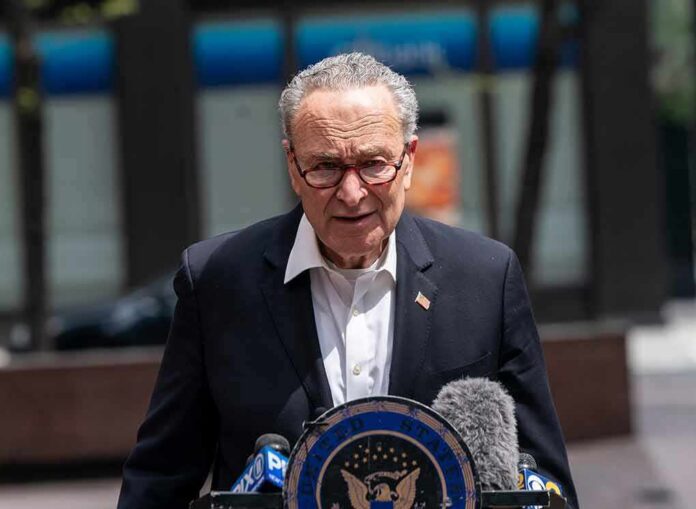
Leadership fights in the Senate are rarely about personalities alone; they are stress tests of a caucus’s theory of how to wield power, sharpen priorities, and translate an election result into governing leverage.
At a Glance
- Sen. Chris Van Hollen converted grumbling about direction into a formal bid to unseat Sen. Chuck Schumer as Democratic leader after a strong midterm showing, arguing voters signaled demand for change.
- Schumer counters that the majority’s size is evidence to stay the course and says he has the votes to remain leader; several senators publicly back him.
- The dispute crystallizes a real policy split—especially on U.S. support for Israel’s war in Gaza—alongside a push from some Democrats for a first-100-days governing plan.
- Historically, Senate leadership challenges are possible but uncommon and usually unsuccessful; incumbency, relationships, and vote-counting prowess are decisive.
What the challenge is really about: mandate, method, and message
Van Hollen’s move matters because he took a critique of strategy and turned it into a ballot. He is not merely signaling discomfort with the status quo; he is organizing around the claim that Democratic gains amount to a governing mandate that should be expressed through new leadership, tone, and priorities. He framed his case explicitly as answering voter demand after the midterms and put himself forward to lead the majority, not as a protest candidate but as an alternative with a distinct policy emphasis, including conditioning U.S. weapons to Israel and a sharper break from the administration’s Gaza posture. In a chamber where power is aggregated in the leader’s office, a leadership contest is the most direct way to test whether colleagues agree.
Schumer’s answer is equally clear and, in caucus politics, potent: results. He points to the Democrats’ 55-seat outcome as validation of his stewardship and says plainly that he has the votes to remain leader, pledging to use the expanded majority to “deliver for the American people”. Several colleagues have already gone on record for him, creating a visible spine of support while the rest of the caucus keeps its counsel before a secret-ballot vote. This is the first essential reality of leadership battles: numbers—first in the electorate, then in the room—are both argument and outcome.
How the mechanism works: secret ballots, simple majorities, and the power of relationships
Senate party leadership is selected by the party caucus on a simple-majority basis in a closed-door, secret-ballot election. There is no seniority guarantee and no public roll call; it is coalition-building of the most unglamorous, methodical sort. The calendar typically places these elections in early December, and while public endorsements can shape momentum, they do not bind votes when senators enter the room. That opacity is not a quirk—it is a feature that protects members from outside pressure and allows deals, assurances, and future commitments to matter as much as public statements.
In that environment, two asymmetries usually favor incumbents. First, the leader’s office is the clearinghouse for member priorities—floor time, committee agendas, campaign support—creating reservoirs of goodwill and IOUs that endure beyond any one vote. Second, proven procedural competence is a currency of its own. Schumer’s public defenders have leaned on that logic: that experience counting votes and sequencing the calendar is its own qualification, especially with more seats to manage and a heavier docket. Those are not platitudes in the Senate; they are job requirements.
Where the substantive disagreement lies
The most visible policy fracture is over Israel and Gaza. Van Hollen has pressed to restrict or condition certain weapons shipments, arguing civilian protection must be built into U.S. support; that stance distinguishes him from Schumer and from Democrats who favor fewer strings on aid. It is a real, high-salience divide with implications for authorizations, appropriations, and executive-branch leverage. But a leader’s portfolio is much larger. Some senators—particularly newer members—have also demanded that any would-be leader publish a concrete first-100-days program with cost-of-living legislation, oversight priorities, and a communications strategy that resonates beyond safe-blue terrain. Their message is procedural and directional: show the plan, then earn the gavel.
Schumer’s reply has been to center the scale of the win and to promise an aggressive governing push using the enlarged majority—a promise several colleagues have validated publicly. Independent Sen. Angus King framed the case for continuity memorably: “Why would you fire the manager when you just won the World Series?”—a concise way of saying that tactical disagreements should not overwhelm a strategic assessment of competence and recent performance. That argument gains force when visible members line up behind the incumbent; Sens. Sheldon Whitehouse, Kirsten Gillibrand, and Ruben Gallego have done so.
Claims of support and what they do—and don’t—prove
Van Hollen has said privately tallied backers number into double digits, suggesting a challenge with real ballast. But until senators attach their names or the ballots are counted, those numbers remain unverified signals rather than evidence. Conversely, Schumer’s claim that he “has the votes” is also a pre-vote assertion—anchored by incumbency and public endorsements, but resolved only at the caucus meeting. In leadership races, pre-count messaging is part persuasion, part deterrence; projecting inevitability can be as important as demonstrating momentum. The only hard checkpoint is the ballot.
This dynamic is why challengers who succeed tend to do so with two assets: a clearly differentiated governing program that reassures skeptics across ideological factions, and a painstaking member-by-member whip operation that locks in commitments despite the pull of the status quo. Van Hollen has a salient policy distinction and an electoral rationale; what remains to be demonstrated is a comprehensive governing plan and a coalition that trusts him to run the floor, manage committees, and protect swing-state members while delivering for progressives. Until that package is visible and validated, the advantage rests with the known quantity.
Chuck Schumer leadership in peril in Senate shakeup.🐍✨
Can Chris Van Hollen Dethrone Chuck Schumer?
Democratic socialists want a new face to represent them. Chris Van Hollen is running on “new leadership”.
The same guy who flew to El Salvador and sat down for drinks with… pic.twitter.com/9VwJ2AF2AE
— Tosca Austen (@ToscaAusten) November 13, 2026
Historical pattern: rare, possible, and usually decided by perceived effectiveness
The Senate’s own historical accounts describe leadership contests as institutionally available but infrequent and, at the top rung, seldom successful. Over the twentieth century the chamber moved from seniority norms toward selecting leaders for their ability to organize and direct a conference—vote counting, scheduling, negotiation—rather than mere tenure. When leadership changes have occurred via intra-party challenge, they have often turned on colleagues’ judgments about operational effectiveness more than ideology. That history explains why incumbents with recent wins and visible mastery of procedure tend to survive challenges; it also explains how a challenger can break through if peers conclude the incumbent’s tactical model no longer fits the moment.
What this means for governing, whichever way it breaks
If Schumer retains the post, expect him to argue that the majority’s size is a license to move on cost-of-living legislation, judicial confirmations, and selective oversight using familiar tools, while calibrating foreign-policy dissent within the caucus. Should Van Hollen prevail, the early test will be operational: presenting, then executing, a program that knits together progressives’ appetite for sharper breaks—on Gaza policy and beyond—with the protection of members in competitive states. Either way, the caucus is signaling what it wants from its leader: not slogans, but a plan precise enough to measure.
Sources:
facebook.com, cbsnews.com, abcnews.com, nbcnewyork.com, ksbw.com, newsday.com, yahoo.com
© featurednews.com 2026. All rights reserved.