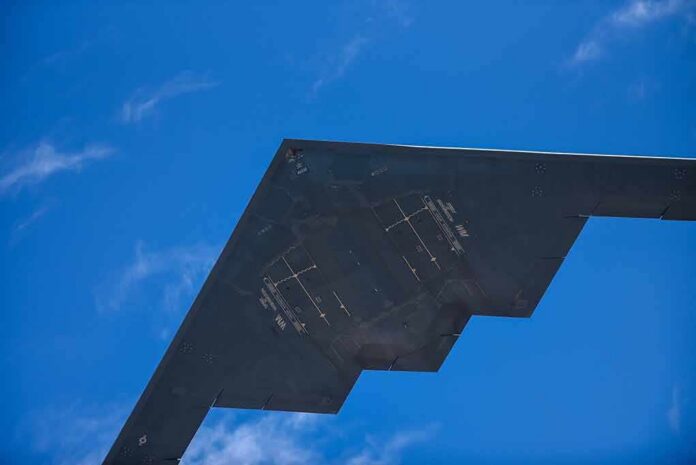
A single safe, clean weapons release in developmental test is not the finish line for a bomber program; it is the inflection point where an airframe stops being a science project and starts proving it can fight.
At a Glance
- The B-21 Raider released a conventional weapon during a test flight from Edwards Air Force Base, demonstrating airborne weapons-release capability.
- The Air Force framed the event as transitioning the Raider from flight test to a functional weapons platform.
- Program officials linked the result to validation of digital models and the maturity of the aircraft’s open-systems architecture.
- Thousands of hours of digital-twin simulations reportedly preceded the drop to accelerate integration and predict weapon trajectory.
- A second B-21 test aircraft enabled the program to expand from basic flight envelope work into mission-systems and weapons-integration testing.
What just advanced: from flying reliably to releasing a weapon on command
The B-21’s first publicized weapons release from Edwards AFB marks the classic crossover in bomber development: mastering the jet as an airplane, then proving it as a weapon system. The Air Force stated plainly that a Raider test aircraft “released a conventional weapon” during the event and characterized the milestone as a transition “from flight test to a functional weapons platform”. That assertion matters because weapons release is the first hard coupling among airframe, stores management, software, and separation dynamics. It is where a stealth bomber’s tightly managed signatures must coexist with the messy physics of opening bays, ejecting mass, and keeping both aircraft and weapon on commanded trajectories.
Northrop Grumman, the B-21’s prime contractor, separately described the flight as a demonstration of weapons-release capability and tied it to the bomber’s design premise: an adaptable platform built to integrate new weapons and effects over time. In developmental test, one clean, controlled release is the opening gate. Many remain ahead—multiple weapons, mixed loads, environmental corners, and mission-system interplay—but the program has stepped through the first one confidently.
How it works: separation dynamics, software timing, and the “digital-first” claim
Safe release from an internal bay is a choreography problem. Doors must open within a narrow timing window to minimize radar and infrared exposure; the ejector system must impart the correct forces so the store clears cleanly without recontact; aircraft flight-control laws may cue small attitude changes to manage airflow in the bay; and the weapon’s own guidance (if active) must start reliably without interference. For a low-observable aircraft, even the door actuation profile and the weapon’s transient plume signature matter. Demonstrating that this chain executed as planned is the heart of what the Air Force just confirmed.
Program officials also linked the result to a heavy up-front investment in modeling. By their account, the B-21 team used thousands of hours of digital-twin simulation before the flight, both to accelerate integration and to predict and refine weapon trajectory, then used the flight to “validate its digital models and the maturity of its open systems architecture”. Digital engineering—authoritative models spanning design, test, and sustainment—has become a central DOD strategy to compress schedules and reduce surprise. It is not magic; its value shows when a predicted behavior matches telemetry closely enough that test cards can advance with fewer incremental flights. The Air Force’s language indicates that is what happened here.
Why this milestone fits the normal test-to-fight progression
Developmental testing verifies that subsystems and integrations work as designed; operational testing later judges whether the total system is effective and suitable under realistic conditions. That deliberate separation exists to prevent early, clean demonstrations from being over-read as warfighting proof. The Edwards release sits squarely in developmental test. It confirms the B-21 can carry and release at least one conventional store as planned, with the program crediting its model-based approach and open architecture for reaching that point efficiently.
This is also when a bomber program usually widens its aperture. The arrival of a second test aircraft expanded the 412th Test Wing’s capacity to move beyond basic flight-envelope and propulsion assessments into mission systems and weapons integration—a prerequisite to the drop reported here. Multiple aircraft mean parallel test cards, more instrumentation permutations, and the ability to isolate variables across sorties. It is how programs gain data density without compromising safety or schedule.
What we still don’t know—and why that is normal at this stage
The Air Force disclosed only that the weapon was conventional; it did not identify the store, release mode, guidance status, or impact result. For an advanced bomber in developmental test, that level of public detail is typical. The claim being made is specific and bounded: the aircraft executed a commanded release safely, as designed, and the behavior aligned with its digital models and open-architecture intent. Later in the campaign, one expects a matrix of releases across altitudes, speeds, bay configurations, and weapon classes, with operational testing eventually addressing accuracy, lethality, reliability, and survivability in representative conditions. The program’s framing—transitioning to a “functional weapons platform”—tracks that arc: function proven, operational sufficiency to come.
Independent oversight will pressure-test those broader claims in due course. GAO and test community guidance emphasize the distinction between early technical validation and demonstrated operational effectiveness—especially for complex systems built around modular open systems design and model-based engineering. For now, the data point is clear and valuable: the Raider has moved from carriage and captive-carry work to live separation, an indispensable prerequisite for everything that follows.
The B-21 Raider has completed its first conventional weapons-release test, marking a major milestone for America's next-generation stealth bomber ahead of its planned operational debut in 2027. pic.twitter.com/sbkWydTRRU
— Aviation Geeks (@aviationgeeks1) November 13, 2026
Why digital engineering and open architecture are the real story underneath the drop
Stealth bombers are not fielded to a frozen specification; they are fielded to outpace an adversary’s countermeasures over decades. That demands an architecture that can accept new weapons, sensors, and electronic effects without invasive rework. The Air Force’s emphasis on open-systems maturity and model validation at this juncture is not rhetorical flourish—it signals what the service is buying as much as the airframe itself: integration velocity and predictability. Programs across the department are pursuing digital engineering to shorten integration cycles and raise first-pass yield in flight test; when a complex release sequence works on the first publicized attempt and matches modeled expectations, it is an existence proof for that approach paying off in practice.
What to watch next: breadth, repeatability, and mission-system interplay
Three threads will define whether this milestone becomes momentum. First, breadth: additional releases across different conventional weapons and more stressing corners of the envelope. Second, repeatability: consistent performance across aircraft, loads, and environmental conditions that builds statistical confidence and clears the path for operational testing. Third, mission-system interplay: demonstrating that targeting, navigation, communications, and defensive management cooperate with weapons employment without eroding the B-21’s low-observable advantages.
The test force now has the capacity—thanks to multiple aircraft and a maturing systems bench—to run that campaign at tempo. Each subsequent data point, particularly those that map closely to preflight models, will compound confidence in both the bomber and the development discipline behind it. The Raider’s first drop at Edwards is therefore more than a discrete event; it is a statement about the program’s trajectory. An aircraft that can release on command is a weapon system in motion. The rest of the work will determine how quickly it becomes a weapon system ready for war.
Sources:
defensedaily.com, edwards.af.mil, aviationweek.com, usnews.com, news.northropgrumman.com, defensepresswire.com, wpafb.af.mil
© featurednews.com 2026. All rights reserved.