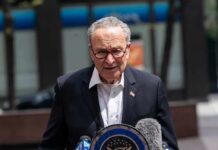
The margin of Steve Hilton’s loss to Xavier Becerra in California’s 2026 governor’s race was not ambiguous; what follows from that defeat is the real story, and Hilton has already tried to convert a decisive setback into a multi-cycle plan to rebuild Republican competitiveness in the nation’s largest state.
At a Glance
- Hilton conceded clearly and positioned the race as the opening chapter of a longer “people-powered” effort.
- Certified county returns and major outlets’ statewide tallies show a decisive defeat for Hilton and a comfortable win for Becerra.
- Hilton says he campaigned in all 58 counties and set explicit goals: break Democrats’ supermajority by 2028, elect a GOP governor by 2030.
- Claims that Democrats outspent him 20-to-1 and that his support was mostly small-dollar are assertions that require finance records to validate.
What Happened: A Clear Result, A Forward-Looking Concession
Steve Hilton lost the 2026 California governor’s race to incumbent Xavier Becerra by a wide margin. County certification in San Bernardino, for example, recorded Becerra at 57.95% to Hilton’s 42.05% with all precincts reporting, while statewide tracking by major outlets placed Becerra near 65.6% and Hilton at roughly 34.4%. Hilton’s election-night message did not challenge the outcome. Instead, he acknowledged defeat and argued that the campaign built the scaffolding of a longer project, casting the effort as a grassroots “people-powered movement” aimed at clawing back legislative seats and, eventually, the governorship.
That framing matters. Concessions that pivot quickly to the next contest often signal whether a campaign intends to vanish with the vote count or to invest in organization, recruitment, and message refinement between cycles. Hilton’s speech emphasized statewide reach—he says he visited all 58 counties—and placed markers on the calendar: end the Democratic supermajority by 2028 and elect a Republican governor by 2030. Those are stretch goals in modern California politics, but they are concrete enough to be tested against future results.
How We Got Here: California’s GOP Drought and Its Structural Roots
California has not elected a Republican to statewide office since the mid-2000s; Arnold Schwarzenegger’s 2006 reelection was the party’s last win at that level before the current period. Analysts point to a durable alignment driven by demographic change, national polarization that ties California Republicans to an unpopular national brand, and the long-tail effects of 1990s immigration politics that helped push Latino voters decisively left. The upshot is an environment where Democratic candidates begin with formidable structural advantages: voter registration, donor networks, union and interest-group infrastructure, and the policy status quo of a legislature shaped by supermajority control.
In that context, a challenger’s statewide share in the mid-30s is not an outlier—it is the baseline any Republican must crack to reenter contention. That is why Hilton’s concession focused on organization and reach rather than a single-issue autopsy. Whether a movement can be built out of a lopsided loss depends less on rhetoric than on the grinding work of candidate recruitment in winnable districts, fundraising that scales beyond a personality-driven campaign, and policy proposals that can cut through California’s dominant narrative about who governs effectively here.
Mechanics of the 2026 Result: What the Numbers Do—and Don’t—Tell Us
County records give us a precise snapshot of the outcome in places like San Bernardino; Becerra’s margin there aligns with the overall statewide picture of a decisive Democratic victory. Major outlets’ statewide dashboards, updated as ballots were tabulated, landed in the mid-60s for Becerra and mid-30s for Hilton. Early on election night, some newsrooms called the race promptly, with the standard caveat that certification would follow; the subsequent canvass confirmed the direction those calls indicated.
What those totals do not provide, absent a deeper precinct analysis, is a diagnosis of where and how Hilton over- or under-performed prior Republican marks. A rigorous postmortem would map turnout by vote method, examine shifts among no-party-preference voters, and compare regional deltas to 2018 and 2022 gubernatorial cycles. Hilton’s team has not released such diagnostics; the concession emphasized reach and enthusiasm, not a forensic breakdown of persuasion or mobilization. That leaves the strategic interpretation intact—ambitious, but still untested against granular vote behavior.
The Money Question: Spending Claims and What Would Verify Them
Hilton asserted that Democratic forces outspent his campaign by 20 to 1 and portrayed his effort as funded by small-dollar donors rather than unions, corporations, or “corrupt interests.” Those are falsifiable claims that turn on definitions and auditable records: candidate committees, party accounts, and the sprawling world of independent expenditures, where outside groups can pour money into advertising and voter contact while remaining legally uncoordinated with a campaign.
California’s finance system makes verification possible through Secretary of State filings and independent-expenditure disclosures; outside spending has become a significant share of total political outlays in competitive races, and the state’s regulators define and track these payments precisely. To validate or refute a 20-to-1 disparity or a predominantly small-dollar donor base, an analyst would reconcile candidate and party reports with IE committee spending, vendor payments, and media buys over the cycle. Until that accounting is published, the spending narrative remains an assertion—politically resonant, but not yet documented in the record.
Strategy Going Forward: What a Real Movement Would Have to Build
Declaring that “change is coming” is the easy part; specifying the machinery that produces change is harder. If Hilton intends to translate a statewide loss into a durable apparatus, three elements are indispensable. First, targeted legislative gains require disciplined district mapping that prioritizes plausible flips and invests in local issues that resist nationalization. Second, fundraising must diversify beyond a single candidacy: sustainable small-dollar programs, regional finance chairs, and coalition partners who can underwrite field and legal operations. Third, message architecture must be policy-specific and measurable—housing approvals, energy permitting timelines, school performance metrics—so that swing voters can connect promises to outcomes in their communities.
California’s recent history offers both caution and precedent. Parties here have rebuilt regionally before, and localized wins can accumulate even under an imposing statewide ceiling. But the ceiling is real. Breaking it demands crossover coalitions—suburban homeowners uneasy about costs, upwardly mobile working-class voters outside coastal cores, and independents who want competence over ideology—that are persuaded by governance proposals more than partisan identity.
I’m born and raised in California. It’s doomed. Steve Hilton didn’t become governor. 37% of the vote. How is that even possible. Everything, Xavier. Run on was a lie. He’s going he’s going to be worse than Newsom. He watched C
— Camp Bucca (@Bucca_boy) November 13, 2026
Bottom Line
The 2026 governor’s race ended decisively: Becerra won comfortably, and Hilton conceded without hedging. What Hilton offers next is a testable proposition—a calendar, a count of legislative seats to break a supermajority, and a pledge to contest the governorship again on firmer ground. The vote totals set the starting line; building the organization, finance, and policy credibility to move those numbers is the work ahead.
Sources:
youtube.com, results.rov.sbcounty.gov, nbclosangeles.com, desertsun.com
© featurednews.com 2026. All rights reserved.