The fight over National Guard authority in Washington, D.C. is not about day-to-day crime policy; it is a constitutional stress test of who governs the nation’s capital and how far a president can push military forces into domestic policing.
The Short Version
- A federal judge concluded the administration’s large-scale National Guard deployment in D.C.—including out-of-state units for routine law-enforcement deterrence—was unlawful, sharpening a long-running home-rule and federalism conflict.
- The D.C. Council urged governors to withdraw their Guard contingents; the Justice Department fired back that the Council has no authority over governors or federal missions.
- D.C. and supportive state attorneys general pursued litigation arguing the deployment violated statutory limits and intruded on the District’s self-government.
- The core legal questions turn on the Guard’s status under Titles 10 and 32, the reach of 32 U.S.C. § 502, and the District’s unique constitutional position—neither state nor municipality in full.
What Is Actually Being Fought Over: Authority, Not Just Policing
It is tempting to frame this as a public safety dispute—more troops mean more deterrence, fewer troops mean more local control—but the fulcrum is legal authority. The District of Columbia lacks the sovereign powers of a state; its National Guard is federally commanded, and its home-rule prerogatives exist by congressional grant rather than constitutional reservation. When the administration mobilized more than 2,000 Guard personnel, including out-of-state units, for law-enforcement support and deterrence within the city, the District sued, and a federal court concluded the deployment exceeded statutory bounds, including the asserted authority under 32 U.S.C. § 502. That ruling reframed the controversy from policy disagreement to unlawful action.
The Department of Justice later castigated the D.C. Council after members pressed governors to pull their National Guard forces from the capital, insisting the Council had no power to direct governors or terminate a federally controlled mission. That rebuke underscores the structural dynamic: D.C. can object vocally and litigate aggressively, but it does not command the instruments of state sovereignty—especially the National Guard.
How the Guard Can Operate at Home: Titles, Status, and Limits
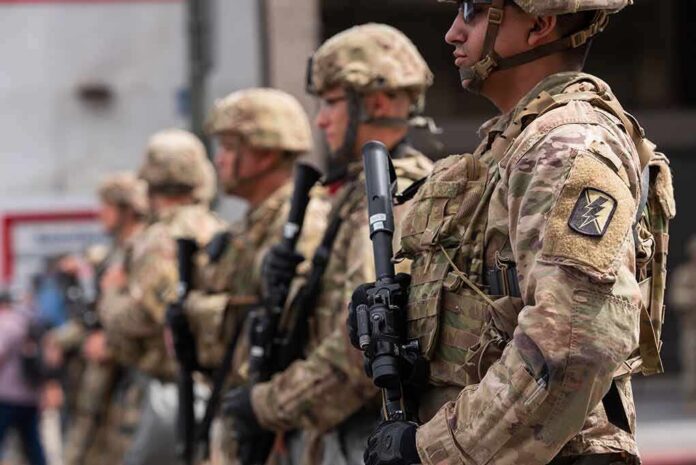
Understanding the Guard’s domestic role requires clarity on legal status. In Title 10 status, Guard units are federalized, under the President and the Defense Department, and the Posse Comitatus Act constrains direct law-enforcement roles absent specific authorization by Congress. In Title 32 status, Guard members remain under their governors but can receive federal pay and direction for training and certain homeland missions. The administration’s D.C. posture leaned on Title 32 to knit together out-of-state troops and sustain an extended law-enforcement support presence—an arrangement the District and subsequent court scrutiny found untenable for the mission claimed. Judge Jia Cobb’s ruling concluded that the cited training authority in 32 U.S.C. § 502 did not authorize the functional deployment at issue, which targeted general crime deterrence in the District rather than qualifying training or an appropriately bounded support mission.
That distinction matters. Congress has repeatedly authorized discrete Guard roles for disaster response, border missions, critical infrastructure protection, and specific civil support functions. But a roving, months-long deterrence and policing augmentation in D.C., carried by out-of-state Guard under Title 32, sits at the legal margin—and in this case, beyond it, according to the court.
Why D.C. Is Different: Home Rule Meets Federal Supremacy
D.C. occupies a constitutional middle ground. Congress granted the District home rule in 1973, enabling local lawmaking and governance but reserving ultimate federal authority. In ordinary circumstances, local officials command local police, set public safety policy, and request (not direct) federal support. The friction emerges when federal authorities assert enduring control over security posture inside the District—especially through quasi-military formations—without local consent. In this episode, the city’s elected officials objected to the Guard footprint, sought relief in court, and were joined by state attorneys general supporting the view that the federalization and deployment intruded on the District’s autonomy and exceeded statutory authority. The Justice Department’s response to the Council’s later appeal to governors—dismissing it as ignorant of the law—reflects how little leverage local bodies have once a federal mission is set.
Historically, Guard deployments within states proceed at a governor’s request or direction; when federalized, they are national forces with tightly circumscribed domestic law-enforcement latitude. The District, without a governor, must navigate those channels differently—and its recourse, as this case shows, is litigation rather than command authority.
What the Court Actually Said—and Why It Resonates
Judge Cobb’s decision did two consequential things. First, it found the administration’s use of the Guard for general crime deterrence in D.C. unlawful under the asserted statutory framework, a conclusion reported across mainstream outlets and legal trackers. Second, it validated a central claim of the District’s suit: that stretching Title 32 “training” provisions to backfill municipal policing with out-of-state Guard forces trespasses on the District’s self-government. In short, crime deterrence is a local policing function; using Title 32 to supply a sustained paramilitary presence for it is not what Congress authorized. The court ordered the deployment ended—an extraordinary rebuke precisely because it targeted not tactics but legal theory.
That outcome did not erase the politics. The administration continued to defend its approach in public and in related filings, and DOJ’s admonition of the Council’s demands to governors signaled an intent to preserve executive latitude where possible. But in the operative legal forum, the framework advanced to justify the D.C. posture failed.
Competing Frames, Weighed by the Evidence
Two narratives recur when Guard troops appear in civilian settings. One emphasizes public safety: visible uniformed presence deters violence, reassures residents, and buys time for civilian agencies to regroup. The other warns of domestic militarization: soldiers trained for combat tasks, not community policing, are a poor fit for routine law enforcement, risk rights violations, and blur crucial lines between military and civil authority. Both frames have history behind them—from hurricane response to border missions to protest security. What distinguishes the D.C. episode is not the Guard in a city per se, but the legal scaffolding under which out-of-state forces were sustained for routine deterrence and policing augmentation in a jurisdiction without state sovereignty. On that narrower and decisive point, the court’s analysis carried the day.
Support for the District’s position extended beyond city hall. A coalition of state attorneys general sided with D.C. in amicus filings, arguing the deployment was unlawful, unconstitutional, and corrosive to the District’s democratic self-governance—language that, while pointed, aligned with the court’s statutory holding rather than trying to constitutionalize everything at once. The Justice Department’s critique of the Council’s outreach to governors, by contrast, did not engage the court’s ruling; it simply emphasized that the Council lacks authority over interstate Guard commitments or federal missions—a correct statement about institutional power even after the legal theory for the specific deployment had been rejected.
What This Means Going Forward
First, expect tighter lawyering for any future Guard presence in D.C. not tied to discrete, time-bounded events or explicit statutory missions. The days of relying on Title 32 training authority as a catch-all for extended urban crime deterrence are over, at least in this jurisdiction and posture, absent new congressional authorization. Second, intergovernmental choreography will matter more. If federal agencies want sustained security augmentation in the capital, they will need mechanisms that respect D.C.’s home-rule space—formal taskings to federal law enforcement, narrowly drawn Guard support under clear authority, or, ideally, partnerships built with local consent instead of over it.
Third, governors will be cautious about lending their Guard units for ambiguous D.C. missions. Even before the ruling, interstate deployments carried political risk; now they carry legal risk if the mission profile resembles routine policing rather than authorized support. And finally, the District’s recourse pathway is clarified. It can object politically, and it can sue; as this case shows, on the specific question of out-of-state Guard for ordinary law-enforcement deterrence, it can win.
Practical Boundaries for Future Deployments
The practical line is not “no Guard in D.C.” The Guard will continue to appear for inaugurations, state funerals, catastrophic incidents, and other extraordinary events under well-grounded authorities. The line is functional: the more a mission looks like standing up a parallel police force for general crime control, the less it fits statutory Guard authorities—especially in the nation’s capital with its unique governance structure. When the executive branch hews to mission-specific statutes, time limits, and clear command relationships, it will find fewer legal reefs. When it stretches training provisions to fill policing gaps, it will run aground, as it did here.
Sources:
justthenews.com, washingtonpost.com, dccouncil.gov, pbs.org, youtube.com, foxnews.com
© featurednews.com 2026. All rights reserved.