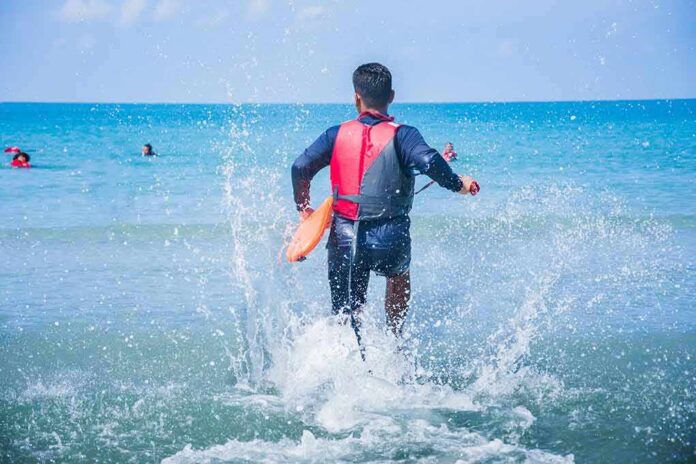
The important fact in this Maine scare is not just that a shark was nearby; it is that a veteran lifeguard was close enough to feel the force of the encounter, lose control of his rescue device, and still make it back to shore unaided. That makes the event a serious public-safety episode, even though the public record still relies largely on witness accounts and media reconstruction rather than a full released incident file.
Key Points
- A Scarborough Beach State Park lifeguard says a great white shark grabbed his rescue torpedo and pulled him briefly underwater.
- He freed himself, swam ashore unharmed, and the beach was closed for about an hour while staff monitored the water.
- Multiple local reports say officials and a shark expert treated the episode as consistent with white shark activity in the area.
- The narrow unresolved question is not whether something alarming happened, but how much of the public story rests on direct observation versus inference.
What Happened at Scarborough Beach
The core sequence is straightforward. Greg Wilfert, a Maine lifeguard with decades of experience, was in the water at Scarborough Beach State Park when, by his account, a shark grabbed his rescue device and dragged him several feet underwater before he broke free and swam back to shore. In one report, he said he first thought he had been caught by a boat propeller; only after realizing there was no boat did he conclude a shark had pulled him under. Another report quotes him saying he was pulled under about five feet and then got to the surface as fast as he could.
This is the kind of incident that can sound sensational when reduced to a headline, but the underlying mechanics matter. A rescue torpedo, or rescue buoy, is not a passive float; it is a tethered flotation device used by lifeguards during active patrol and rescue work. If something large takes hold of the device or the strap attached to it, the lifeguard can be yanked off balance instantly. That is what makes this episode plausible as a brief, violent drag rather than a prolonged struggle. The danger came from leverage and surprise as much as from any injury inflicted.
Why Officials Treated It as a Shark Encounter
The public reporting does not show a released police narrative, dispatch log, or forensic examination of the gear, but it does show local authorities and outside observers treating the event as a white shark encounter rather than a vague marine mishap. One report says a bystander saw the rescue torpedo shoot several feet out of the water after Wilfert was pulled under, and another says the incident was reviewed and corroborated as white shark activity by a New England Aquarium expert. That matters because the classification did not rest on one person’s frightened impression alone.
Still, the limits of the record should be stated plainly. Wilfert himself did not report seeing the shark directly; he inferred it from the force on the buoy and from the setting, saying there was no fish that could have done that. That is not the same thing as eyewitness identification. It is a strong inference, reinforced by officials and recent regional shark activity, but it is still an inference. In a serious safety analysis, that distinction matters because it separates direct perception from expert reconstruction.
The Maine Shark Context Is Real, and It Explains the Speed of the Response
This incident did not occur in isolation. Local coverage repeatedly notes a cluster of recent great white sightings off Maine beaches, including more than half a dozen sharks on video over a 48-hour span and more than a dozen recent sightings off the coast. That broader pattern is not proof of this particular encounter, but it does explain why the beach response was immediate and why officials acted as if a credible shark hazard was present. When a coastline is already seeing regular white shark activity, a close call is more readily treated as a genuine marine threat rather than dismissed as an oddity.
That broader context also explains the public’s appetite for a simple story. Maine’s shark season has become highly visible because the sightings are frequent enough to generate video, closures, and press coverage, yet rare enough to preserve their shock value. The result is a familiar coastal paradox: the ocean appears safe until the one event that reveals how thin the margin can be. A lifeguard being dragged underwater by his own rescue gear turns that paradox into a practical question of staffing, surveillance, and beach protocol.
🦈Shark Drags Lifeguard Underwater at Scarborough Beach in Maine
A shark grabbed a lifeguard's rescue device and dragged underwater at a beach in Scarborough, MaineOn Saturday afternoon, August 8, 2026, an uninjured lifeguard escaped a close encounter after being dragged 5 to 6… pic.twitter.com/VfIgITHMX6
— American Crime Stories (@AmericanCrime01) August 11, 2026
What Is Known, What Is Not, and Why the Difference Matters
The known facts are enough to support a confident public-safety reading. A veteran lifeguard was in the water, was pulled under, escaped, and the beach was briefly closed while staff checked conditions. What remains less certain in the public record is the exact mechanism: some reports describe the shark grabbing the rescue device, others the strap or rope connected to it. That variance is not trivial. It suggests that the story has been stabilized in broad outline, but not yet fully reconstructed from primary evidence.
That gap is where skepticism has legitimate purchase. Without the incident report, equipment exam, or continuous footage of the moment of contact, the public has to distinguish between what was directly observed and what was inferred from aftermath and context. Yet the lack of a full forensic package does not erase the event; it simply limits how precisely it can be described. The safe reading is therefore disciplined: Scarborough Beach experienced a real and alarming shark-related close call, and the public account of it is strong enough to support caution, even if the technical details remain partly documentary rather than purely evidentiary.
What This Episode Means for Maine Beaches
The larger implication is not that Maine’s coast has become a place of routine shark attacks. It is that the state now sits inside a live ecology where white sharks are visible enough, close enough, and frequent enough that beach managers must treat them as an operational factor. That changes everything from patrol patterns to closure thresholds to the use of drones, wave runners, and shore-hugging lifeguard positions. In Scarborough, officials reportedly responded by moving lifeguards closer to shore, deploying aerial monitoring, and limiting how far swimmers could enter the water.
For the public, the lesson is more practical than dramatic. A shark encounter does not have to produce a bite wound to be serious; a forceful drag, especially on a working lifeguard, is enough to justify immediate closure and caution. For coastal communities, the real issue is not whether every headline captures every technical detail perfectly. It is whether the warning embedded in the incident is taken seriously before the next swimmer or guard finds out the hard way that the margin between ordinary surf and a dangerous encounter can disappear in an instant.
Sources:
nypost.com, abc45.com, cbsnews.com, youtube.com
© featurednews.com 2026. All rights reserved.