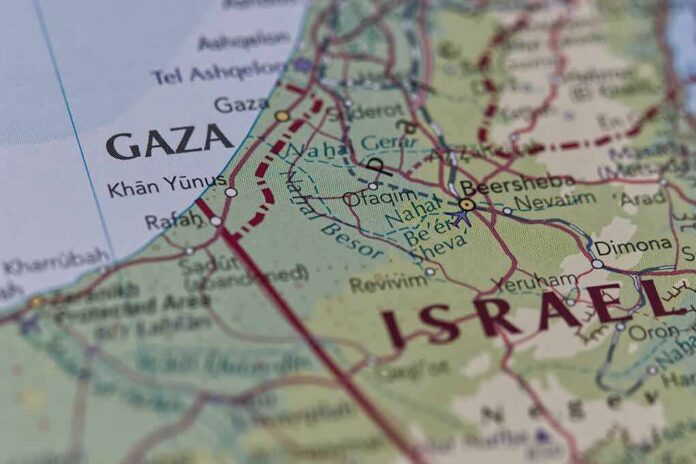
The fight over how we describe Gaza is really a fight over what we think we’re seeing: an ideological contest between radical Islamism and liberal modernity, or a conventional, if devastating, struggle over territory, strategy, and statecraft; Bill Maher’s 9/11 anniversary monologue crystallized that fault line and forced the argument into the open.
The Short Version
- Maher’s thesis is explicit: the enduring post‑9/11 struggle pits radical Islamism against Western liberalism, and Gaza has become the clearest arena of moral confusion in the West about that clash.
- He argues progressive discourse now minimizes Islamist ideology, muddles language around terrorism, and mislabels the Gaza war as genocide, thereby distorting moral judgment.
- Counter-voices resist civilizational frames, emphasizing complexity: intelligence failures, strategic miscalculation, humanitarian catastrophe, and a conflict not reducible to faith or culture alone.
- The real stakes are normative: which frame controls law, media, and politics determines how we assign culpability, regulate force, and educate a rising generation about open-society values.
What Maher actually argued — and why the frame matters
On the 25th anniversary of 9/11, Maher advanced a clear claim: the through-line from the hijackers to Hamas is ideological, not merely geopolitical. The relevant dyad, in his account, is radical Islamism versus Western liberalism, and the Gaza war has revealed a Western elite unnerved by naming that reality. He criticized media style guides and public rhetoric that fence off the term “terrorist” or place it in scare quotes, contending that euphemism corrodes moral clarity. He then extended the critique to the language of genocide, arguing that to elide Hamas’s doctrine and conduct while re-labeling Israel’s response as an exterminatory project is to invert first principles of liberal ethics and law.
Maher’s insistence is not semantic nitpicking. In contemporary conflicts, categories do real work: “terrorism,” “self-defense,” “genocide,” and “occupation” are not just descriptors; they trigger legal duties, diplomatic posture, platform rules, and, ultimately, public consent for the use or restraint of force. Frames govern consequences. Disputes over Gaza’s vocabulary are thus not academic; they are the contest to define what the West is permitted to defend and what it must condemn.
The competing analysis: complexity over civilization
There is a serious counter-case. Analysts who have lived inside the military-intelligence and policy apparatus resist civilizational shorthand; they argue the October 7 shock resulted as much from discrete strategic failures as from any monolithic ideological arc. RAND researchers, for example, trace the catastrophe to Israeli strategic hubris and a breakdown in warning-to-decision pipelines: indications of a large Hamas operation were available but dismissed — a classically human, institutional error pattern rather than an inexorable clash-of-worlds spiral. On this reading, the war’s reality is a web: adversary doctrine and intent, yes, but braided with deterrence failure, coalition politics, humanitarian logistics, and information operations — each demanding tailored, not grand-civilizational, remedies.
Philosophers who share Maher’s concern for liberal norms also nuance the label. Sam Harris calls it a clash of cultures rather than civilizations; his distinction tries to isolate militant Islamism from the world’s diverse Muslim communities while still naming the incompatibility between theocrats who reject pluralism and the open society that depends on it. That refinement matters if the aim is to defend liberalism without licensing collective blame.
Where the disagreement is real — and how to weigh it
Two questions sit at the core. First, is the dominant axis explanatory or performative — ideology driving events, or institutions failing to manage knowable risks? Second, what language best protects liberal commitments without flattening moral nuance in a mass-casualty war?
On the first, both dynamics operate. Hamas’s charter, doctrine, and practice are grounded in a revolutionary Islamist project that repudiates pluralist liberalism; that is an ideological constant. But October 7 also exposed contingent vulnerabilities — deterrence assumptions, force posture, and cognitive biases — that are the stuff of strategy, not metaphysics. Treating Gaza exclusively as civilization-versus-civilization misses the policy levers; treating it exclusively as a managerial failure misses the animating ideas that make certain acts thinkable and others obligatory to their authors. Adult analysis can accommodate both.
The charge of genocide — the sharpest point of contention
This is where Maher’s critique cuts hottest. He rejects labeling Israel’s campaign as genocide, asserting that the term’s legal core — specific intent to destroy a protected group, in whole or in substantial part — is not met by a wartime counterattack against an embedded militia, however bloody. He points to aid flows and evacuation corridors to argue against exterminatory intent, and he warns that casual genocide talk degrades the category and fuels antisemitism by casting Jewish self-defense as inherently annihilationist.
Many legal scholars and human rights institutions have taken the opposite view, arguing that the pattern of operations, siege conditions, official rhetoric, and civilian toll collectively evince genocidal conduct and, in some analyses, intent. This is not a fringe posture; it reflects a broader trend in international legal commentary and advocacy over the past several years, which sees Gaza as a paradigmatic stress test for the Genocide Convention in an age of urban warfare with non-state actors. The legal dispute is thus genuine and unresolved in public fora; each side anchors its position in different evidentiary aggregates and inferential standards.
Language, liberalism, and the civic immune system
Strip away the heat and the civics problem remains: open societies depend on a shared grammar for violence and restraint. If “terrorist” becomes unusable even when groups target civilians as a tactic; if “genocide” becomes a synonym for any catastrophic civilian harm regardless of intent; if “resistance” and “collective punishment” are hurled as tribal passwords rather than legal assessments, we lose the ability to distinguish combatant from noncombatant, reprisal from extermination, and proportionality from license. That is how civic immune systems fail: the body politic stops recognizing the difference between an infection and an antibody.
Maher’s monologue forces that hygiene conversation onto the table. His core claim — that Western elites are uncomfortable naming the ideological content of radical Islamism and therefore slide into euphemism or inversion — lands because institutions have, at times, treated clarity as a reputational hazard rather than as a public duty. The counter-claim — that precision also means rejecting civilizational overreach and attending to strategic failure and humanitarian law — is equally indispensable. The task is not to pick one frame and abolish the other; it is to keep both in view and refuse the lazy conflations that corrode judgment.
🚨WATCH: Bill Maher skewers the feckless 🚨
Refusing to call 9/11 what it was, and Democrats who call Gaza a genocide. @royalezioxx
— Leslie Young (@AkaLazarus) September 12, 2026
What this means going forward
For media, adopt rigor without coyness: define terms, attribute labels to sources when contested, and separate descriptive clarity from pejorative flourish. For policymakers, make doctrine explicit: if the enemy is a theocratic movement that rejects pluralism, say so; if the center of gravity is institutional readiness and alliance management, fund and fix accordingly. For citizens and educators, teach the distinction Harris tries to preserve — between a militant ideology that must be opposed and hundreds of millions of Muslims who live, work, and worship within liberal orders — because that is the difference between defending an open society and dismantling it from fear.
Sources:
scrapsfromtheloft.com, yahoo.com, wiser.wits.ac.za, city-journal.org
© featurednews.com 2026. All rights reserved.