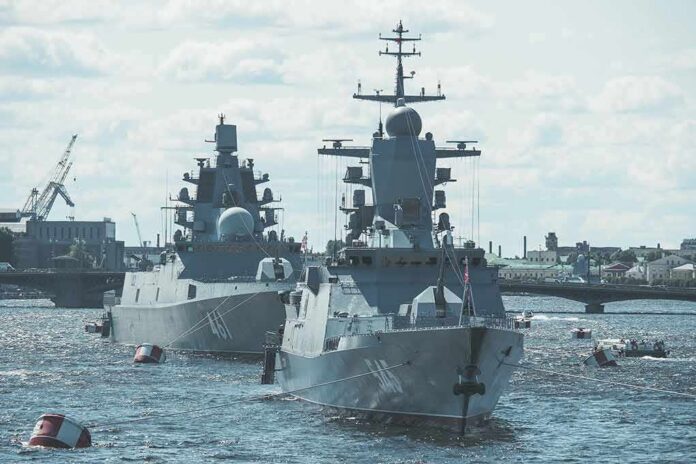
The most consequential fact about China’s navy is not any single warship it has launched but the factory system behind it: a shipbuilding base so large that the United States no longer has a plausible peacetime path to match it, only strategies to work around it.
Key Points
- China’s shipyards produced 53.69 million deadweight tonnes of shipping in 2025, 56.1% of the entire world’s output, and captured 69% of new global orders, according to China’s Ministry of Industry and Information Technology.
- The PLA Navy commissioned more than 18 new warships in 2025, headlined by the aircraft carrier Fujian (Type 003), the country’s third and most advanced carrier.
- The imbalance is structural, not cyclical: China builds on the order of 1,000 to 1,500 commercial vessels a year, versus roughly three to eight in the United States.
- Washington’s near-term response leans on allies — South Korea and Japan — rather than a rebuilt domestic base, since America’s commercial shipbuilding capacity essentially disappeared after the Cold War.
- China appears to be pausing mass production of some destroyer classes not out of weakness but to transition to a next-generation, all-electric fleet architecture built for networked, high-energy warfare.
The scale of China’s industrial advantage
Naval power has always rested on industrial capacity as much as tactics, and nowhere is that clearer than in the current gap between Chinese and American shipbuilding. China’s output for 2025 reached 53.69 million deadweight tonnes, an 11.4% increase over the prior year, giving it 56.1% of global shipbuilding volume. New orders totaled 107.82 million DWT — 69% of everything ordered worldwide — and the order backlog hit 274.42 million DWT, a record high representing roughly two-thirds of global backlog. Momentum has not slowed. Figures for the first half of 2026 show completions up 51.2% year-on-year and new orders up 173.1%, pushing China’s share of new global orders to 82.3%.
These are commercial tonnage figures, not warship counts, but the distinction matters less than it might seem. China’s shipbuilding sector is explicitly dual-use: the same yards, the same steel-cutting lines, and often the same workforce that produce bulk carriers and container ships also produce frigates and destroyers. Analysts at the Center for Strategic and International Studies have described this as the industrial engine behind the PLA Navy’s expansion, noting that China already fields more battle-force ships than the U.S. Navy and is projected to reach roughly 425 ships by 2030. Twelve CSSC-owned shipyards alone build virtually the entirety of China’s modern naval fleet.
What actually launched: the 2025 fleet additions
Behind the tonnage statistics sits a concrete list of hulls. The PLA Navy commissioned more than 18 warships in 2025, the largest being the aircraft carrier Fujian (Type 003), formally commissioned on November 5, 2025, at Sanya Naval Base in a ceremony attended by Xi Jinping. Detailed open-source tracking puts the year’s additions at one Type 003 carrier, one Type 075 amphibious assault ship, one Type 055 large destroyer, seven Type 052D destroyers, and six frigates split between the Type 054A and the newly introduced Type 054B. Precision beyond that is difficult by design — the navy maintains deliberate secrecy around submarine production in particular, which is why outside estimates of PLAN warship totals are usually presented as “at least” figures rather than exact counts.
The submarine picture, while less transparent, is no less significant strategically. Open-source assessments put China’s undersea fleet at roughly 68 boats, a number comparable to the U.S. Navy’s, with 12 of them nuclear-powered; six Type 094 ballistic-missile submarines alone now carry warheads representing roughly 12% of China’s total nuclear stockpile. Combined with continuing amphibious expansion — four Type 075 landing helicopter docks are now in PLAN service, described by Chinese state media as among the largest such vessels in Asia — the pattern is one of simultaneous growth across every category of naval vessel, not concentration in a single showpiece platform.
Why America cannot simply out-build this
The imbalance did not appear overnight, and it will not close quickly. Peter K. Lee, a research fellow at the Asan Institute for Policy Studies, has laid out the scale bluntly: China produces somewhere between 1,000 and 1,500 commercial vessels annually and controls more than half of global commercial shipbuilding, while South Korea holds roughly 27% and the United States accounts for about 0.1% — somewhere between three and eight ships a year. American commercial shipbuilding effectively collapsed after the Cold War, leaving the country with a navy-only industrial base that lacks the scale, the supplier networks, and the skilled labor pool that a thriving commercial sector would otherwise sustain.
That is why the administration’s response has leaned on allies rather than a purely domestic rebuild. Washington’s 2023 strategic investment arrangement with South Korea allocates $150 billion of a $350 billion package specifically to shipbuilding cooperation, and Hanwha’s 2024 acquisition of one of the last two major U.S. commercial shipyards — with plans to scale toward 20 ships a year — is emblematic of the approach. South Korean firms including HD Hyundai have already expanded shipbuilding capacity into the Philippines, Vietnam, and planned facilities in India, giving the U.S. potential partners with a track record of building an advanced shipbuilding industry from near zero, as South Korea itself did in the 1970s by importing best practices from Japan and Europe. Parallel reporting indicates the U.S. Navy is also examining direct purchases of warships from Japan and South Korea, and even Turkey, to expand fleet numbers faster than domestic yards can deliver.
🇺🇸🚢 US Navy shops for warships abroad as China’s shipyards dwarf its own
While Donald Trump continues to peddle grand delusions of US naval supremacy, including a glittering Golden Fleet capable of staring down China, the reality – exposed by the failed war on Iran – is bleak.…
— Bluegrass Fair Minded (@AkBluegrass3) September 17, 2026
A pause that signals acceleration, not retreat
One development worth watching closely is China’s apparent slowdown in new-start production of its Type 052D and Type 055 destroyers at major yards including Jiangnan and Dalian in late 2025. Read in isolation, a pause might suggest China has hit a capacity ceiling. Read against the broader modernization trajectory, it looks more like a retooling interval ahead of a generational shift: China is reportedly moving toward a three-tier surface combatant architecture built around integrated electric propulsion, a technology prerequisite for directed-energy weapons and for ships that function as networked nodes rather than standalone platforms. The Type 054B frigate, which entered service in January 2025 as China’s first all-electric frigate class, has already moved into what satellite imagery suggests is mass production by early 2026.
The trend lines into 2026 reinforce the same conclusion the tonnage data suggests: this is not a temporary surge but a durable industrial advantage. China’s shipbuilding output is projected to exceed 60 million DWT in 2026, and one long-range assessment concludes there is no systemic challenge visible to China’s 55–70% share of global completions, orders, and backlog over a five-year horizon. For the U.S. Navy, the practical consequence is a shift in strategic posture — from an assumption of shipbuilding parity toward one of managed asymmetry, offset through alliances, munitions stockpiles, and unmanned systems rather than an attempt to out-produce a rival that currently builds more tonnage in months than the American commercial sector manages in years.
Sources:
19fortyfive.com, english.www.gov.cn, asianmilitaryreview.com, dredgewire.com, en.wikipedia.org, vpk.name, infra.economictimes.indiatimes.com, globaltimes.cn, militarywatchmagazine.com, macaonews.org, xindemarinenews.com, news.cgtn.com, steelorbis.com, csis-website-prod.s3.amazonaws.com, apps.dtic.mil
© featurednews.com 2026. All rights reserved.