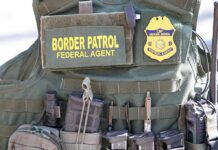
The United States increasingly resolves alleged atrocity histories not in criminal court but at the border: civil immigration law has become a primary tool for ejecting suspected human-rights violators when criminal prosecution is out of reach.
At a Glance
- ICE removed Amos Sheik Massaquoi to Liberia after immigration proceedings, citing alleged involvement in killings, torture, and recruiting child soldiers during Liberia’s civil wars.
- Immigration removal relies on civil standards and statutory inadmissibility/removability grounds; it is not a criminal conviction and does not adjudicate guilt for war crimes.
- Accusations of wartime abuses often rest on investigative files that are not public; critics press for transparency while agencies cite witness safety and intelligence sensitivities.
- The United States has long used immigration authorities to remove alleged human-rights violators amid Liberia’s slow domestic accountability and sporadic foreign prosecutions.
What the government did and what that means
Immigration and Customs Enforcement says it removed Amos Sheik Massaquoi to Liberia and publicly described him as someone believed to have ordered or participated in extrajudicial killings, torture, arbitrary detention, forced labor, and child-soldier recruitment during Liberia’s 1989–2003 civil wars. The agency’s account also traced his U.S. entry in 2006, an overstay of his authorized period, later ICE custody, and an immigration judge’s removal order—signals of a standard civil enforcement pathway rather than an ad hoc expulsion. The legal consequence is precise: a removal order lawfully expels a noncitizen from the United States; it is not a finding of criminal guilt for war crimes and does not require proof beyond a reasonable doubt. That distinction is not semantic. It explains why these cases can move even when criminal prosecution is impractical, time-barred, or jurisdictionally fraught.
ICE’s human-rights and war-crimes work has been institutionalized for years through a dedicated investigative program and playbook that identifies alleged perpetrators, builds administrative cases, and pursues removability or exclusion on document fraud, misrepresentation, persecutor bars, or human-rights-related grounds under immigration law. The agency’s own handbook reflects that orientation: where criminal options are limited, the administrative system becomes the lever to deny safe haven and effect removal.
How civil immigration law became a war-crimes accountability tool
For nearly two decades, U.S. authorities have used immigration pathways to confront alleged atrocities tied to Liberia’s wars. In 2012, for example, ICE secured the removal of George Saigbe Boley, a former militia leader found removable based on the use of child soldiers—the first removal order under authorities linked to the Child Soldiers Accountability Act, which underscored how immigration adjudication can overlap with human-rights facts even when the forum is civil, not criminal. More broadly, ICE has reported hundreds of arrests and over a thousand removals of known or suspected human-rights violators since the early 2000s, illustrating a strategic pattern: when criminal prosecution is unavailable or insufficient, immigration law serves as the practical instrument to close sanctuary gaps and eject alleged offenders.
This approach exists partly because Liberia’s domestic accountability has lagged. International monitors and rights groups have long documented the scarcity of in-country prosecutions for civil-war-era crimes, pushing survivors and advocates to look to foreign courts and immigration systems for traction. Recent assessments continue to flag the gap between the scale of wartime abuses and the pace of formal justice at home, which helps explain why deportations and overseas cases loom so large in the postwar accountability landscape.
Evidence asymmetries and their consequences
These cases are frequently shaped by asymmetric information. Agencies may possess intelligence, confidential interviews, or protected-witness evidence that cannot be disclosed publicly without jeopardizing safety or sources; the public, by contrast, often sees only summary statements, press releases, and the fact of a removal order. That asymmetry creates predictable tensions: supporters credit the institutional checks inside DHS, ICE, and immigration courts, while skeptics emphasize the opacity of the underlying record and the absence of incident-level corroboration in the public domain. The result is a debate less about whether atrocity crimes occurred—extensive documentation shows all factions committed grave abuses in Liberia’s wars—than about how confidently any single individual’s role can be established in a forum that withholds key files from public scrutiny.
In this context, precision about standards matters. Immigration judges decide removability on the record before them, applying civil burdens and statutory bars; they are not tasked with proving international crimes beyond a reasonable doubt. Agencies can also find a person removable for conduct distinct from the alleged atrocities—such as fraud or an overstay—while still articulating human-rights allegations as policy justification for prioritization. That blend of legal hook and moral narrative is common in human-rights removals and is lawful, but it can blur in public conversations where a deportation is misread as a war-crimes conviction.
Where the dispute lives: allegations versus adjudicated guilt
On the specific allegations that ICE cited against Massaquoi, the public record, as presented through reporting, frames them as what the agency “believes,” not as findings from a criminal verdict. In parallel, the broader jurisprudential trail around Liberia-related suspects shows how fragile individualized proof can be decades later: foreign proceedings have sometimes ended in acquittals or reversals when prosecutors could not place an accused at the scene or meet criminal burdens, even amid voluminous accounts of widespread atrocities. The through-line is not exoneration of the wars’ brutality—it is the legal system’s insistence that individual criminal liability rests on precise, corroborated facts, tested adversarially. That is a higher bar than immigration law requires and explains why removal and criminal accountability can diverge in outcome.
The friction is healthy if properly understood. Removing a noncitizen under immigration law is a sovereign choice conditioned by statute and due process in that forum; convicting someone of war crimes is a separate enterprise that demands robust, transparent evidence tested in open court. Conflating the two—by treating deportation as proof of guilt or, conversely, treating the absence of a criminal conviction as proof of innocence in the immigration context—misreads both systems.
https://twitter.com/KRYPTOCEAN_/status/2100755704663453847
Implications for policy, due process, and Liberia’s justice horizon
For U.S. policymakers, three imperatives follow. First, keep the legal lanes distinct and honest: use immigration authorities to deny safe haven where the statute permits, but resist rhetorical shortcuts that imply criminal culpability absent a conviction. Second, maximize responsible transparency. Even redacted publication of immigration decisions, with clear statutory grounds and non-sensitive reasoning, strengthens public trust without compromising witnesses. Third, continue to invest in cross-border evidence development; when feasible, a criminal case—domestic or through cooperation with jurisdictions that recognize universal jurisdiction—delivers a clearer, more durable accountability signal than civil removal alone.
For Liberia, sustained progress requires building credible domestic capacity to investigate and prosecute legacy crimes, supported by international partners. As long as survivors must look abroad for semblances of justice—whether via deportations or occasional foreign trials—the legitimacy of the postwar settlement remains provisional. Immigration law can move people. It cannot, by itself, close the moral and legal accounts of a civil war.
Sources:
foxnews.com, iconocast.com, nytimes.com, justiceinfo.net, judiciary.uk, thenation.com
© featurednews.com 2026. All rights reserved.