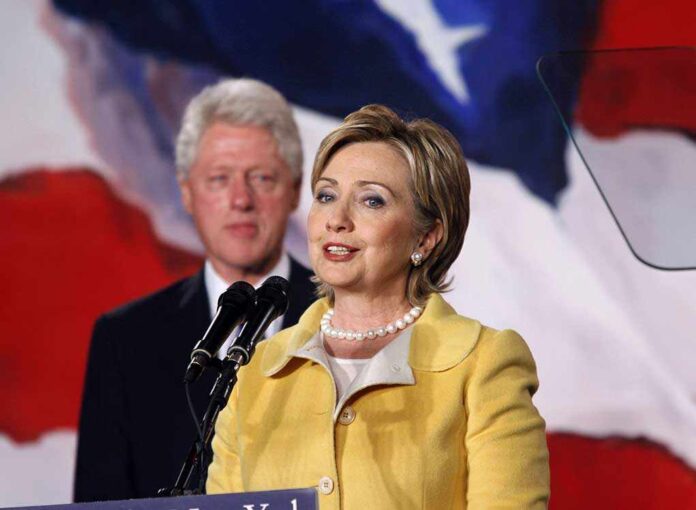
Congressional subpoenas now target Bill and Hillary Clinton, escalating the fight for transparency over elite connections to Jeffrey Epstein and exposing how past government failures still undermine public trust.
Story Highlights
- House Oversight Committee subpoenas the Clintons and top law enforcement officials for in-person depositions on Epstein’s case.
- Bipartisan support signals sweeping accountability demands after years of government secrecy.
- Negotiations stall Clinton depositions, fueling frustration over elite privilege and lack of transparency.
- Investigation underscores calls for constitutional checks and aggressive Congressional oversight in the Trump era.
Congressional Subpoenas Demand Elite Accountability on Epstein Scandal
On July 23, 2025, the House Oversight Committee, led by Chairman James Comer, took unprecedented action by issuing subpoenas for in-person depositions from Bill and Hillary Clinton, alongside former Attorneys General and FBI Directors, in connection with the federal government’s handling of the Jeffrey Epstein case. This move signals a new era of Congressional oversight, one that seeks to clarify the involvement and potential knowledge of high-profile individuals regarding Epstein’s activities and the government’s response. The Committee’s demand for Department of Justice records intensifies the push for transparency, reflecting the frustrations of Americans who have watched government agencies evade scrutiny for years.
Unlike previous attempts at accountability, the current investigation is bipartisan, with both Republicans and Democrats supporting the subpoenas for records and testimony. This marks a significant departure from past partisan gridlock, demonstrating a united front in the pursuit of answers. The focus on in-person depositions underscores the seriousness of the inquiry and responds directly to conservative concerns about the erosion of public trust in government institutions. For many Americans, especially those who felt ignored under prior administrations, this investigation aligns with renewed calls for constitutional checks and the defense of American values against elite privilege.
Clinton Depositions Delayed: Ongoing Negotiations Raise Questions
As of November 2025, depositions for the Clintons have not occurred, with negotiations ongoing to accommodate their schedules. This delay has only heightened public frustration and suspicion, as many view the Clintons’ privileged status as a barrier to true accountability. The Committee has released thousands of pages of documents from Epstein’s estate and continues to seek additional records from the Department of Justice. Conservative Americans are reminded of past government overreach, secrecy, and lack of responsiveness—issues that the Trump administration pledged to address. The situation highlights the persistent challenges in holding powerful figures to the same legal standards as ordinary citizens.
Despite the absence of direct allegations against the Clintons, their longstanding association with Epstein has fueled widespread scrutiny. Since at least 2002, Bill Clinton’s connections to Epstein have been public, including flights on Epstein’s jet for humanitarian missions. While the Clinton Foundation maintains that Bill Clinton knew nothing of Epstein’s criminal activities, political and media scrutiny has persisted, especially after Epstein’s death and the conviction of his associate, Ghislaine Maxwell. The Committee’s letters cite these relationships as relevant, emphasizing the need for full disclosure and rigorous oversight.
Bipartisan Push for Transparency and the Fight to Restore Public Trust
The bipartisan nature of the subpoenas reflects a broad desire to restore transparency and accountability in government. The investigation is taking place amid ongoing public and political demands for openness regarding Epstein’s network. For conservative Americans, this effort is not just about uncovering facts—it is about affirming the principle that no one is above the law. The Committee’s work exemplifies the values of limited government and individual liberty, challenging the culture of secrecy that has plagued federal agencies. Legal experts note that Congressional subpoenas for in-person depositions of former presidents and secretaries of state are rare, underlining the gravity of the inquiry.
Short-term, the investigation has intensified political and media scrutiny of the Clintons and other former officials. Long-term, it may lead to legislative reforms in how federal investigations of high-profile criminal cases are conducted. The stakes are high for all involved: reputational risk for those subpoenaed, renewed hope for Epstein survivors and advocates, and the possibility of lasting change in Congressional oversight. As the Trump administration delivers on its promises to defend American values and cut through government red tape, this investigation stands as a test of whether Congress can reclaim its role as a watchdog for the people.
Sources:
Bill Clinton’s connections to Jeffrey Epstein investigated by House Oversight Committee
Bill and Hillary Clinton delay depositions in House Oversight Committee investigation