When a president’s son who has received a sweeping pardon turns around and posts a fiery “No Kings” manifesto about his rival’s family corruption, he inadvertently illustrates the central paradox of modern American political scandal: the facts on self‑enrichment can be real on both sides, even as the systems of accountability that should referee them grow increasingly selective and fragile.
Key Points
- Hunter Biden’s viral “No Kings” post leveled detailed corruption allegations at Trump family business ties to defense contracts, Gulf investment funds, and regulatory changes, and a major AI fact‑check found most of his specifics broadly accurate.
- The same Hunter Biden now speaks as someone shielded by a full, retroactive presidential pardon covering a decade of potential federal offenses, underscoring how American presidents can still act as quasi‑monarchs when their own families are at risk.
- Independent reporting to date supports two parallel truths: Hunter Biden monetized the “illusion of access” and his surname, while existing records do not show his father directly sharing in or directing those deals.
- Trump family business entanglements with Saudi‑backed funds, foreign investments, and government spending fit a long‑standing pattern of executive‑branch self‑enrichment that scholars and advocates now treat as a structural corruption problem, not a partisan anomaly.
Hunter Biden’s “No Kings” broadside and what it actually alleged
Hunter Biden’s Fourth of July “No Kings” post was not a vague rant; it was a catalog of specific financial relationships he argued show the Trump family treating U.S. policy as a private revenue stream. According to contemporaneous coverage, he cited a $620 million Pentagon loan that he described as the largest in the program’s history and tied to Trump family interests; an Air Force drone contract and what he called the Army’s largest drone motor order, likewise linked to Trump‑connected firms; and a $24 million Pentagon robotics deal with a company where Eric Trump reportedly serves as chief strategy adviser. He also pointed to a stake in a Kazakhstan tungsten deposit backed by roughly $1.6 billion in U.S. government support, again connected to Trump sons, and to Jared Kushner’s post‑White House investment vehicle seeded with $2 billion from Crown Prince Mohammed bin Salman and now managing more than $6 billion, largely from Gulf governments.
On the domestic regulatory side, Biden highlighted a proposed firearms rule that would allow some guns to be shipped directly to buyers’ front doors, a change that would disproportionately benefit an online retailer whose board includes Donald Trump Jr. He framed these deals as evidence of a “king” mentality—one family turning public power into a hereditary economic engine—contrasting it with the intense investigative scrutiny directed at his own laptop and finances over the past six years.
Importantly, Mediaite’s report on an AI‑driven fact‑check (by Grok) concluded that Biden’s description of these deals “largely holds up”: the contracts, fund relationships, and corporate roles he named correspond to real transactions and positions, even if some rhetorical flourishes—such as “largest in history”—remain unconfirmed without specialized audits. In other words, when stripped of social‑media hyperbole, the financial skeleton of his case is not imaginary.
The pardon that changed the moral optics of the messenger
Biden’s choice of “No Kings” as a slogan collides starkly with his own legal story. In December 2024, President Joe Biden issued a “full and unconditional” pardon for his son Hunter, wiping away not only the gun conviction and tax‑related offenses already adjudicated, but “those offenses against the United States which he has committed or may have committed” during the entire period from January 1, 2014 through December 1, 2024. That span covers the years when Hunter served on the board of the Ukrainian energy firm Burisma and engaged in lucrative ventures with Chinese partners, episodes Republicans and conservative outlets have long portrayed as influence‑peddling.
The scope of the document, released via FOIA, is unusually broad for a presidential pardon and effectively immunizes Hunter from federal prosecution for a decade of potential misconduct. In a subsequent podcast conversation with California Governor Gavin Newsom, Hunter acknowledged bluntly that the pardon came at a reputational cost to his father, saying the president “chose me over his legacy” and emphasizing that the gesture reflected paternal love rather than legal necessity.
The White House has defended the decision by characterizing Hunter as “targeted” and the prosecutions as a “miscarriage of justice,” arguing that political adversaries would continue to pursue him absent clemency. That defense resonates with many who see the cascade of investigations into Hunter as disproportionate to the underlying offenses. But it also highlights the structural irony: in a republic that prides itself on equal treatment under law, a president still possesses near‑monarchical power to erase his own child’s criminal exposure.
What we know—and don’t—about Hunter Biden’s business and Joe Biden’s role
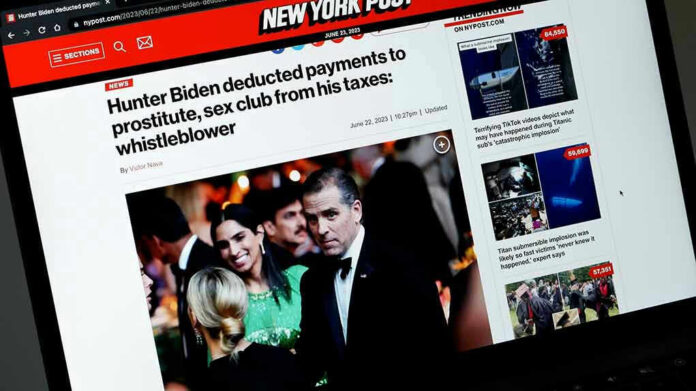
The evidentiary record on Hunter Biden’s business practices is now extensive, much of it assembled by his critics. NBC News’ analysis of his hard drive and related documents found that from 2013 to 2018 he and his firm earned about $11 million through legal work and board seats, including Burisma in Ukraine and ventures tied to the Chinese energy conglomerate CEFC. A Republican‑led Senate report concluded he “cashed in” on his family name and flagged certain transactions as potential efforts to obscure fund flows, but its authors conceded the investigation produced “no massive smoking guns” of criminal conduct.
Crucially, available corporate records and partner testimony have not substantiated the claim that Joe Biden himself participated in or profited from these deals. A former business partner told Congress Hunter was selling the “illusion of access” rather than actual decision‑making: Joe Biden was occasionally placed on speakerphone to impress clients, but the partner insisted the then‑vice president was never directly involved in the financial arrangements. ABC News, citing Wall Street Journal reporting, similarly noted that corporate records and witness statements show no direct role for Joe Biden in overseas ventures, and that emails often touted as proof of his involvement do not clearly demonstrate his awareness or benefit.
This distinction matters. Trading on a family name in private business is ethically fraught, especially when the family member is deeply engaged in foreign policy. Yet the legal threshold for corruption under current U.S. doctrine generally requires evidence that public office was used to confer concrete benefits in exchange for things of value. So far, investigators have not produced documents or testimony showing Joe Biden altered U.S. policy to reward Hunter’s partners. The sweeping pardon protects Hunter from further federal scrutiny of those years, but it does not retroactively prove or disprove policy corruption; it simply closes the door on testing those allegations in court.
The Trump family, self‑enrichment, and the Saudi connection
The Trump side of the ledger looks different not because the category of behavior is unique—leveraging a political brand for private gain is a bipartisan story—but because the scale and proximity to core security decisions are unusually stark. The PBS FRONTLINE documentary “The Crown Prince and the President” details how Donald Trump cultivated a transactional partnership with Saudi Crown Prince Mohammed bin Salman (MBS), publicly boasting of Saudi purchases of his properties and pursuing large arms deals, including a heavily promoted $110 billion package.
Within that relationship, Jared Kushner emerged as the primary U.S. interlocutor. Despite limited diplomatic experience, he managed key Middle East files while simultaneously building deep personal ties with MBS. After leaving the White House, Kushner launched an investment fund that received a $2 billion commitment from Saudi sovereign wealth, a decision internal Saudi reviewers initially questioned on business merits before MBS overruled them. Hunter Biden’s post seizes on this fund as emblematic of a “kingly” system in which Gulf monarchies reward former U.S. officials who favored their interests while in office, creating a feedback loop of influence and dependence.
Overlay that with domestic episodes—foreign delegations encouraged to stay at Trump‑branded hotels, continuing business operations at properties that benefited from the presidency, and aggressive personal lawsuits used to extract payments from disfavored companies—and the pattern fits what anti‑corruption scholars describe as “self‑enrichment” of the executive. The Brennan Center for Justice has argued that decades of Supreme Court decisions narrowing the definition of corruption and loosening campaign finance rules created exactly this environment: one where bad behavior has room to flourish because the legal guardrails are too weak to constrain it.
The “No Kings” movement and partisan framing wars
Hunter Biden’s post has been informally adopted as a rhetorical banner by a small but noisy “No Kings” protest movement that casts itself as a defense against hereditary rule and oligarchic capture. Conservative media have responded by portraying these protests less as evidence‑driven civic action than as the product of a “far‑left machine.” A Fox News investigation framed one “No Kings” event—featuring figures like Jane Fonda—as part of a network of roughly 400 progressive organizations with $3 billion in annual revenue, backed by donors such as George Soros and the Tides Foundation.
The segment emphasized that one sponsor, Refuse Fascism, is fiscally housed under a nonprofit currently facing Treasury and congressional scrutiny over alleged anti‑Semitism and tax issues, and highlighted executive salaries as proof of an activist “industry.” This framing aims to delegitimize the anti‑monarchy rhetoric by associating it with controversial actors and suggesting that it is less a spontaneous moral reaction than a professionalized campaign against Trump.
On the other side, liberal outlets have tended to cast Hunter Biden as an “unlikely social media force” striking back at hypocritical critics, which can make his allegations sound like cathartic clap‑back rather than the foundation for serious oversight. Neither frame fully engages the underlying question: are American executive families, across parties, systematically embedding themselves in national and global financial structures in ways that outstrip traditional checks and blur the line between public duty and private wealth?
Oh, the irony of Hunter Biden lecturing on family businesses and kings while his own laptop authenticated by forensics and admitted in court, spilled emails about "10 held by H for the big guy" in a Chinese deal, with associates like Tony Bobulinski confirming the "big guy" as…
— Oregon Patriot (@MilderAnn) July 5, 2026
Dynasties, scandal cycles, and the deeper corruption problem
Historically, accusations that a president has turned the government into a “family business” have cycled through U.S. politics with remarkable regularity. From Teapot Dome in the Harding era to controversies around Clinton associates, to Trump’s own Ukraine‑related impeachment and hotel patronage, major executive‑branch scandals feature claims of relatives or close allies monetizing proximity to power. A Harvard Law School review of U.S. anti‑corruption history stresses that enforcement has ebbed and flowed, often tightening after headline scandals only to loosen as legal doctrine shifts and memories fade.
What has changed in the last few decades is the density of money in politics and the legal permissiveness around it. Supreme Court decisions from Buckley v. Valeo through Citizens United expanded the role of ultra‑wealthy donors and super PACs, while other rulings narrowed the scope of federal corruption statutes. The cumulative effect, as the Brennan Center notes, is to “carve out vast swaths of conduct from accountability,” emboldening officials and their networks to push boundaries without fear of prosecution. In that context, both Hunter Biden’s exploitation of his surname and the Trump family’s blend of public office with private ventures look less like aberrations and more like symptoms.
Anne Applebaum, reflecting on comparative corruption, has argued that Hunter Biden’s conduct—getting himself appointed to boards and business roles because of his name—is ethically troubling but “not even living in the same world” as the scale of Trump‑era self‑enrichment, which built direct pipelines between presidential power, foreign autocrats, and family‑controlled enterprises. That assessment aligns with much expert commentary: the categories overlap, but the magnitude and systemic impact differ.
Why Hunter’s post is both substantively important and rhetorically vulnerable
Seen against this background, Hunter Biden’s “No Kings” post does two important things. First, it stitches together disparate reporting on Trump‑family business interests into a coherent narrative of dynastic self‑dealing. On the merits, much of that narrative holds: Kushner’s fund and its Saudi seed money are documented; Eric Trump’s corporate roles and the contracts his firms pursue are matters of record; Trump Jr.’s board position at an online gun retailer is public; and the incentive structures attached to Pentagon spending and regulatory changes are real.
Second, it dramatizes a legitimate worry: that when presidents and their relatives operate as global business actors, it becomes difficult to know where national interest ends and personal interest begins. That worry is not partisan; it applies as readily to the Biden network as to the Trump network, and to future administrations that may be even more deeply embedded in private capital.
Yet the post is also vulnerable. Hyperbolic lines (“made King George look like an amateur,” “they own the investigators”) and opaque claims (such as the “largest in history” assertion about the Pentagon loan, which remains unverified without program‑wide records) give critics easy openings to dismiss it as performative outrage rather than a prosecutable brief. The existence of Hunter’s own sweeping pardon—and the undeniable fact that he spent years monetizing his connection to power—makes any moral posture about “No Kings” easier to caricature as hypocrisy.
What genuine accountability would look like
For readers who care less about partisan point‑scoring and more about restoring a republic of equal citizens, the key question is not whether Hunter Biden is an imperfect messenger. He is. The question is whether the specific structural concerns his post points toward will be taken seriously regardless of who raises them.
That would mean, at minimum, independent audits of large defense‑linked loans and contracts where politically connected families are involved; transparent reviews of post‑office investment funds seeded by foreign governments; and consistent disclosure and conflict‑of‑interest rules that apply to relatives of presidents across party lines. It would also mean resisting the temptation to treat pardons of family members as normal, even when the targeted‑prosecution rationale feels emotionally persuasive. Presidents can love their children and still submit them to the same legal processes as everyone else; when they do not, they strengthen the very “kingly” precedents their critics fear.
Hunter Biden’s post did not resolve these dilemmas, but it did something useful: it forced the uncomfortable convergence of two truths on public display. Political families, including Trump’s, have exploited proximity to power for private gain in ways that deserve scrutiny. And the current president, in using his constitutional authority to insulate his own son, has demonstrated how far the United States still is from living up to its “No Kings” rhetoric.
Sources:
twitchy.com, thedailybeast.com, thewrap.com, aol.com, abcnews.com, the-independent.com, facebook.com, youtube.com, abc7ny.com, enewspaper.latimes.com, vox.com, nbcnews.com
© featurednews.com 2026. All rights reserved.