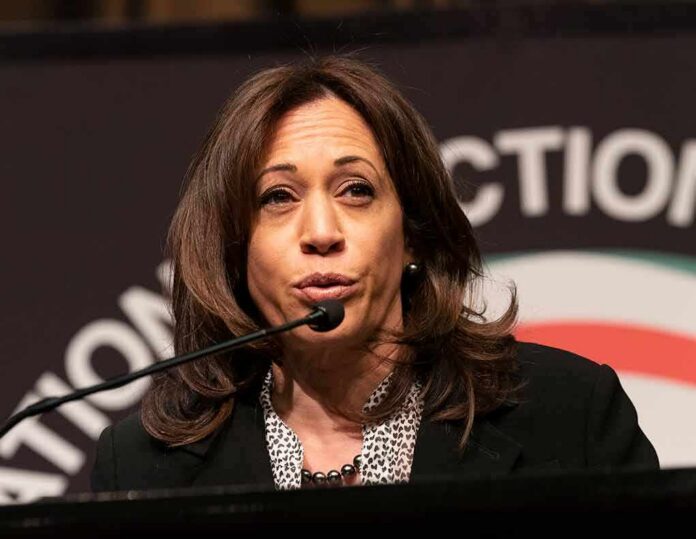
The clearest signal about Kamala Harris’s 2028 intentions is her own on-record answer: she is actively considering a run, and she is positioning herself to play a major role in the cycle whether as candidate, influencer, or both.
At a Glance
- Harris publicly said she “might” run in 2028 and is “thinking about it,” framing the question around where she can best serve the country.
- She pledged to be “more involved than ever before in 2028,” reinforcing that she intends to hold national political influence.
- Early polling shows her at or near the front of a hypothetical Democratic field, though results vary widely across surveys.
- No formal campaign or exploratory committee exists; the evidence supports active consideration, not a declared bid.
What Harris Has Said And Why It Matters
When asked directly at the National Action Network convention whether she would run in 2028, Harris replied, “Listen, I might. I’m thinking about it.” She repeated that she was weighing the decision through the lens of public service—“who and where and how can the best job be done for the American people”—and promised, “I’ll keep you posted.” Those are not evasions or deflections; they are deliberate signals from a national figure testing receptivity while preserving freedom of action. The exchange also included a crisp commitment to 2028 relevance: she would be “more involved than ever before in 2028,” a formulation that keeps both candidacy and kingmaker options on the table. Major outlets covered the comments as confirmation that a run is under consideration, underscoring the national salience of the signal.
The significance is twofold. First, this is not third-hand rumor; it is Harris on the record, under direct questioning, articulating criteria and intent. Second, by invoking experience in the White House and emphasizing service, she framed a potential campaign not as personal restoration but as institutional stewardship—an argument that historically travels well within party electorates when a recognizable figure tests a third presidential try.
How Early Support Looks—And What It Actually Means
Public attention quickly turned to early polling, where Harris often appears as a top option in a still-theoretical Democratic field. In one Focaldata/Financial Times reading she registered around 30 percent; a Center Square Voters’ Voice series placed her between 27 and 31 percent; and a Harvard/Harris survey showed a sharper surge to 50 percent among Democrats in late April, up from 41 percent the prior month. Those numbers demonstrate gravitational pull: in an unformed race, the best-known figure tends to consolidate soft preference. But volatility is high. A separate New York Times/Siena snapshot had her at 12 percent with 45 percent undecided, reminding us that question wording, candidate lists, and timing can swing results dramatically when no one is actually running yet.
Seasoned observers treat such spreads as a feature of the pre-season, not a contradiction. Early polls perform best when a party has an overwhelming favorite; otherwise, they function as a name-recognition heat check. The discipline is to read them as evidence of viability and awareness, not as a forecast of delegate math. That is especially true when the field is unsettled and national media coverage itself can shift impressions week to week.
Why The Signals Fit A Familiar Early-Cycle Pattern
Harris’s posture—publicly open, substantively noncommittal, conspicuously engaged—is textbook early-cycle politics. Ambitious national figures keep optionality high, test messages in friendly rooms, and allow donors and activists to come to them before formal structure locks in. Political scientists have long noted the rhythm: ambiguous remarks, favorable trial heats, and high-visibility appearances congeal into a provisional “front-runner” narrative that may or may not harden as rivals declare and issues sharpen. The cautionary literature on front-runner fallacy exists for a reason: early leads outside of overwhelming-favorite scenarios often dissipate once the campaign becomes real.
That does not diminish the strategic value of this stage. It buys time to gauge party mood, map potential coalitions, and identify whether one’s comparative advantage lies in running, shaping the field, or negotiating an early alignment. Harris’s promise to be “more involved than ever before” in 2028 is thus strategically elastic; it can encompass a campaign, but also an endorsement architecture, fundraising muscle, and agenda-setting speeches that influence the eventual nominee’s platform.
Where The Evidence Is Firm—and Where It Isn’t
The firm parts are straightforward. Harris personally and publicly confirmed she is considering a bid, and she articulated the criteria by which she’ll decide. Her comments were widely covered by national outlets that treated them as meaningful signals rather than banter. Multiple reputable polls show her with substantial potential support, in some cases commanding, in others merely leading a diffuse field.
The soft parts are equally clear and should not be over-read. There is no exploratory committee, no filing with the Federal Election Commission, no announced staff or policy program. The remarks set no timetable. Hypothetical ballot tests are exactly that—hypothetical. And “more involved than ever” is a promise of heightened engagement, not an unambiguous declaration of candidacy. Those boundaries do not undercut the signal; they simply define it.
How To Assess Viability If Harris Runs
If Harris moves from consideration to candidacy, the mechanism by which early advantage converts to nomination is well understood. First, she would seek to translate national familiarity into early-state infrastructure—organizers and validators in South Carolina and Nevada, targeted media in New Hampshire, and donor bundlers aligned with those geographies. Second, she would work to consolidate influential party factions—Black church networks, organized labor, women’s advocacy groups, and national security surrogates—into an unmistakable coalition before rivals can define themselves. Finally, she would present governing experience as comparative advantage: time in the White House produces fluency on executive levers, crisis management, and personnel that few outside the presidency’s inner circle can match.
History is instructive on trajectories, not guarantees. Vice presidents and vice-presidential nominees often try for the top job; many secure nominations, fewer win the presidency. The record is mixed, but the springboard effect is real enough that party actors take such figures seriously until proven otherwise. That is precisely the posture Harris is eliciting now: take her seriously, because she is thinking seriously.
Hi. I don't know who needs to see(hear)this OR if anyone will actually even see this but…
I'm a Texan. A Texan who disliked our current leaders. A Texan who feels betrayed by Trump. A Texan who absolutely wanted everyone primaried and voted out BUT I did NOT go to the voting…
— Insayne Layne (@InsayneLayne) November 6, 2026
The Practical Markers To Watch Next
Because Harris has set the expectation that she will be deeply engaged in 2028, the next phase is observable. Watch for formal committee paperwork; recurrent travel to early states beyond ceremonial appearances; named senior hires with presidential-cycle pedigrees; and donor activity that resembles a national build rather than a general-purpose political fund. Consistent polling from the same firms—same samples, same question sets—will also clarify whether today’s spreads are settling into something durable or merely bouncing with the news cycle. Until then, the state of play is straightforward: Harris has told the public she might run, and she is acting like a politician preparing to matter in 2028 whether or not she ultimately files.
Sources:
facebook.com, yahoo.com, thehill.com, pdclarion.com, nytimes.com, apnews.com, kentucky.com, nbcnews.com
© featurednews.com 2026. All rights reserved.