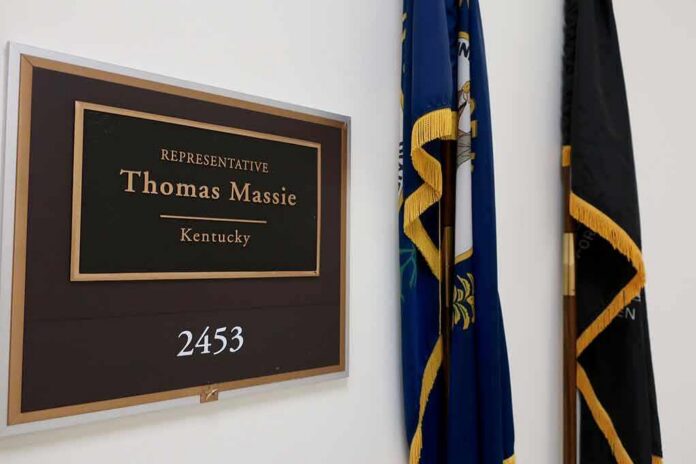
A presidential campaign does not begin with a declaration; it begins with an opening left deliberately unclosed, and that is precisely the posture Thomas Massie has adopted since losing his Kentucky primary to a Trump-backed challenger in May 2026.
Key Points
- Massie filed FEC paperwork for 2028 but has not confirmed a presidential run, a Senate bid, or a Libertarian Party ticket — only that he is keeping “options open.”
- A coalition of Libertarian Party activists and anti-war conservatives, including Mises Caucus founder Michael Heise and commentator Bret Weinstein, is actively recruiting Massie to lead a rebranded third party built around an “America First” anti-interventionist platform.
- Organizers have floated capturing 5 to 15 percent of the national vote, a stated goal rather than a measured level of support.
- History shows third-party bids rarely reach the scale organizers imagine — Perot hit 18.9 percent in 1992, but Nader managed 2.7 percent in 2000 and Johnson 3.3 percent in 2016 — making any spoiler scenario a plausible irritant, not a settled outcome.
- Federal matching funds for minor-party candidates exist but hinge on past electoral performance or a steep fundraising threshold, a structural hurdle any Massie campaign would have to clear before it could meaningfully compete.
What Massie Has Actually Done — and What He Has Not
Strip away the speculation and the documented record is narrow but real. On May 25, 2026, one week after Trump’s endorsed challenger ended his fourteen-year House career, Massie filed a Statement of Candidacy with the Federal Election Commission for Kentucky’s 4th Congressional District in 2028. He explained the move publicly: the filing lets him “continue raising funds to continue my political operations” as a sitting officeholder and “potential candidate for federal office”. That is a procedural step, not a platform announcement. Pressed directly on whether he was eyeing the presidency, Massie’s answer has been consistent and carefully noncommittal: “I will not rule out anything, and right now I’m not going to rule in anything”.
That studied ambiguity is the entire foundation on which the Libertarian recruitment story rests. No reporting establishes that Massie has accepted a nomination, authorized a campaign apparatus, or even confirmed interest in the office. What exists is organizer enthusiasm layered atop a politician’s refusal to foreclose his options — a familiar pattern in American politics, where ambitious operatives read opportunity into silence long before the principal himself commits.
The Recruitment Effort: Who Is Pushing, and Why
The push is concrete and organized, even if its target remains unconfirmed. Election Wire reported on November 8, 2026, that a coalition fronted by Michael Heise, founder of the Libertarian Party’s Mises Caucus, is attempting to draft Massie as the standard-bearer of a rebranded party, alongside a newly launched American Liberty Party and a dedicated Draft Massie effort. Bret Weinstein, the biologist-turned-commentator who has built a following critiquing what he calls Washington’s “uniparty,” has publicly unveiled the plan as a “friendly takeover” of the Libertarian ballot line. The strategic logic Weinstein has articulated is blunt: a candidate who siphons 5, 10, or 15 percent of the vote from a major party forces that party “to listen and cave to interest of the people”.
The theory of the case is that an anti-war, anti-interventionist “America First” message — one explicitly distinct from the GOP’s foreign-policy establishment — could pull disaffected Republicans who distrust foreign entanglements and resent the party’s post-Trump direction. Massie’s own public statements supply ample raw material for that theory. He has criticized congressional Republicans for, in his words, letting Trump “start a war, increase spending, arm a genocide, betray MAHA, and cover up for Epstein’s coconspirators”, and he has long staked out opposition to foreign aid, including aid to Israel, as a defining position. None of that proves voters would follow him onto a third-party ballot line in numbers large enough to matter; it proves only that the ideological raw material organizers are counting on genuinely exists in his record.
Why Third-Party Math Rarely Matches Third-Party Ambition
American political history offers a long, instructive run of insurgent candidacies that looked, in the moment, like they might reorder a presidential race — and mostly didn’t. Ross Perot remains the modern high-water mark, pulling 18.9 percent of the popular vote in 1992 on the strength of a billionaire’s self-funded media blitz, then collapsing to 8.4 percent in 1996 once the novelty and the money both thinned. Ralph Nader, despite genuine ideological energy on the left, managed just 2.7 percent in 2000 — enough, arguably, to matter in Florida, but nowhere near the scale his supporters imagined. Gary Johnson, running as a sitting-governor Libertarian with name recognition Massie would have to build from scratch, topped out at 3.3 percent in 2016. The pattern across three decades is occasional large protest votes bracketed by far more common, far more modest showings. Organizer ambition and actual vote share have rarely matched.
There is also a structural wall that gets little attention in the enthusiasm of a recruitment push: federal money. The FEC’s public funding program reserves general-election grants for minor or new party candidates based on their party’s prior electoral performance, and primary matching funds require a candidate to raise over $5,000 in each of twenty states — roughly $100,000 broadly distributed — before qualifying. A rebranded Libertarian Party with no electoral track record under its new banner would likely start that race from zero, meaning any Massie campaign would need to build fundraising infrastructure and ballot access simultaneously, in all fifty states, against two major parties with decades of institutional muscle.
A coalition of anti-Trump Republicans and Libertarian Party operatives is plotting to recruit outgoing Rep. Thomas Massie for a third-party presidential campaign in 2028
The effort is reportedly part of an effort to siphon votes away from the eventual Republican nominee.…— Patricia (@Patrici04211472) November 9, 2026
What This Means for 2028
The honest assessment is this: a recruitment campaign with named organizers, real infrastructure, and a coherent ideological pitch is underway, and that is newsworthy on its own terms. But the leap from “activists want Massie to run” to “Massie will run and reshape the Republican coalition” skips several unresolved steps — his own decision, ballot-access logistics, fundraising viability, and the gap between stated voter anger and actual third-party turnout that history repeatedly exposes. Massie’s calculated ambiguity serves him well either way: it keeps fundraising channels open, preserves leverage within a GOP that just ousted him, and costs him nothing while the draft movement does its work. Whether that translates into a 2028 ballot line, or simply into negotiating position, remains genuinely unsettled — and will stay that way until Massie, not his would-be recruiters, decides to speak.
Sources:
thehill.com, wlky.com, rawstory.com, wlwt.com, docquery.fec.gov, ibtimes.co.uk
© featurednews.com 2026. All rights reserved.