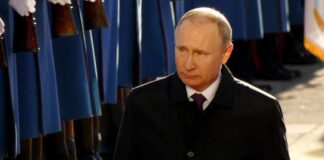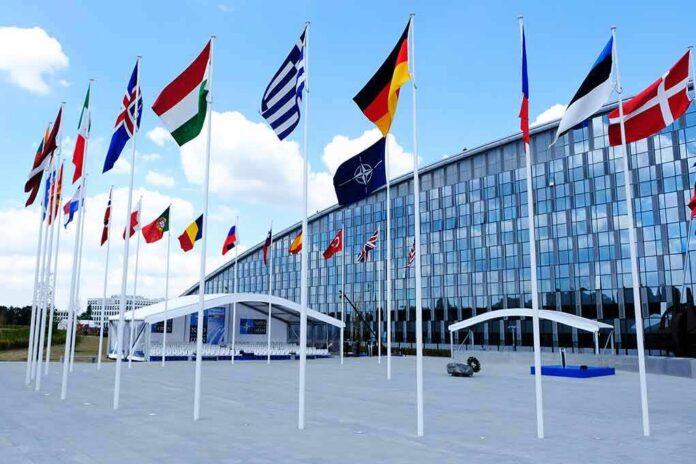
As American jets strike Iran and energy prices bite at home, President Trump says NATO “wasn’t there when we needed them” and warns that future U.S. support for Europe may now hinge on a very cold bargaining chip: Greenland.
Story Snapshot
- Trump says most NATO allies refused to back the U.S. war on Iran and blocked access to bases and airspace.
- NATO’s chief counters that thousands of U.S. flights used European bases, exposing a deep split inside the alliance.
- Trump links NATO’s “failure” on Iran to his renewed push to place Greenland under U.S. control.
- Years of U.S. pressure boosted allied defense spending, but Trump says Europe still expects American protection “for free.”
Trump: NATO “Wasn’t There When We Needed Them”
President Trump has hammered the North Atlantic Treaty Organization (NATO) for months over what he calls a near-complete lack of help in the Iran war. In Oval Office remarks and summit press conferences, he said allies “went out of their way not to assist,” refusing base access or overflight rights for U.S. operations. He singled out major countries like Germany, France, Italy, and Spain as turning Washington down when American pilots and sailors were in harm’s way. Trump’s core complaint is simple and blunt: the United States pays to defend Europe, but when America finally needs allied muscle, most European governments sit on their hands.
Trump also widened his criticism beyond Europe, blasting Japan, Australia, and South Korea for staying out of the fight despite hosting large U.S. forces. At the White House, he said “everyone agrees with us, but they don’t want to help,” calling NATO’s refusal to join operations in and around the Strait of Hormuz “a very foolish mistake.” On social media he warned that NATO “wasn’t there when we needed them, and they won’t be there if we need them again,” urging Americans to “remember Greenland, that big, poorly run, piece of ice.” For a base of voters already tired of global freeloaders and high gas prices, that message lands hard.
Rutte and NATO Push Back, Citing Thousands of Flights
NATO Secretary General Mark Rutte has worked to calm the storm, but his defense of the alliance shows how wide the gap is. In public remarks after meeting Trump, Rutte said “ally after ally” made bases available for U.S. planes in the six‑week campaign against Iran, pointing to the United Kingdom, France, Germany, Greece, Italy, and Portugal as key hosts. He cited up to 4,000–5,000 American military flights from NATO soil, arguing that this proves the alliance did not abandon the United States when the shooting started. Independent reporting backs that there was at least some European logistical support, especially for U.S. aircraft moving to and from the region.
Still, European leaders admit they refused to join front‑line combat or a formal NATO mission, saying there was no clear legal basis for the war. Many governments were wary because the operation was launched without full consultation in Brussels and without a United Nations mandate. Spain is the one country clearly reported to have denied U.S. access to its bases and airspace, which supports part of Trump’s anger but not his broader claim that every major ally turned him down. The result is a confusing picture: NATO territory helped U.S. forces move, but NATO as a political body stayed on the sidelines while American and Israeli forces took the risks.
Greenland, Burden‑Sharing, and the Future of the Alliance
Trump’s renewed focus on Greenland shows he is ready to tie European security directly to hard assets and dollars. Reports describe him warning that the United States could pull troops out of unhelpful NATO states and shift them to countries that back U.S. wars and accept U.S. control over key territory like Greenland. He has floated tariffs and even military pressure as tools to assert control over the Arctic island, stunning traditional diplomats but thrilling supporters who want America to stop bankrolling what they see as weak allies. For many conservatives, Greenland is not a joke; it is a way to lock down energy routes, rare minerals, and a forward base while ending Europe’s free ride.
This clash sits on top of a long history. For years Trump has blasted NATO countries for failing to meet defense‑spending promises, even as his pressure drove a surge in European military budgets. Analysts note that under his leadership, allies added hundreds of billions of dollars to defense, closing some of the gap between U.S. and European effort. Yet Trump still calls NATO a “paper tiger,” warning that America will not keep protecting countries that will not fight beside U.S. troops when it counts. With the Iran war exposing these cracks, the big question now is whether Washington will keep treating NATO as a sacred bond, or as a deal that must finally pay off for the American people.
Sources:
youtube.com, pbs.org, foxnews.com, apnews.com, facebook.com, stripes.com, theconversation.com, npr.org, britannica.com, nytimes.com, brookings.edu
© featurednews.com 2026. All rights reserved.