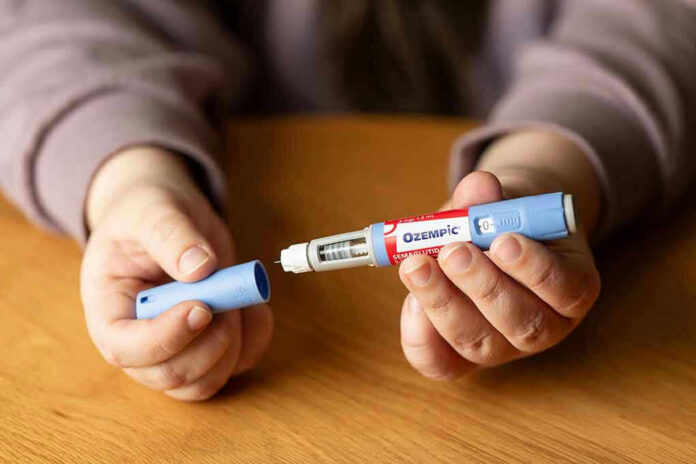
For many veterans and military families, whether they can get Ozempic, Wegovy, Mounjaro, or Zepbound often comes down to a single line in their medical record, not what their doctor thinks would actually help them.
Story Snapshot
- VA and TRICARE do not treat Ozempic, Wegovy, Mounjaro, and Zepbound as “one thing” — coverage depends on the diagnosis written in your chart.
- TRICARE generally covers Ozempic and Mounjaro for type 2 diabetes, while Wegovy and Zepbound for weight loss are limited to certain plans and require strict prior authorization.
- The Department of Veterans Affairs (VA) and CHAMPVA focus GLP-1 coverage on diabetes, heart disease risk, liver disease, or sleep apnea — not simple weight loss alone.
- Rule changes and carve-outs hit retirees and older beneficiaries hardest, feeding a sense that federal health programs favor budgets over patients.
What These Drugs Are – and Why the Diagnosis Matters
Drug makers sell Ozempic, Wegovy, Mounjaro, and Zepbound as powerful tools to lower blood sugar, cut weight, and even reduce heart risk, but the federal health systems split them by purpose. Wegovy and Zepbound are approved by the Food and Drug Administration for chronic weight management, while Ozempic and Mounjaro are approved for type 2 diabetes, with some extra heart and kidney benefits in certain patients. That difference on the label is what the VA, CHAMPVA, and TRICARE use to draw their coverage lines, even when the same molecule is in the syringe.
Veterans and service members often hear about these drugs on the news or from friends and think they are interchangeable, but that is not how the government systems see them. Each program looks first at the diagnosis code, then at whether the drug is on its list, then at whether you meet extra rules such as body mass index cutoffs, failed cheaper treatments, or enrollment in lifestyle programs. Those layers of rules make people on both the left and right feel like the system is more focused on guarding the treasury than on getting them healthy enough to work, serve, and care for their families.
What the VA and CHAMPVA Actually Cover
The Department of Veterans Affairs uses a national formulary with local prior authorization rules and treats weight-loss drugs as non-formulary, meaning they are harder to get than standard diabetes drugs. Independent summaries of that formulary say Ozempic and Mounjaro are listed for type 2 diabetes, with standard copays, while Wegovy and Zepbound sit in a non-formulary bucket where a doctor must prove special medical need, such as liver disease or cardiovascular risk, to get approval. As a result, simple obesity without other serious conditions rarely qualifies, which leaves many veterans who gained weight after deployments or injuries feeling blocked from the same tools their civilian peers can sometimes access through employer plans.
The related Civilian Health and Medical Program of the Department of Veterans Affairs, known as CHAMPVA, is even stricter about weight loss. Official CHAMPVA guidance says it will cover Ozempic and Mounjaro only when a beneficiary has a type 2 diabetes diagnosis and will cover Zepbound only when there is documented moderate to severe obstructive sleep apnea and Wegovy only when used to prevent major cardiovascular events or to treat a specific type of fatty liver disease, not for basic weight loss. The policy states clearly that CHAMPVA does not cover GLP-1 drugs for weight loss as a stand-alone goal, no matter how high someone’s body mass index is or how much their weight has damaged their daily life.
TRICARE Rules: Plan Type and Prior Authorization Decide a Lot
TRICARE, which covers active-duty service members, many retirees, and their families, follows the same “diagnosis first” logic but adds another filter: the type of TRICARE plan you have. TRICARE’s pharmacy contractor explains that GLP-1 medications for type 2 diabetes — such as Ozempic, Mounjaro, Trulicity, and Victoza — are covered across the system when there is an approved prior authorization, meaning your provider shows that you truly have diabetes and meet the program’s clinical requirements. In practical terms, that makes it much easier for a beneficiary with clear type 2 diabetes to get Ozempic paid for than for someone seeking the drug mainly to slim down.
For pure weight loss, TRICARE draws a much narrower circle. The same contractor guidance says Wegovy, Zepbound, and other weight-loss drugs are covered only for beneficiaries enrolled in TRICARE Prime or TRICARE Select and only when prior authorization is granted. Starting August 31, 2025, TRICARE cut off coverage for these weight loss drugs for everyone not on Prime or Select, which includes many retirees and those on special coverage arrangements. That move has fueled anger among older veterans and spouses who feel they gave decades to the country only to see newer, more expensive treatments reserved for a smaller, favored slice of the population as costs rise.
Why Coverage Feels Arbitrary – and What It Says About the System
The split between diabetes and weight loss uses may make sense to budget planners, but it feels arbitrary to many patients living with both conditions at once. A veteran with type 2 diabetes can get Ozempic or Mounjaro through the VA or TRICARE if they clear the paperwork, while their battle buddy with severe obesity but no diabetes may be told that the same drug is “too expensive” for weight loss, even if losing weight could prevent diabetes later. To many Americans, this looks less like careful medicine and more like a bookkeeping trick that waits until people get sicker before helping them.
For conservatives, these GLP-1 rules look like another example of a bloated federal system that rations care while wasting money elsewhere; for liberals, they highlight how hard it is for lower and middle income people to access breakthrough treatments that the well-connected can buy out of pocket. Both sides can see how complex, diagnosis-based rules and plan carve-outs let the bureaucracy say “we cover that drug” in press releases, even while many real patients hit a wall when they try to fill a prescription. In the end, VA and TRICARE coverage of Ozempic, Wegovy, Mounjaro, and Zepbound shows a deeper problem: a government health system that often protects formulas and budgets first and leaves ordinary Americans to fight through fine print when they are simply trying to get well enough to chase the American Dream again.
Sources:
military.com, goodrx.com, tricare.mil, formblends.com, va.gov
© featurednews.com 2026. All rights reserved.