The defining truth of the Paris unrest is double: a mass, education-driven protest over deteriorating public services ran alongside opportunistic looting and arson—two distinct currents that collided in the same streets but do not describe the same movement.
The Short Version
- The mobilization began in schools, with grievances about teacher shortages, overcrowded classrooms, and decaying facilities, then widened to cost-of-living concerns.
- Hundreds of thousands marched nationwide in largely peaceful demonstrations; masked groups simultaneously committed arson, vandalism, and looting.
- On-the-ground accounts and officials distinguished theft-oriented looting from protesters’ stated aims.
- How France processes this dual reality—policy demands versus public order—will shape both education reform and protest legitimacy in the years ahead.
What actually happened: two streams in one street
By size and stated purpose, the protests were not a riot dressed up as a cause. They grew out of school-based complaints—teacher absences, packed classrooms, shabby buildings—and broadened into a critique of cost-of-living pressures and declining public services. Education unions and student groups drove early mobilization, with reports of school blockades and closures as the effort scaled nationally. During peak days, several hundred thousand people marched across France; mainstream coverage characterized those marches as largely peaceful even as images of fires and smashed storefronts dominated broadcasts.
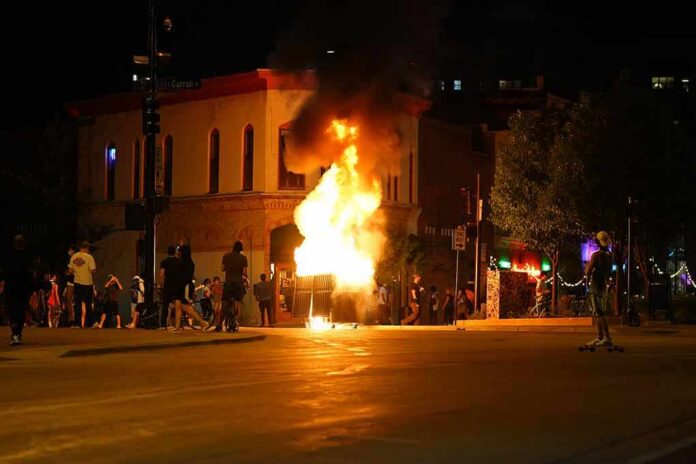
In parallel, smaller, masked contingents—dressed in black, faces covered—torched vehicles, set buildings ablaze, and looted shops. That juxtaposition is not an analytical dodge; it is the descriptive core. Authorities, local witnesses, and many demonstrators themselves drew the line in real time. A Paris shop owner told reporters the people who robbed his store were taking advantage of the unrest, not advancing education or living-cost demands. President Emmanuel Macron echoed the distinction between “legitimate demands” and those who destroyed and looted. Videos that went viral captured the same boundary-setting from below: a woman blocking the doors of a Paris supermarket, pleading—this is not the cause—while looters pushed past.
How the education-centered movement took shape
Movements that erupt into national view often begin with operational failures people live every day. Here, the irritants were concrete: chronic teacher shortages, classrooms bursting at the seams, facilities in visible disrepair. Students and education staff organized school-by-school, then city-by-city; blockades, closures, and coordinated actions signaled that what began as localized frustration had matured into a national campaign for resources and standards. As participation widened, the agenda broadened: fuel prices and the monthly arithmetic of household budgets entered the frame alongside the core claim—France’s public-service promise, starting with schools, is fraying.
Scale matters because it rebuts the lazy equivalence of protest and riot. Reports cited roughly 450,000 participants on one national action and about 550,000 at another, evidence of a coalition broader than any black-clad bloc. Are those figures exact? No crowd estimate is. But even with methodological caveats, they capture an unmistakable fact: the streets filled with ordinary people, many of them students and education workers who did not set fires or shatter glass.
Why the cameras saw flames: the mechanics of attention
Television is built for spectacle. A car on fire is photographically irresistible; a testimony about a leaking roof or an algebra class with forty students is not. French protest scholarship has long documented the pattern: when collective action crosses from orderly to disorderly, press and political frames pivot to security and deviance; legitimacy is granted within—and withdrawn beyond—the bounds of social stability. That pivot happened here. Articles and broadcasts led with looting, police deployments, and arrest tallies, while the movement’s education-specific claims slid down the column or off the screen, even when reporters acknowledged that most demonstrators were peaceful.
This is not a media conspiracy; it is an incentive structure. But it has consequences. Public opinion hardens around the most vivid images, and policymakers reach first for order-restoration toolkits. The risk is that a system-level policy problem—staffing, infrastructure, inequality—gets reframed as a policing problem. Once that happens, budgets follow the frame.
Separating theft from protest: what the evidence supports
The cleanest claims are the narrowest. We have credible reporting that looters targeted goods—sportswear, electronics—where the payoff was immediate and material, not symbolic or programmatic; that is a different logic from marches aimed at budget lines, class sizes, or admissions pathways. We have on-record statements from officials and eyewitnesses distinguishing protesters from vandals. We have footage of citizens and shopkeepers pushing back physically against looters, signaling social norms that reject theft even among those sympathetic to protest aims.
What we do not have—and should not pretend to—are incident-level attributions proving that no marcher ever broke a window. Social movements are porous. The meaningful claim is narrower: the aims articulated by organizers and the participation of hundreds of thousands are not reducible to the conduct of masked groups who sought cover in the crowd. The preponderance of evidence supports that separation.
Why the schools were the spark: policy mechanics behind the grievance
Teacher shortages cascade. When vacancies go unfilled, schools rely on substitutes or redistribute students, inflating class sizes and compressing instructional time. Facility neglect compounds the strain; maintenance deferrals become health and safety problems that also erode trust. Parents see conditions that would be unacceptable in other public services; students experience daily reminders of unequal opportunity. In that environment, even modest shocks—fuel price spikes, inflation—turn a sector grievance into a society-wide indictment: the basic bargain of a capable public state is wobbling.
France has weathered versions of this before, from the 2006 CPE protests to the Gilets Jaunes. Each time, the enduring lesson is structural: if the state does not address the service-delivery substrate, public order operations buy calm but not consent. Education, as the first public institution most citizens encounter, is the substrate.
The path forward: prove the diagnostics, then fund the fix
Lasting resolution begins with measurement that skeptics will accept. Publish school-level dashboards: vacancies by subject, substitute coverage rates, class-size distributions, maintenance backlogs, and time-to-repair. Couple that with transparent admissions and placement data that let families see pathways and bottlenecks. With diagnostics in the open, budget debates sharpen: funds target staffing pipelines, incentives for hard-to-serve schools, and facility upgrades where the need is verified. That is how policy moves from slogans to schedules and line items.
For protest organizers, the same logic holds. Keep the coalition anchored in specific, auditable demands; keep distance—practical and rhetorical—from those who treat demonstrations as shopping opportunities with smashed glass for doors. For government, maintain the necessary distinction between enforcing order tonight and investing in institutions that reduce disorder next year. Both are obligations of the state; neither substitutes for the other.
Sources:
facebook.com, bbc.com, bbc.co.uk, csee-etuce.org, humanium.org
© featurednews.com 2026. All rights reserved.