When a battlefield loss exposes a pattern of preventable vulnerabilities, grief turns into an accountability test: did commanders align base selection, hardening, air defense, dispersal, and medical readiness to a known drone threat, or did avoidable choices turn a lethal strike into a mass-casualty event?
The Short Version
- Six U.S. Army Reserve soldiers were killed by an Iranian drone strike at Port Shuaiba, Kuwait; families and soldiers argue the site was indefensible and poorly prepared for mass casualties.
- Vice President JD Vance publicly acknowledged troop-location decisions were a “huge mistake” and said changes followed, while promising a fuller accounting.
- Reports indicate proposals to relocate, warnings about drone vulnerability, and limited defenses ill-suited to the threat; a comprehensive mass-casualty plan was reportedly absent.
- The question is not drones versus leadership, but whether commanders made reasonable, threat-informed choices—and whether different decisions would likely have changed the outcome.
Port Shuaiba as a force-protection case study: what went wrong, and why it matters
Port Shuaiba concentrates several enduring problems in modern base defense: precision drones are cheap and ubiquitous; ad hoc operating sites are tempting for logistical convenience; and medical and evacuation frameworks often lag behind the threat profile. According to multiple accounts synthesized by the Associated Press, senior commanders shifted an operations center to Port Shuaiba despite assessments that the location was not sufficiently defensible against drones, while the only reported nearby U.S. air-defense coverage—a Patriot battery—was poorly matched to the class of Iranian drones involved. Mass-casualty planning, soldiers said, was not fully implemented before the attack. None of that absolves the enemy for launching the strike; it does focus the inquiry on whether American choices converted risk into tragedy.
The loss was severe: six Army Reserve soldiers were killed, and dozens wounded, when an Iranian drone hit the command area on March 1, 2026, including Sgt. 1st Class Nicole M. Amor, whose husband, Joey, has since pressed national leaders for answers. Public records and local reporting identified the fallen, anchoring the event’s gravity beyond politics. In a televised exchange, Vice President JD Vance acknowledged that troop positioning had been a “huge mistake,” asserted that changes had been made, and promised to determine exactly what happened and how to improve. That admission is consequential; it concedes a core premise of the families’ concern while leaving the decision chain and technical specifics to forthcoming investigations.
How base defense is supposed to work against drones
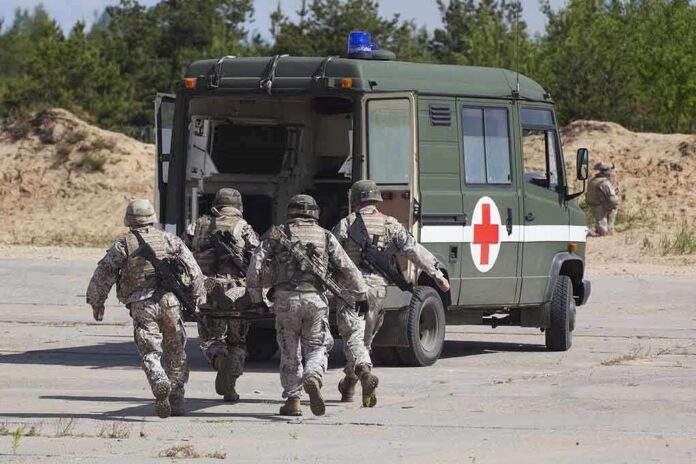
Drone-era force protection is layered by design. Active defense intercepts what it can; hardening and protective construction reduce vulnerability if something gets through; dispersal and concealment deny lucrative target density; and medical preparedness absorbs shocks with rapid triage, evacuation, and continuity of operations. RAND’s historical syntheses describe this as a portfolio, not a menu: no single layer solves the problem, but each adds friction and survivability against attacks that have only grown more precise and persistent in recent years. Practically, that means commanders weigh threat intelligence, interceptor suitability, radar and sensor coverage, physical standoff, blast-resilient sheltering, and the time-distance math of evacuating the wounded. When any one layer is thin, the others must thicken.
At Port Shuaiba, the public reporting sketches a stack of thin layers. Officers and soldiers cited threat assessments warning the site was not sufficiently defensible, relocation proposals that were rejected, and a defensive posture built around a Patriot system with limited utility against the specific drones Iran employed. Soldiers also reported that a broad mass-casualty plan had not been implemented; a prepared evacuation concept allegedly went unbriefed after the planner was reassigned. Each of those assertions deserves documentary scrutiny, but together they describe a defense in depth that was neither deep nor adaptive to the known threat.
Where the record is strong—and where it is still incomplete
Several claims rest on more than emotion. The central facts of the attack and casualties are established by official identifications and contemporaneous coverage. The vice president’s acknowledgment of a troop-location mistake and his commitment to remedial action are on the record. The AP’s reporting—sourced to officers, wounded soldiers, and internal planning accounts—details specific alleged deficiencies: site selection contrary to assessments, mismatched air defenses, and insufficient mass-casualty planning. These are not vague insinuations; they are concrete allegations that can be verified or refuted with command documents, force-protection assessments, and medical-response logs.
What we do not have publicly is the completed investigative spine that ties preattack choices to outcomes with engineering rigor: the exact defensive systems and readiness states at Port Shuaiba, warning timelines, shelter construction and occupancy, the drone’s flight path and warhead characteristics, casualty locations, and the time-motion record of medical response. Without that, no one outside the chain of command can say which deaths would have been prevented by different choices. That is not exculpatory; it is the gap a formal 15-6 investigation, inspector general review, or congressional inquiry should close—precisely the kind of disciplined reconstruction RAND and GAO have urged for years when installations face evolving threats.
Command judgment under uncertainty: reasonable risk or preventable error?
Operational decisions live in trade space. Leaders balance mission proximity, partner access, logistics, and force protection; sometimes the least-bad option still carries unacceptable risk. The nub here is whether decision-makers had actionable assessments signaling that Port Shuaiba was unusually vulnerable, whether feasible alternatives existed, and whether they adjusted other layers—hardening, dispersal, medical capacity—accordingly. The AP accounts suggest that relocation options were available, vulnerability was flagged, and compensating measures were insufficiently implemented. If documentation corroborates that sequence, the case for preventable error strengthens. If, conversely, records show no viable alternative locations, timely mitigation steps, and rapid medical response consistent with best practice, the narrative changes to tragic inevitability in a high-threat theater.
Vance’s public stance—acknowledging a serious mistake in troop location and promising changes—moves the debate past reflexive denial. It implies at least one layer of the defensive portfolio failed the reasonableness test and has since been corrected. The remaining work is granular: identify the approval chain for site selection, catalog the counter-UAS posture and its suitability to the known threat, reconstruct warning and shelter timelines, and evaluate medical planning against doctrinal standards for mass-casualty response in contested environments.
The Iran war has also imposed human costs, with 21 U.S. service members killed and hundreds injured since the conflict began in late February.
In the war’s early hours, six U.S. Army Reserve soldiers were killed in an Iranian strike on a site in Kuwait, including Master Sgt.… pic.twitter.com/8P89COcKv0
— CBS News (@CBSNews) October 18, 2026
What accountability should deliver—beyond blame
Accountability is not a synonym for punishment; it is a system’s way of learning fast enough to save lives next time. A credible review of Port Shuaiba should answer five questions: Did commanders follow their own force-protection assessments? Was the counter-UAS posture matched to Iranian drone profiles? Were troops dispersed and sheltered to minimize single-point vulnerability? Was a mass-casualty plan briefed, exercised, and resourced? And were reasonable alternatives to the site considered and rejected for defensible mission reasons? Families deserve transparent answers; forces downrange need the fixes embedded in checklists, training, and resourcing so the same pattern does not recur.
Sources:
cbsnews.com, bostonglobe.com, themorningsun.com, militarytimes.com, apnews.com, wcax.com, en.wikipedia.org, rand.org
© featurednews.com 2026. All rights reserved.