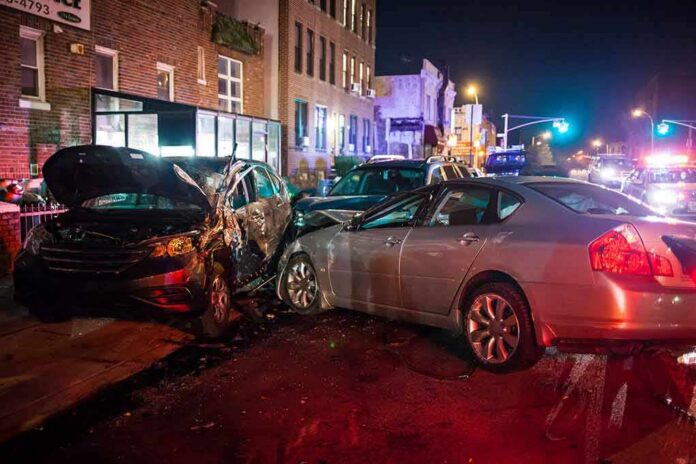
When a car leaves the roadway and mounts a sidewalk crowded with vendors and commuters, the law does not see mere “bad driving.” In California, prosecutors increasingly treat fatal DUI crashes as second-degree murder under the state’s implied-malice doctrine—an approach now squarely at issue in the North Hollywood case charging Ihor Demianenko with three counts of murder after three women were killed and others seriously injured.
At a Glance
- Los Angeles County prosecutors charged 61-year-old Ihor Demianenko with three counts of murder and two DUI-related felonies in a North Hollywood crash that killed three women and injured others.
- Authorities allege Demianenko’s blood-alcohol concentration was more than three times California’s 0.08% legal limit.
- LAPD’s account says a southbound Toyota Sienna veered off Lankershim Boulevard at unsafe speed, struck street fixtures, then hit pedestrians and vendors on the sidewalk.
- The charging theory mirrors California’s “Watson murder” framework—second-degree murder based on implied malice in certain fatal DUI cases.
What prosecutors say happened in North Hollywood
The Los Angeles County District Attorney’s Office filed a criminal complaint charging Demianenko with three counts of murder, along with DUI causing injury and driving with 0.08% blood-alcohol or more causing injury, after a minivan left Lankershim Boulevard near Chandler Boulevard and plowed onto a sidewalk lined with vendors, killing three women and seriously injuring others. LAPD identified Demianenko, age 61, as the driver of a white Toyota Sienna. The agency’s initial reconstruction places the vehicle southbound on Lankershim “at an unsafe speed” before it veered right, collided with a pole, and then struck pedestrians and vendors gathered outside the North Hollywood Metro station.
Prosecutors have publicly alleged a very high alcohol level—“more than three times” the legal limit—though they have not disclosed the numerical test result or methodology in public statements. News outlets attributed that allegation to the District Attorney’s Office in reporting on the delayed arraignment and on the severity of the charges. Those filings formalize a theory that the crash sequence and the driver’s intoxication made out not only felony DUI injuries but three counts of murder tied to the deaths at the scene.
How a DUI fatality becomes second-degree murder in California
California’s second-degree murder by implied malice—widely called a “Watson murder” after the state supreme court’s 1981 decision in People v. Watson—does not hinge on intoxication alone. Prosecutors must show a willful act whose natural and probable consequences are dangerous to human life and that the defendant acted with conscious disregard for that danger. In DUI homicides, the doctrine often draws on a confluence of facts: very high blood-alcohol levels, risky driving maneuvers, warnings or prior education about DUI risks, and the obviousness of the hazard in the driving environment. Appellate courts have since upheld numerous implied-malice convictions in fatal DUI cases under this framework.
Practically, a Watson theory asks a jury to decide whether the driver knew the lethal risk but drove anyway—an inference that can be supported by prior DUI convictions or program attendance in some cases, but can also arise from the circumstances themselves when the danger would be unmistakable to a reasonable person. The North Hollywood charges signal prosecutors believe the combination of alleged intoxication far above the legal limit, unsafe speed, and steering onto a populated sidewalk satisfies both the dangerous-act and conscious-disregard elements recognized in post-Watson case law.
The facts that anchor the North Hollywood filing
Several features of the case align with the charging posture. First, the crash scene—Lankershim at Chandler outside a Metro station—was a predictable pedestrian zone; crowds of commuters and long-standing street vendors were present when the minivan left the roadway. Second, the District Attorney’s announcement identifies three deaths and two serious injuries tied directly to the vehicle’s path onto the sidewalk, which, coupled with an allegation of extreme intoxication, strengthens the state’s argument that the conduct crossed from gross negligence into implied malice. Third, LAPD’s description of the crash mechanism—unsafe speed, a veer to the right, impact with a street fixture, and subsequent collisions with people—gives the prosecution a coherent sequence of dangerous acts to present at trial.
Identifying the driver and vehicle promptly also matters. LAPD and multiple outlets named Demianenko as the driver and the white Toyota Sienna as the involved vehicle shortly after the crash near the North Hollywood Metro station, ensuring that the state can tie the forensic, medical, and reconstruction evidence to a specific person and machine—an essential evidentiary foundation for both DUI and homicide counts.
Why implied malice is the fulcrum
In a garden-variety DUI fatality, the typical charge is gross vehicular manslaughter while intoxicated. Murder requires more: proof beyond a reasonable doubt that the driver, subjectively aware of a lethal risk, chose to proceed anyway. California courts have repeatedly explained that implied malice turns on a willful act, dangerous to life, undertaken with conscious disregard—not on intoxication alone. Prosecutors often build that state-of-mind case from objective indicators that make risk impossible to miss: extraordinary BAC levels; sustained high speed or egregious maneuvers; prior DUI advisements; and a driving environment dense with pedestrians or known hazards. The North Hollywood filings, by invoking implied malice, signal that the state believes those indicators coalesced here.
This is also why the precise crash narrative matters. A southbound vehicle leaving a multi-lane arterial at speed into a known vendor corridor is qualitatively different from a low-speed fender-bender. The law treats that leap from roadway to sidewalk as a willful act whose natural consequences are dangerous to human life—a classic predicate for implied malice when paired with extreme impairment and evident hazard.
What comes next procedurally
The case moved quickly from scene to booking to formal charges: murder counts, DUI causing injury, and driving with 0.08% or more causing injury, with media reporting high bail and an early court appearance calendar. At arraignment and preliminary hearing, prosecutors typically preview the evidentiary backbone: toxicology results, collision reconstruction, witness statements, and any relevant video. Defense counsel can contest the admissibility and interpretation of toxicology, challenge reconstruction assumptions, and test whether the state’s facts truly establish conscious disregard rather than gross negligence. A court’s probable-cause evaluation at the preliminary hearing will often foreshadow whether a Watson theory is trial-bound or narrowed to manslaughter.
Why this case resonates beyond one intersection
Even for those who did not know the vendors by name, the sightlines are familiar: a transit portal, evening foot traffic, small businesses lining the curb. California has seen too many collisions in exactly these spaces, and prosecutors have increasingly asked juries to reckon with the moral difference between impairment and implied malice. The North Hollywood charges plant that question squarely in front of a future jury: when a driver, allegedly at more than three times the legal alcohol limit, leaves a major boulevard at speed and tears across a vendor corridor, is that merely intoxicated negligence—or the willful disregard for life that the implied-malice doctrine was built to punish?
Sources:
nypost.com, lacounty.gov, latimes.com, cnn.com, da.lacounty.gov, nbclosangeles.com, people.com, abc7.com
© featurednews.com 2026. All rights reserved.