One on-air correction can do more to clarify how political media should work than a thousand partisan insults: when a high-profile host concedes a factual overstatement, it proves that evidence can still penetrate performance — and it exposes how easily a single bad stat gets conscripted into a sweeping indictment of character.
The Short Version
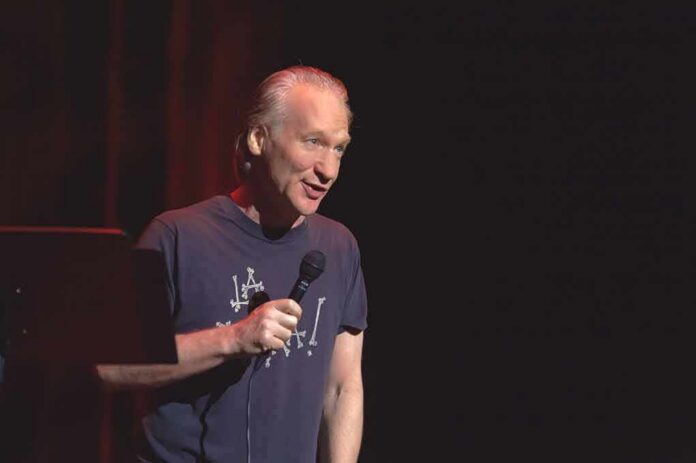
- Bill Maher publicly acknowledged he overstated a claim about President Trump’s endorsement record, after Trump sent him contrary data; that discrete correction is established.
- Trump’s broader attack mixes a specific dispute with sweeping character judgments; the evidence supports the narrow correction, not a general claim that Maher lies habitually.
- Maher argues direct engagement with Trump is legitimate and says he challenges him face-to-face on policy and facts; independent accounts of a long dinner support that description of dialogue.
- The California “illegal voters” allegation appears in Trump’s post, but the available record here does not supply the underlying segment or election data to adjudicate it.
A narrow correction is real; the leap to “liar” is not supported
The firmest ground in this dispute is narrow: Maher said on a later broadcast that he had overstated a claim about Trump’s endorsement success, and he attributed his change to information Trump sent him. The accounts agree on the core facts — Maher told his audience his earlier statement “wasn’t true” and that he “did overstate it,” after Trump texted him charts detailing endorsements and outcomes. That is a concrete, attributable correction, and it supports criticism of that one claim’s accuracy, not a blanket conclusion about Maher’s overall honesty. Put plainly: a single acknowledged error is evidence of an error, not of a habit of lying or intent to deceive.
Trump’s accompanying charge that Maher lied about “illegal voters” in California, by contrast, is asserted without the primary materials needed to verify it in this record: no transcript excerpt, no clip, no figure to test against California voter files or court-validated audits. Without those particulars, all we can responsibly conclude is that Trump alleged a falsehood; we cannot evaluate it on the evidence provided here.
How this kind of fact dispute should be adjudicated
There are two categories of statements in contemporary political talk: verifiable factual claims (countable outcomes, documented events, quoted statutes) and everything else (analysis, ridicule, hypotheticals, predictions). The first can and should be checked against primary sources. In the endorsement case, the check is straightforward: define what counts as an endorsement, compile the universe of candidates, and match them to certified election results. If Maher said Trump was “winning almost none,” and the compiled record showed hundreds of endorsements with a large majority of wins, the correction follows. What it does not do — at least not by itself — is establish intent. U.S. defamation law draws that bright line for a reason: in disputes involving public figures, liability turns on “actual malice,” meaning knowledge of falsity or reckless disregard for the truth, not merely hostility or error. Courts have repeatedly dismissed suits that confuse a bad estimate with bad faith.
That legal logic mirrors the epistemic one journalists and commentators should adopt. An incorrect number in a rapid, comedic monologue can result from incomplete data, selection criteria, or an honest misread — all fixable by transparent correction. A pattern of knowing misstatements is something else entirely and requires a systematic showing across many claims, not an inference from a single conceded overstatement.
Direct dialogue and its limits as proof
Maher has defended his choice to confront Trump directly — at dinners and on text — arguing that face-to-face exchanges are a way to deliver critiques Trump would never encounter through articles he does not read. He has described challenging Trump on the Supreme Court, Afghanistan, China, the 2020 election, and more. Stephen A. Smith’s independent account of one dinner — four hours and twenty minutes, with Trump engaging rather than evading — supports the claim that these were extended, substantive conversations, whatever one thinks of their optics. As a practice of engagement, that claim is credible. As proof that Maher’s public statements are uniformly accurate, it proves nothing either way.
It is also true that Maher has, over years, styled himself as a fact-focused critic of Trump. In televised exchanges he has pressed Trump-aligned guests with pointed rebuttals on election procedures and fraud claims, invoking contemporaneous fact-checks about observer access and the paucity of credible hotline tips. Those episodes establish that Maher does, at times, anchor his critique in checkable facts — they do not immunize him from error in other segments, including the endorsement claim he retracted.
Why the rhetoric overwhelms the record
The structure of this dispute is familiar. A specific, testable claim (endorsements) gets corrected; a separate, unverified allegation (California voters) is asserted; and the discussion is then saturated with invective — “coward,” “loser,” “pothead” — that guarantees coverage but blurs the boundary between facts and feelings. That blur is the point: in polarized environments, people often decide what is true by who is saying it and to whom they belong, not by the underlying records. Research on polarization consistently finds that misinformation exploits identity cues and that corrections, when they work, tend to reduce heat by resetting shared baselines, not by escalating conflict. None of that absolves a commentator of getting numbers right; it does explain why a single correction will be amplified as vindication by one camp and dismissed as nitpicking by another.
There is also an optics cost to backchannel fact disputes. When a sitting president texts a television host to contest a segment and the host revises on air, supporters see accountability and speed; critics see pressure and access journalism. Both readings are available. The way to disarm the skepticism is procedural: publish the transcript, post the dataset, define terms, and show the math. That is the path that serves every audience, not just the friendlies.
What would settle the open questions
Two evidentiary gaps remain if the goal is to move beyond rhetoric. First, the California segment needs primary documentation: the exact language Maher used, the numbers invoked, and the election-administration records that would verify or falsify them. Second, the endorsement file should be independently compiled to a single standard — what counts as an endorsement, how withdrawals are handled, and how uncontested races are treated — and then scored against certified results. Either exercise is routine for a newsroom researcher and would yield an answer people could replicate.
Short of that documentation, the only confident conclusion is the modest one the record supports: Maher made a specific overstatement about Trump’s endorsement performance and corrected it after receiving contrary data; that correction stands. Trump’s expansion of that episode into a sweeping indictment of Maher’s character and truthfulness is not supported by the evidence presented here. And Maher’s defense — that he confronts Trump directly and seeks to fact-check him publicly — is consistent with third-party descriptions of their interactions, while orthogonal to the accuracy of any given claim.
I think this is Trump's longest Truth Social post ever. 1300 words. Bill Maher had turned into a Trump shill I didn't watch anymore, and now Trump takes away the rest of Maher's audience with a blistering attack.
1/3#Trump #Maher #BillMaher #Leavitt #LaBella pic.twitter.com/33uyqBDDu3— PaidProtester (@paidprotestr) October 26, 2026
How to read episodes like this, going forward
Evaluate the claim, not the combatants. Ask four questions: Is the statement specific enough to test? Is there a primary record that can decide it? Has the speaker shown their work? And, when corrected, do they fix the record publicly? On those criteria, the endorsement dispute lands where it should: specific, testable, corrected. The California allegation remains unripe in this file for lack of primary material. Everything else — the derision, the applause, the tribal satisfaction — belongs to the ratings economy, not the truth economy. If we want the latter to prevail, we should reward the behavior that builds it: publish the transcript, post the spreadsheet, and keep the adjectives out of the arithmetic.
Sources:
mediaite.com, dailymail.com, trumpstruth.org, washingtontimes.com, latenighter.com, npr.org, en.wikipedia.org, thewrap.com
© featurednews.com 2026. All rights reserved.