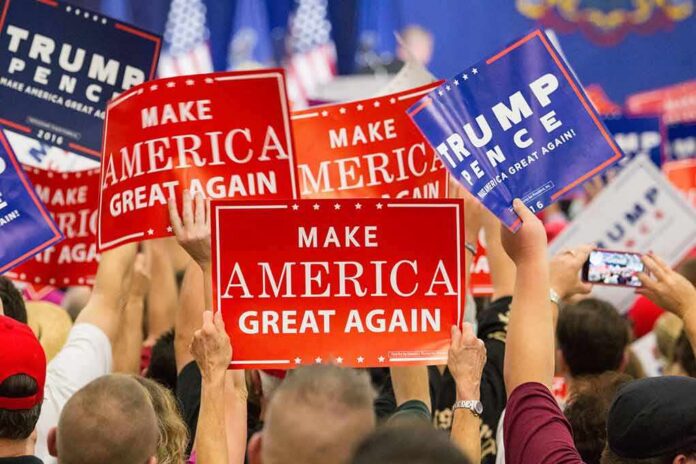
Presidential visits to battlegrounds are not ceremonial; they are party-strength tests that mobilize core voters, set the message frame for down-ballot races, and signal which contests truly matter. President Trump’s Port Huron rally fit that mold exactly: a full-throated push to elect Republican Senate nominee Mike Rogers and gubernatorial nominee John James, wrapped in a hard-edged attack on Democratic Senate nominee Abdul El-Sayed that made identity and loyalty the centerpiece of the appeal.
The Short Version
- Trump campaigned in Port Huron for Mike Rogers (Senate) and John James (governor), making their victories the stated objective of the trip.
- The rhetoric targeted Abdul El-Sayed with allegations framed around religion and extremism; reporting describes those allegations as unsupported and repeatedly denied by El-Sayed.
- Thousands attended, demonstrating mobilization energy; crowd size is not proof of persuasion.
- The rally underscores the nationalization of state races and the risks/rewards of presidential intervention in competitive contests.
What actually happened in Port Huron
In Port Huron, President Trump staged a late-campaign rally that elevated two Michigan Republicans—Mike Rogers for U.S. Senate and John James for governor—both of whom appeared at the event and shared the stage with him. Local and state coverage is consistent: this was an endorsement rally designed to steer votes toward Rogers and James, and Trump said as much from the lectern. The Times Herald reported the candidates’ participation and the sequencing of remarks; MLive summarized the event’s “clear political objective” as convincing Michigan voters to choose Rogers and James, noting that Trump pressed that message repeatedly throughout his address.
Attendance was robust by local accounts. The Detroit News described “thousands” at the Port Huron venue and an energized room—evidence of turnout capacity and message reach, even if not a measure of persuasion or ballot conversion on its own. Trump’s political operation spotlighted the rally in advance, and his team promoted celebrity involvement—most notably Nicki Minaj—as part of the event’s closing-argument theater for Michigan Republicans.
https://www.youtube.com/watch?v=oDcoEiEYsx4
The central message: elevate allies, define the opponent
The case for Rogers at the rally was framed as a binary: a vote for a trusted Republican aligned with Trump’s agenda versus a vote that, in the president’s telling, would empower a dangerous opponent. Trump leaned on language about El-Sayed that national outlets and state-focused reporters characterized as Islamophobic and premised on allegations lacking disclosed evidence. CNBC reported that Rogers had raised Muslim Brotherhood ties “without evidence,” and Associated Press-affiliated reporting emphasized that El-Sayed denied and denounced the claims repeatedly. NBC News likewise centered on Trump’s invocation of “jihadist” and Muslim Brotherhood tropes to urge voters to stop El-Sayed.
As a practical matter, that means the persuasive spine of the event rested less on policy contrasts than on identity and loyalty narratives. The reporting record here is uniform: the Port Huron argument against El-Sayed was anchored in claims about religion and extremism that El-Sayed has rejected and that outlets covering the race did not corroborate with presented documentation.
How presidential rallies function in competitive states
Two campaign mechanics converged in Port Huron. First, presidential endorsements are dual-use instruments—intended to lift allies while reaffirming the president’s command of the party’s message. Political science research on endorsements finds they can sharpen voter cues, spur fundraising, and amplify attention, but their electoral effects are conditional and can backfire depending on district partisanship and message tone. Second, modern statewide campaigns are nationalized; candidates seek presidential validation because many voters rely on party-leader heuristics rather than deep familiarity with down-ballot resumes. That dynamic pulls local races into national fights over immigration, religion, identity, and presidential performance, exactly the terrain this rally chose.
On rallies specifically, evidence from recent cycles suggests short-lived bumps in support and participation around populist presidential events, concentrated among partisan leaners and strong identifiers—a mobilization effect rather than broad persuasion. An NBER working paper observing Trump-era rallies found temporary increases in candidate support and campaign contributions around events, especially among Republicans, without consistent spillover to other candidates on the ticket. That base-rallying logic matches Port Huron’s visible objective: energize Republicans behind Rogers and James when it counts.
Where the arguments are strong—and where they are not
The uncontested elements are straightforward. Trump campaigned directly for Rogers and James; both joined him on stage; the crowd was large and enthusiastic; and the event was promoted by the campaign apparatus. Those facts are well documented by local and national outlets with reporters on site or closely tracking the event. The aim—elect Rogers and James—was explicit and repeated.
The vulnerable flank lies in the rally’s attack line. Multiple outlets described the centerpiece claims about El-Sayed’s alleged ties to the Muslim Brotherhood or extremism as lacking disclosed evidentiary support, and they reported El-Sayed’s categorical denials. CNBC’s formulation—allegations “without evidence”—and AP-linked coverage of El-Sayed’s responses frame the accusations as unsubstantiated assertions rather than demonstrated facts. That does not negate the rally’s political effect; it does mark the boundary between charged rhetoric and verifiable documentation.
Consequences for Michigan’s races
In a state where independents routinely decide margins, the choice to make identity and loyalty the fulcrum carries strategic trade-offs. It likely reinforced Republican cohesion around Rogers and James, helped unify message discipline late in the game, and saturated media with their names—outcomes campaigns prize in the closing stretch. It also risked narrowing the aperture for swing voters who bristle at religious tests or who prefer policy-grounded contrasts on the economy, public safety, or governance competence. Expert commentary in Michigan’s press captured that tension: mobilization value on one side, potential alienation of persuadables on the other.
For Rogers, the Port Huron pairing with Trump cemented his status as the Republican vessel for the Senate seat and made the contest a referendum on which vision of national security and identity voters trust. For James, the rally linked a gubernatorial bid to national stakes and presidential backing, consolidating partisan enthusiasm. Whether those benefits translate into vote share is the perennial unknown; crowd energy and message repetition are inputs, not certified outcomes. The public record from this event, however, leaves no doubt about intent or emphasis: elect Rogers and James, stop El-Sayed, and do it by nationalizing the race’s terms.
Nicki Minaj takes fans inside Air Force One before joining President Trump at his Michigan rally.
The rapper shares a behind-the-scenes video from aboard the presidential aircraft, giving followers a rare glimpse inside as she travels with the president to Michigan ahead of the… pic.twitter.com/p48oJ1eGeU
— Fox News (@FoxNews) October 26, 2026
How to read rallies like this going forward
When a sitting president enters a battleground to elevate down-ballot allies, judge the move on three axes. First, operational capacity: coordinated staging with candidates, disciplined repetition of names and asks, and visible surrogate support are all present here—indicators of a functioning mobilization apparatus. Second, message architecture: Port Huron’s core was identity-based argumentation; campaigns choosing that pathway should expect intense media scrutiny, especially when allegations are not accompanied by documented evidence and are forcefully denied by the target. Third, coalition math: rallies efficiently bank partisan energy, but the cost can be marginal-voter recoil when rhetoric crosses from contrast to castigation. That is the strategic bet Port Huron placed.
Sources:
facebook.com, nbcnews.com, cnbc.com, thetimesherald.com, yahoo.com, cnn.com, detroitnews.com, michiganadvance.com, wbtv.com
© featurednews.com 2026. All rights reserved.