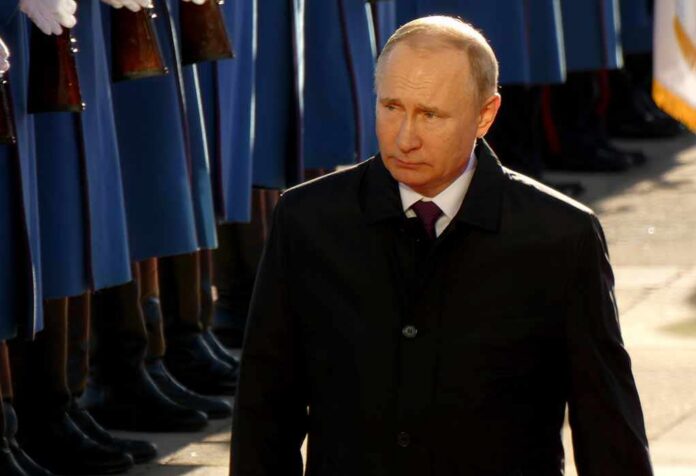
When a head of state announces an American’s freedom on live television as a U.S. envoy sits across the table, you are not watching an ordinary prison discharge; you are seeing statecraft conducted through the custody of a person.
At a Glance
- Stephen Hubbard, a U.S. citizen convicted in Russia of “mercenary” activity tied to Ukraine, has been released and put on a plane home after President Vladimir Putin publicly announced the decision during a meeting with U.S. envoy Steve Witkoff.
- Hubbard’s 2024 conviction carried a six-year-and-10-month sentence under Russian law following a largely closed trial; prosecutors alleged service with a Ukrainian territorial-defense unit and monthly pay.
- No reciprocal exchange was identified in contemporaneous reporting; President Trump said the United States gave nothing in return, though undisclosed diplomatic terms—if any—were not detailed publicly.
- The case sits in a broader pattern where criminal proceedings against foreign nationals intersect with diplomacy; the practice is widely analyzed as “hostage diplomacy” in policy literature, irrespective of how any single case is labeled.
What happened: a public release, announced at the top
Russia released American citizen Stephen Hubbard and transferred him to St. Petersburg’s Pulkovo Airport, where he began his journey home, according to President Vladimir Putin’s on-camera announcement during a meeting with U.S. envoy Steve Witkoff. That sequence—leader-level acknowledgment, airport transfer, immediate departure—defines the action as a political decision even before any formal paperwork is published. President Trump praised the outcome and asserted that the United States provided no concession in return. The principal public accounts reported no reciprocal swap or trade, and Hubbard’s lawyer credited Trump, Witkoff, and other U.S. officials for securing the release.
In practice, such public choreography is deliberate. By placing the announcement in a televised bilateral setting, the Kremlin made the release legible to multiple audiences at once: the American family awaiting their relative, Russian constituencies watching their leadership manage a high-visibility case, and third countries evaluating whether engagement can produce humanitarian dividends without overt horse-trading.
The Russian legal case: conviction, allegations, and a closed courtroom
Hubbard’s custody rested on a formal Russian court judgment in October 2024. He was convicted of participating as a mercenary in hostilities in Ukraine and sentenced to six years and ten months in a general-regime colony. Proceedings were largely closed; the public record of evidence consists primarily of official summaries and state-media accounts rather than a trial transcript and exhibits. Russian prosecutors alleged that Hubbard joined a Ukrainian territorial-defense formation, fought until his capture in 2022, and “systematically received material compensation,” citing monthly payments around $1,000.
For our purposes, two points matter. First, the conviction supplied Moscow a domestic-legal basis for holding an American in wartime. Second, because the evidentiary record was not aired in open court, outside observers cannot independently reconstruct the granular proof—contracts, payroll records, or battlefield logs—behind the mercenary charge from public sources. The conviction stands as a matter of record; its underlying materials remain opaque in open reporting.
How the release was framed: diplomacy without declared quid pro quo
The release unfolded through a direct channel between senior Russian and U.S. figures, not via an anonymous intermediary. Putin’s announcement came while seated with Witkoff; expressions of thanks flowed in both directions; and Trump publicly positioned the outcome as a humanitarian success that required no American concession. The contemporaneous press summaries describe no swap lists, no named Russian transferees, and no announced sanctions relief as an exchange condition. That silence in the reporting record is not dispositive of what was—and was not—discussed behind closed doors; it does, however, define the outcome as presented to the public at the time: a unilateral Russian act acknowledged by both sides as humanitarian.
That framing fits a familiar diplomatic script. When governments secure a citizen’s return without publicly pricing it, they emphasize the person, not the transaction. It lowers the political temperature, reduces the incentive for copycat detentions by signaling that “the market” is not rich, and preserves maneuvering space for other negotiations not meant for television.
Where this case sits in a wider pattern
Policy research over the past decade has mapped a practice commonly called hostage diplomacy: the use of a state’s criminal-justice tools to detain foreign nationals and leverage their governments. Analysts debate definitions and remedies, but the mechanism is consistent—legal process outwardly, bargaining value underneath. Russia features prominently in that literature, alongside China and Iran, and Western states have alternated between deals and pressure to bring people home. The scholarship is explicit on one risk: concessions can incentivize more detentions by setting a price; that logic is why some governments avoid public swaps and describe releases as humanitarian, even when hard diplomacy preceded them.
The Hubbard case does not require a label to be intelligible. He was convicted in a Russian court, Russia then chose to release him at a politically salient moment, and both sides narrated the outcome as humanitarian rather than transactional. That is a recognizable pattern whether or not any undisclosed understandings existed.
BREAKING: Trump shares photo of American Stephen Hubbard on plane home after being released by Russia
👉 Read the latest about Hubbard's release: https://t.co/kVfOc2cVv2 pic.twitter.com/Js2gNFIBcM
— Tammy (@Tammybruce0) October 21, 2026
What matters for Americans and allies
For families, the metric is simple: return. For governments, the calculus is more complex. Every publicly priced exchange sets a precedent and a menu; every unpriced return still communicates something to counterparties about channels, timing, and tone. The Hubbard release demonstrates three operational truths. First, maintaining leader-level lines of communication can yield discrete outcomes even amid broader confrontation. Second, attaching public gratitude to a counterpart’s “humanitarian” action is not just courtesy; it is a signaling device that helps both capitals defend the outcome domestically. Third, the legal posture of a detainee—convicted, charged, or uncharged—shapes, but does not determine, the diplomatic options.
Key uncertainties that do not change the bottom line
Open reporting has offered inconsistent shorthand about Hubbard’s age and exact detention timeline, and it has not identified the specific Russian legal instrument—pardon, commutation, deportation—that effectuated his release. Those details matter for historians and lawyers; they do not alter the core, uncontested facts established in public: a 2024 conviction for mercenary activity; a leader-level, on-camera announcement of release in 2026; and a same-day transfer to the airport to depart for home.
The practical lesson for travelers and policymakers
Americans traveling, working, or volunteering in conflict-adjacent environments should treat criminal exposure abroad as both legal and geopolitical. In places where great-power tensions run hot, the risks are not limited to the statute book; they include the possibility that one’s case becomes an instrument in a larger game. For policymakers, the lesson is complementary: build and maintain the channels that let you extract people without publishing a tariff schedule for human freedom. The Hubbard release shows that, in this arena, outcomes flow from quiet leverage and public restraint, not victory laps.
Sources:
facebook.com, cnn.com, ibtimes.sg, tandfonline.com
© featurednews.com 2026. All rights reserved.