Donald Trump has turned a long-running political truth into a stump-ritual: he sells Republican contenders by their looks, using appearance as a shorthand for strength, fitness, and “central casting” leadership—and he does it repeatedly, across states, candidates, and stages.
The Short Version
- On the 2026 trail, Trump repeatedly praised GOP candidates’ looks and mocked Democratic opponents’ appearance at rallies in Georgia, Kentucky, and Ohio.
- Named Republicans—Ed Gallrein, Jon Husted, Mike Collins, and Rick Jackson—were cast as “good-looking,” “handsome,” or “all man,” while Democrat Jon Ossoff’s looks were derided.
- This is not a one-off quip but a pattern across events; it functions as a quick heuristic about leadership and strength.
- Research shows voters often use appearance as a cue, though single compliments rarely produce measurable electoral gains.
What Happened: A looks-forward pitch, repeated from state to state
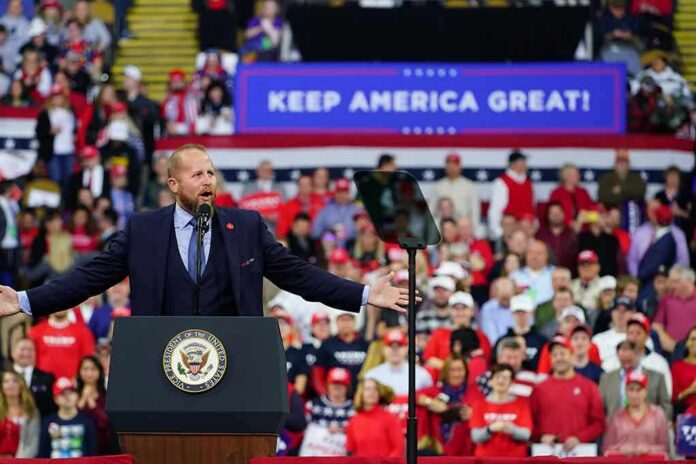
Across multiple mid-October rallies in 2026, Trump folded appearance into his endorsements. In Kentucky, he pointed to House candidate and former Navy SEAL Ed Gallrein—“Look at this beautiful guy” and “Central casting”—making visual presence stand in for readiness and reliability. He also described Ohio Senate candidate Jon Husted as “a perfect individual, a good-looking guy,” riffing about shoulders, feet, hands, and jawline to underline physical form as a proxy for mettle. In Georgia, he sharpened the contrast: “I don’t think Ossoff is a good-looking man,” he said of the Democratic senator, before pivoting to Republican Mike Collins—“actually…a good-looking man,” “all man”—and calling GOP gubernatorial nominee Rick Jackson “handsome, distinguished, [and] beautiful-looking”.
These were not stray asides. Reporting describes a string of rallies where the same trope recurred—praise for Republicans’ looks, derision for Democrats’—offered as a crisp, memorable sales pitch. The frame traveled with him, showing up in different states and lineups across at least the Georgia and Kentucky swings, with contemporaneous coverage treating it as a definable motif rather than a single gag.
How it works: Appearance as a competence cue
Trump’s language is flamboyant, but the mechanism he’s exploiting is familiar. Voters routinely lean on visual heuristics—appearance, bearing, facial expressiveness—under low-information conditions or when they’re gauging leadership in a snap. Political psychology and behavioral research have documented that candidates rated as more attractive, or more “competent”-looking, tend to receive more favorable evaluations and sometimes higher vote shares; one study of German candidates estimated roughly a one-point advantage between the least- and most-attractive candidates, a small but real edge in close races. Experimental work similarly shows that simply displaying candidate photographs can tilt participation and preference toward the candidates judged more attractive.
Trump packages that bias in the vernacular of casting calls—“central casting,” “all man,” the inventory of jawlines and shoulders—collapsing complex judgments into a single, vivid claim: this is what a leader looks like. In his rallies, that message rides on repetition and rhythm, not on policy exposition, and it maps cleanly onto long-running masculinity scripts in American politics—strength, dominance, physical presence—that his audiences recognize immediately.
What this is—and what it isn’t
The evidence supports a pattern: Trump is using appearance-laden praise and mockery as a recurring way to boost allies and diminish adversaries. It does not, however, demonstrate a measurable causal bump for the featured candidates—no rally-specific polling swing, donation surge traceable to the compliments, or turnout lift uniquely linked to the remarks shows up in the reporting. The coverage records what he said, where, and about whom; it does not claim those lines, by themselves, moved votes. That distinction matters. Visual heuristics shape impressions; they are not a guaranteed vote machine.
Still, impressions are the building blocks of campaigns. In low-salience down-ballot races, especially, a memorable image or line—“all man”—can define a candidate for inattentive voters and the local press. Trump’s endorsements have always been performance as much as proclamation; here the performance foregrounds looks because looks are legible instantly, even to casual observers. That is utility, not accident.
Why the tactic fits Trump’s political repertoire
From his reality-television sensibility to his long-standing “brand” talk, Trump treats politics as casting. In that grammar, a candidate’s visual fit—how they read onstage, how a crowd reacts to their silhouette—signals suitability. His rally patter turns that instinct into an applause line: the hero is handsome and sturdy; the villain is cosmetically contrived. It dovetails with research on how traditional masculinity stereotypes can structure political support: when audiences prize dominance and toughness, the person who looks the part can get the nod, or at least the benefit of the doubt. Trump’s flourish, then, is not merely flattery; it’s narrating hierarchy.
The device also travels well across formats. Local television needs short clips; digital headlines need a hook. “Beautiful guy” and “all man” deliver that economy. Earned media amplifies the contrast, even when coverage frames it as spectacle. That coverage, in turn, fixes the label—handsome Republican, awkward Democrat—in the public conversation, which is precisely the point of a shorthand.
🚨 TRUMP TOUTS PRESIDENTIAL POWER AT KENTUCKY RALLY — BACKS GOP CANDIDATES AHEAD OF NOVEMBER MIDTERMS
President Donald Trump rallied supporters Saturday in Highland Heights, Kentucky, promoting his second-term record and urging Republicans to turn out for the November 3…
— MDBayNews (@MDBayNews) October 17, 2026
The limits and risks of an appearance-first endorsement
Two boundaries remain. First, appearance effects are context-dependent and generally modest; they operate alongside party identification, issues, candidate quality, and fundamentals. The best-supported conclusion is that looks nudge impressions; they rarely substitute for a compelling case on policy or performance. Experimental and observational work show the cue, not a cure-all. Second, an overt looks contest can backfire with audiences who read it as unserious or objectifying, especially if paired with personal ridicule rather than policy contrast. The same lines that energize a rally can alienate persuadable voters seeking substance—or draw coverage that centers the insult rather than the endorsement.
What to watch next
As campaigns grind toward decision points, the operative questions are practical. Do the candidates Trump anoints with appearance praise adopt the frame in their own advertising and fundraising? Does local coverage carry the casting message into earned media, or shift back to issues and records? And when contests tighten, do Republicans double down on the image cue or pivot to policy contrasts that speak to late deciders? The record to date shows the line works onstage. Whether it travels to ballots is a different test—one that will be settled, as always, by voters.
Sources:
youtube.com, apnews.com, newsnationnow.com, ground.news, ibtimes.co.uk, bostonglobe.com, thedailybeast.com, cnn.com, cambridge.org, psu.edu
© featurednews.com 2026. All rights reserved.