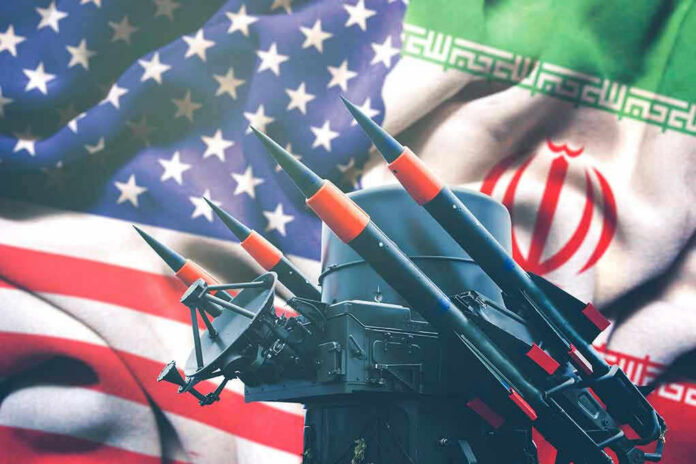
A secretive Iran peace memo that President Trump says he signed inside Versailles could either mark a hard‑won victory for American strength—or a fragile truce that still lets Tehran test the West.
Story Snapshot
- Trump says he formally signed an Iran peace memorandum at Versailles that promises to end the war and reopen the Strait of Hormuz.
- The 14-point memo commits Iran to curb its nuclear program and ease regional attacks, while the U.S. loosens some sanctions once terms take effect.
- Iranian officials and state media have often denied or downplayed having a final deal, showing deep distrust and possible stalling.
- The agreement is binding only as an initial framework and can collapse if Iran cheats during the 60‑day follow‑on talks window.
What Trump Says He Signed At Versailles
President Donald Trump told reporters that he signed an initial peace agreement with Iran while attending a dinner at the Versailles palace in France, turning weeks of tense talks into a public claim of victory.[3] The deal is a memorandum of understanding, not yet a full treaty, but U.S. officials say it includes reopening the Strait of Hormuz, ending fighting in Iran and Lebanon, and a reconstruction fund of about three hundred billion dollars for Tehran.[3] Trump argued that without this understanding, the world faced an “economic catastrophe” from blocked oil and wider war.[3]
Separate reporting backs up that a memo really was signed around the time of Trump’s Versailles visit, even as public statements sounded confusing.[1] U.S. officials said the memorandum had already been digitally signed by Trump and Vice President J.D. Vance days earlier, and that Trump then added his signature again while at Versailles.[1] According to one official, Iran’s president also signed that same day, though Tehran did not immediately confirm it, leaving many wondering whether Iran’s leadership is fully on board.[1]
What Is Actually In This Iran Memorandum
Details read to reporters by senior U.S. officials show that the memo is both tough and temporary, with clear wins for American leverage but also serious risks.[1] The U.S. draft sets a new minimum standard for diluting Iran’s highly enriched uranium and calls for Washington to help destroy or remove nuclear material if Iran complies, directly targeting Tehran’s path to a bomb.[1][2] It also promises toll‑free passage through the Strait of Hormuz for sixty days, restoring vital oil flows, but does not rule out Iran charging fees after that period ends.[1]
The memorandum also lays out regional security pieces that matter to allies and to U.S. troops in harm’s way.[1][3] It includes language on protecting Lebanon’s territorial integrity after recent Israeli strikes on Hezbollah, aiming to freeze a conflict that could otherwise draw in more American forces.[1] In return, the United States will move to waive, but not fully remove, some sanctions once the memo is in force, and a larger package envisions hundreds of billions of dollars in reconstruction funding for Iran if a final deal is later reached.[3][22] For many conservatives, that kind of massive cash flow into an anti‑American regime raises hard questions about who really benefits.
Why This Deal Is Real, But Still Fragile
Even as Trump and mediators describe a signed text, there is strong evidence this is only a first step and can still fall apart.[2][22] Pakistani leaders and U.S. officials have said the memorandum’s signing is meant to trigger a sixty‑day period of follow‑on talks, not to settle every nuclear or regional issue at once.[2][3] Analysts reviewing the public terms say the memo extends fragile ceasefires, increases shipping, and buys time, but does not yet resolve core disputes over how the Strait of Hormuz will be governed long term or how deep Iran’s nuclear concessions will go.[22][23]
🚨🔥HISTORIC MOMENT! President Trump SIGNING the historic Iran peace deal at Versailles!
The Memorandum of Understanding is OFFICIAL.
No more nukes. Strait reopening.
47 getting it DONE on the world stage!🇺🇸 pic.twitter.com/oqSHO4pmr1
— Commentary Donald J. Trump Posts From Truth Social (@TrumpDailyPosts) June 18, 2026
Crucially, U.S. officials themselves describe the signed text as final on paper, but not locked in politically.[1] One official said the memorandum “has not been changed” since it was signed electronically, yet stressed that either side can walk away until a full agreement is reached during those sixty days of talks.[1] That means if Iran uses the pause to stall, hide nuclear work, or keep backing proxy attacks, the United States may need to snap back sanctions or even restart strikes, a point Trump has underlined in earlier warnings.[5][11] The pattern of Tehran denying deals in public while bargaining in private shows this is peace through strength, not trust, and conservatives will want to watch closely that American sovereignty, energy security, and taxpayer money are protected as the next phase begins.
Sources:
[1] Web – Iran-US war latest: Trump says he signed initial peace agreement with …
[2] Web – Iran-U.S. negotiators have agreed to broad principles of agreement, …
[3] Web – Iran-U.S. negotiators have agreed to broad principles of …
[5] Web – Trump will ‘bomb the hell out of’ Iran if no deal reached — as it …
[11] Web – Trump says a deal with Iran and opening of Strait of Hormuz are …
[22] Web – Experts react: The US and Iran just announced an interim peace …
[23] Web – Initial US-Iran deal ‘should not be overestimated’ – DW.com
© featurednews.com 2026. All rights reserved.