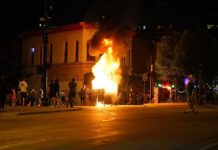
When federal agents search the home of a sitting member of Congress with a judge’s authorization, it signals not rumor but a live criminal inquiry that has met a concrete legal threshold; the public debate that follows often confuses that threshold with proof of guilt, and the difference matters.
The Short Version
- Homeland Security Investigations executed a judicially authorized search at Representative Ilhan Omar’s D.C. residence as part of an ongoing federal criminal investigation.
- A magistrate judge’s approval reflects a finding of probable cause to search—not a conclusion that crimes were committed or can be proven at trial.
- Reporting ties the probe to immigration paperwork and potential fraud or false statements; agents seized Omar’s phone and grand-jury subpoenas reportedly issued to relatives and others.
- Omar’s attorneys deny wrongdoing, allege political motivation, and challenge procedures, invoking constitutional protections for legislative materials.
What the search establishes—and what it does not
The Justice Department confirmed that Homeland Security Investigations executed a judicially authorized search warrant at Representative Ilhan Omar’s Washington-area home, describing the action as part of an ongoing federal criminal investigation. In plain terms, prosecutors presented evidence to a federal magistrate judge, who agreed there was probable cause to believe evidence of a federal crime would be found at the premises; agents then carried out the warrant. This is not conjecture—it is the formal machinery of federal criminal process, triggered only after a judge’s sign-off and executed by specialized agents with jurisdiction over immigration and related fraud offenses.
Probable cause is a real threshold, but it is not the same as proof beyond a reasonable doubt. A search warrant signals the government has specific reasons to look; it does not mean prosecutors can prove a charge or even that a charge will ever be brought. The affidavit that would explain the precise facts remains under seal, which is standard while investigators gather evidence and present matters to a grand jury. That leaves the public with the architecture of the process—judge, agents, search—but not the blueprints. Still, the formalities themselves are consequential; they mark a case that has matured past rumor into court-approved steps.
The reported investigative focus: immigration filings and potential false statements
Multiple outlets with independent sourcing have tied the investigation to immigration paperwork associated with Omar’s path to citizenship, framing the legal questions in terms of fraud or false statements—classic lanes for HSI, which polices immigration-related criminal violations. While the government has not identified specific statutes, this category often implicates 18 U.S.C. § 1001 (false statements), 18 U.S.C. § 1546 (fraud and misuse of visas, permits, and other documents), or denaturalization-adjacent theories when naturalization is alleged to have been procured illegally. The Associated Press reported that agents seized Omar’s phone and that prosecutors issued more than a dozen grand-jury subpoenas, including to some relatives—indicia of a broad evidence sweep across documents, communications, and potential witnesses.
Two complexities will define any prosecutorial theory. First, knowledge and intent: it is one thing to show inaccurate filings; it is quite another to prove the subject knowingly lied. Second, time: many immigration events at issue may date back decades, which forces prosecutors to identify recent conduct or statute-of-limitations tolling theories. Those are surmountable in some scenarios—recent filings, concealment, or obstruction can restart the clock—but they require specificity that is not yet public. That is why sealed affidavits and filter protocols exist: to protect an investigation’s integrity while courts supervise the boundaries of executive power.
Court oversight and constitutional guardrails in searches of lawmakers
Searching a member of Congress is not forbidden, but it is freighted with constitutional constraints—most notably the Speech or Debate Clause, which protects legislative acts from executive intrusion. Courts have upheld warrants in principle while policing execution in practice; the D.C. Circuit’s Rayburn decision, arising from the FBI’s search of Representative William Jefferson’s office, held that compelled disclosure of privileged legislative materials to the Executive violates the Clause and requires careful segregation of protected content. That precedent, alongside congressional research service guidance, is why judges often require “filter teams” and protocols before investigative agents can review seized items that may mingle personal, political, and legislative materials.
Early coverage indicates that Omar’s legal team has already raised these concerns, arguing that the government exceeded court-imposed constraints. Such disputes are routine in sensitive searches and can result in judicial orders to separate, return, or suppress privileged material. They do not negate probable cause; they test the government’s adherence to execution rules designed to preserve constitutional equilibrium between branches.
The counter-case from Omar’s attorneys—and how to weigh it
Omar’s lawyers categorically deny any violation related to her citizenship, describe the investigation as vindictive and politically motivated, and have demanded the immediate return of seized property. They also emphasize that Omar became a naturalized U.S. citizen in 2000 after fleeing Somalia in 1995. As public advocacy, this is expected and appropriate; as evidence, it is assertion rather than documentary refutation. Their letter additionally challenges the search’s timing—close to an election—invoking a Department norm to avoid overt steps that might influence voters. That norm is real, but it is prudential, not legally binding, and does not void a judge’s warrant. The claims of political motive remain allegations in the absence of named, contradictory facts that undercut the warrant’s judicial basis.
Two points deserve clear separation. First, DOJ’s confirmation of a judicially authorized search, the magistrate’s probable-cause determination, and the reported seizure of a sitting lawmaker’s phone and issuance of grand-jury subpoenas are verifiable process facts. Second, whether those steps culminate in charges—and whether any such charges would survive motion practice and trial—is an evidentiary question not yet ripe for public adjudication. The attorneys’ statements contesting motive and procedure may shape judicial scrutiny of how the search was executed or what evidence agents may review; they do not erase the warrant’s existence or its legal significance.
Why the distinction between “can search” and “can charge” matters
Public debate routinely collapses three distinct standards. Probable cause to search asks: is there a fair probability evidence of a crime is presently at a specific place? Admissibility asks: was that evidence collected lawfully and filtered to respect privileges? Proof beyond a reasonable doubt asks: does the totality of admissible evidence convince a jury that the defendant committed each element of an offense? A case can satisfy the first while failing the second due to execution errors or privileges; it can satisfy both and still fail the third if the evidence is insufficiently persuasive or does not establish the defendant’s knowledge and intent. Understanding where this investigation sits on that ladder prevents overreading either the fact of the search or the vigor of the denials.
This framework also explains the sealed affidavit. Courts routinely keep supporting affidavits nonpublic during active investigations to protect witnesses, preserve investigative techniques, and avoid tainting grand-jury work. Appellate decisions have recognized a qualified right of access counterbalanced by compelling interests in secrecy during the pre-indictment phase; selective unsealing—often with redactions—sometimes occurs once those interests recede. Until then, the warrant’s existence carries weight; the affidavit’s contents remain a closed record for good reasons tied to investigative efficacy and safety.
🚨 JUST IN: HSI INVESTIGATORS are on scene RIGHT NOW outside Somali Rep. Ilhan Omar's home
DOJ is involved.
The raid on her house took place at 6AM, PRE-DAWN: "Federal CRIMINAL investigation" 🔥
And the entire search even got JUDICIAL approval.
Ilhan Omar is furious, agents… pic.twitter.com/CuhwDZpsMx
— The White Hats (@realWhiteHats) October 23, 2026
What to watch from here
Three inflection points will tell the story’s direction. First, litigation over filter protocols and any Speech or Debate issues: if a court orders additional segregation or suppression, that will narrow what investigators can review and potentially blunt the case. Second, any move to partially unseal the affidavit or to disclose a property receipt detailing categories of seized items; those documents would clarify the statutes at issue and the evidence sought. Third, the grand jury’s cadence: additional subpoenas, witness cooperation, or immunity deals often precede either charges or closures. Until one of those paths materializes, the prudent reading is straightforward: a serious federal investigation has progressed past rumor and into court-approved searches, while the question of chargeable, provable criminal conduct remains open.
Sources:
redstate.com, abc7.com, npr.org, dw.com, wjla.com, cbsnews.com, jurist.org, usatoday.com, apnews.com, abcnews.com, web.facebook.com
© featurednews.com 2026. All rights reserved.