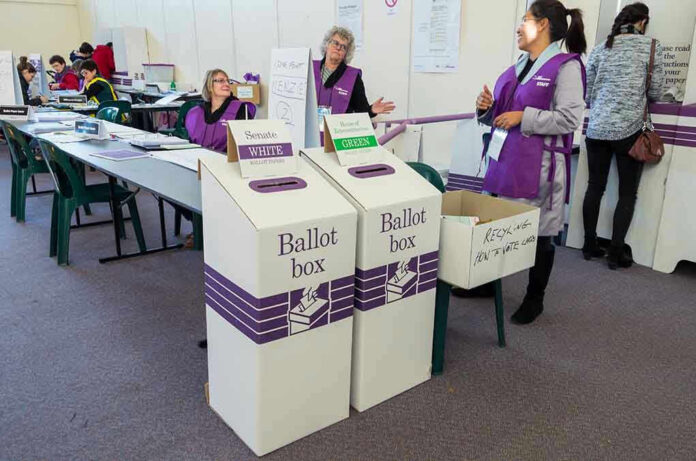
A Michigan city councilman was caught on official surveillance video stuffing absentee ballots into a drop box just days before winning re-election, reviving fears that election security reforms are being undermined where they matter most.
Story Snapshot
- Surveillance footage shows Hamtramck Councilman Abu Musa handling bundles of absentee ballots before his re-election win.
- Michigan State Police confirmed the video’s authenticity and opened a formal investigation into potential election fraud.
- Two other council members were recently charged with absentee ballot forgery in a broader pattern of abuse.
- Ballot drop box monitoring, enacted to prevent fraud, exposed the alleged misconduct but failed to stop it in real time.
Ballot Box Scandal Erupts Days Before Election
On August 1, 2025, Hamtramck, Michigan’s official surveillance cameras captured City Council member Abu Musa handing what appeared to be stacks of absentee ballots to a driver, who then deposited them into a city election drop box. This footage emerged just days before the August 5 primary, in which Musa secured re-election by a clear margin. The Michigan State Police swiftly confirmed the video’s authenticity and announced an ongoing investigation, raising serious questions about the integrity of the electoral process and the effectiveness of recent security enhancements.
The release of this footage follows a troubling pattern in Hamtramck politics. The city had already faced allegations of absentee ballot fraud in its 2023 council elections, resulting in felony charges against council members Muhtasin Sadman and Mohammed Hassan. Both were accused of forging ballots and orchestrating vote-buying schemes targeting newly naturalized citizens. Despite these high-profile prosecutions and new security measures—including mandatory surveillance of ballot drop boxes—multiple council members have now been implicated in possible election-related crimes, suggesting systemic weaknesses that demand urgent attention from state authorities.
Election Security Reforms Put to the Test
Michigan voters approved significant election security reforms in 2022, requiring surveillance cameras at all absentee ballot drop boxes. These reforms were designed to deter ballot harvesting and boost public confidence amid widespread skepticism of mail-in voting. However, the Hamtramck incident demonstrates that surveillance alone cannot prevent determined bad actors from manipulating the system. The city clerk, responsible for overseeing elections, publicly criticized the inconsistent enforcement of election laws and called for more robust penalties and investigative follow-through, echoing concerns voiced by many who value transparent, lawful elections.
Law enforcement and election officials are now under heightened pressure to deliver accountability. The Michigan State Police are leading the investigation into Musa’s conduct, with the possibility of further charges if wrongdoing is confirmed. Attorney General Dana Nessel has previously requested a special prosecutor for related cases, underscoring the state’s recognition of the potential for broader conspiracies. The FBI’s involvement, with agents visiting Hamtramck City Hall earlier in 2025, signals the seriousness of these allegations and the need for multi-agency coordination to restore public trust.
Broader Implications for Election Integrity
The latest revelations threaten to erode already fragile trust in absentee voting and the use of drop boxes, especially in swing states like Michigan. In the short term, voters are left wondering whether their voices count in a system vulnerable to abuse. In the long term, these incidents may drive calls for stricter controls, including tighter restrictions on absentee ballots, enhanced real-time monitoring, and severe penalties for violators. For conservatives, the scandal is a stark reminder of why vigilant enforcement—and not just new laws—is essential to preserving the integrity of our elections.
This case also has national resonance. With absentee and drop box voting increasingly controversial, Hamtramck’s experience highlights both the promise and the limitations of technological fixes to election fraud. Experts agree that while surveillance footage can expose wrongdoing, it must be paired with prompt, consistent action from authorities to deter future abuses. Anything less risks emboldening those willing to flout the rules and undermines the very foundation of democratic self-government.
Ongoing Investigation and the Road Ahead
As of August 18, 2025, Abu Musa has not been formally charged, but he remains under active investigation. Meanwhile, the community faces deepening divisions and uncertainty, with repeated scandals casting a shadow over local governance. The outcome of the investigation—and any resulting reforms—will serve as a test case for Michigan and the nation. For Americans who believe in secure, transparent elections, the events in Hamtramck reinforce the urgent need for real accountability and the unwavering defense of constitutional principles.
Sources:
Two Hamtramck city council members charged with election fraud
Hamtramck City Council Member Caught on Camera Stuffing Absentee Ballots Days Before Re-Election Win
Hamtramck council members charged with forgery in Michigan election fraud case