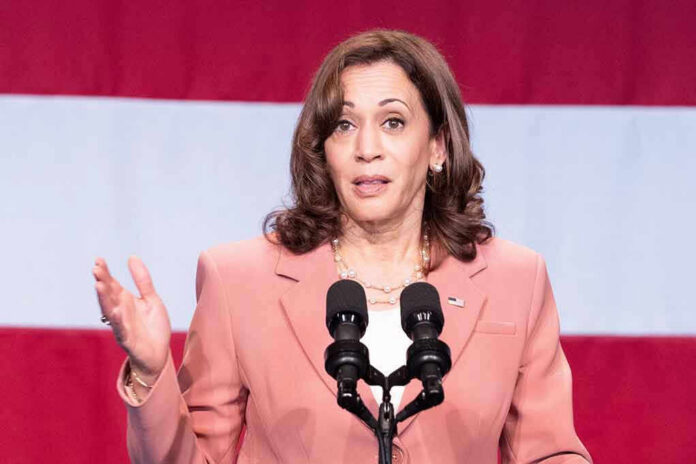
Kamala Harris is back on the Michigan stage slamming President Trump as “corrupt, callous and incompetent”—a reminder that Democrats are leaning harder on viral insults than on a governing alternative.
Quick Take
- Harris delivered the remarks at the Michigan Democratic Women’s Caucus in Detroit over the weekend prior to April 20, 2026.
- The phrase “corrupt, callous and incompetent” is the central quote driving the clip’s online spread.
- Mainstream coverage from the 2024 cycle shows Michigan as a recurring arena for Harris-Trump “barbs,” especially tied to unions and Detroit politics.
- The episode underscores how post-election messaging increasingly functions as content for partisan media and social platforms, not policy debate.
Detroit remarks revive a familiar post-election playbook
Kamala Harris appeared at the Michigan Democratic Women’s Caucus in Detroit and used a sharp three-part label for President Donald Trump: “corrupt, callous and incompetent.” The event took place over the weekend before April 20, 2026, and the clip circulated online through partisan channels. Available reporting does not describe a formal policy announcement tied to her comments, and no immediate response from Trump was cited in the provided materials.
“Corrupt, Callous and Incompetent” – Kamala Harris Trashes Trump During Remarks in Michigan (VIDEO) https://t.co/HbEtis8COq pic.twitter.com/CvDylgxU3d
— NA404ERROR (@Too_Much_Rum) April 20, 2026
The setting matters because Michigan remains one of the country’s most politically contested states, with unions and the auto economy frequently used as messaging anchors. The available context suggests Harris is trying to keep Democratic activists energized after the 2024 election loss by returning to the state and framing Trump personally rather than arguing through a specific legislative contrast. That approach is effective for rallying a base, but it offers limited insight into what Democrats would do differently.
Michigan has been a repeat battleground for Trump-Harris messaging
During the 2024 campaign cycle, Harris and Trump repeatedly used Michigan events to sharpen contrasts, with Harris emphasizing workers and union backing while Trump drew attention for criticisms aimed at Detroit. A CBS News segment captured the dynamic as routine trading of “barbs” while both sides campaigned in the state. In other words, the Detroit remarks fit a pattern: Michigan stops are often less about persuading undecided voters and more about motivating core supporters through high-salience cultural and economic themes.
That pattern also explains why phrases like “corrupt, callous and incompetent” travel quickly: the words are short, emotionally loaded, and built for clipping and reposting. The research notes the quote appears “tailored for viral, partisan amplification,” and the clip’s spread appears driven by online engagement rather than new information. When politics becomes a contest of shareable one-liners, voters on both left and right often conclude the system is more focused on performance than problem-solving.
Rapid-response politics: ads, clips, and constant counterpunching
The Michigan messaging war has also included rapid-response advertising. After Trump criticized Detroit in the run-up to Michigan events, the Harris campaign released an ad titled “Detroit vs. Trump” meant to clap back quickly and define the dispute on favorable terms. This kind of immediate content production reflects modern campaign infrastructure: statements, counterstatements, and video assets designed to dominate a news cycle. It is politically rational—but it can crowd out detailed discussions of budgets, energy costs, inflation pressures, and public safety.
What conservatives should watch: governance vs. grievance incentives
Republicans currently hold the White House and control Congress, which means voters will measure the GOP less by rhetorical sparring and more by results. At the same time, Harris’s strategy signals that Democrats may invest heavily in personal and institutional attacks, betting that frustration with “the elites” and distrust of federal competence can be redirected against Trump’s administration. For conservatives who want limited government and accountability, the challenge is separating substantiated oversight from content-first outrage that produces heat but little reform.
One limitation in the available research is the lack of independent corroboration for the full context of Harris’s Detroit remarks beyond the circulated video and partisan write-up. Still, the broader picture is clear: Michigan remains a staging ground where national figures test attack lines, and where political incentives reward attention-grabbing language. Americans across the spectrum who feel the federal government is failing them will likely see this episode as more proof that too many leaders prefer campaigning—forever—over governing.
Sources:
Harris, Trump trade barbs while campaigning in Michigan
“Corrupt, Callous and Incompetent” – Kamala Harris Trashes Trump During Remarks in Michigan (VIDEO)
Detroit vs. Trump: Harris campaign drops ad clapping back